
Why is Intercultural Competence Helpful? The Case of the Ion Exchange Resins

Is there a bottom-line business benefit to intercultural competence? As someone who has lived and breathed cross-cultural and intercultural business competency for well over thirty years, that question tends to elicit a chuckle in me. And today, the person on the phone who asked me that question reminded me of a story.

You see, just yesterday I received an invitation to an “OB-OL-kai” in Japan, a “get together of Old Boys and Old Ladies,” a reunion of a group of colleagues that I miss terribly and would love to party with, again, face to face. We went through a lot together. They are some of the most talented professionals I’ve had the pleasure of working with in my career. And a few members of that group were involved in the story I’m about to tell you:

Cultural Detective and the Case of the Ion Exchange Resins

We worked for a multinational business that globally sourced ion exchange resins. IERs are small beads used to separate, purify or decontaminate; they are used to make ultra-pure water, for example. Don’t worry about the technicalities; this story focuses on how the people worked together.

In this case, the IERs were produced in southern France, at a facility that was one of the absolute best in the world. My client imported the IERs to Japan, selling them primarily to the semiconductor manufacturing industry.

The Japanese customers had extremely high quality standards, and the French-produced IERs consistently met all the customer’s requirements. The product was well within spec. But, the Japanese customers were worried: occasionally the IERs they received from France would vary slightly in color. One shipment might arrive quite clear, the next shipment more yellow or orange. Always the specifications were met. The IERs functioned to their purpose. But the color varied.

“The color doesn’t matter,” the French vendor explained. “The color has absolutely no impact on the performance of the IER.”

“Yes, that is true. We understand that color does not affect performance,” came the reply from the Japanese customer. “But we are concerned about why there is a color variation? We feel it must indicate a variance in the production process itself. There must be some variable in production that is not consistent and could be improved.”

A classic cultural gap: a focus on result vs. a focus on process. Does the product perform as required? Or do we look at continuous improvement of the production process itself?

In this case, the argument could quickly produce a stalemate, with both supplier and customer insisting their view is “correct.” The French could insist that their IERs are the best the customer will find. As long as the customer doesn’t find an equivalent product, that could be ok. But, it’s not a very good answer on a global stage, where there always seems to be another supplier waiting in the wings, with cheaper cost, easier shipping, or more commitment to listening to the customer.

Possible results of the vendor insisting that color doesn’t matter?
  • Lost customer (and this was a lengthy and very lucrative relationship),
  • Lost business/profit/cash flow,
  • Lost investment in developing this customer,
  • Huge reinvestment to develop a new customer of the same caliber,
  • Loss of opportunity to improve their product and their production process,
  • Not to mention the human aggravation.

The Japanese, in turn, could blame the supplier. “They are not committed to being the best they can be. They are resting on their laurels, on their prior success. We need suppliers who strive to maintain their leading edge. We need a supplier who listens to us and respects us.”

Possible results of the customer insisting color variation matters?
  • Diminishing trust of, communication and collaboration with the vendor, leading to
  • Loss of a strategic vendor,
  • Loss of the investment in selecting and developing the vendor,
  • Huge reinvestment to source and develop a new vendor,
  • Major time and financial commitment to establishing a relationship and educating a new vendor regarding customer needs, in hopes that the new relationship might become a strategic partnership.

I have seen this push-pull occur so often in my career. It frustrates those involved, it causes aggravation, it wastes time, and it wastes money. Take a moment to put some money to the points above, to calculate the “bottom-line impact” of such a simple cross-communication. In this industry, it is easily in the millions of dollars. And why? Due to pride, to arrogance, but mostly due to ignorance: not really understanding cultural differences and how to navigate them effectively.

And what might an interculturally competent solution look like? We know it involves multi-directional bridging, and systemic as well as interpersonal solutions. And, usually, such interculturally competent solutions are win-wins for both customer and supplier.

How so? Well, the vendor could listen to the customer, learn from the customer, even though the customer’s points don’t pertain directly to the product performance. In this way, the vendor would:
  • Strengthen trust and teamwork with the Japanese customer,
  • Could very well improve the quality of its manufacturing process, which in turn
  • Could help ensure it remains best-in class.
  • The customer will refer more customers to the vendor, due to the strong relationship with and excellent quality of the vendor, and the vendor’s global markets will grow.
In turn, the customer could voice its praise for the vendor’s quality, and explain that it’s intentions are collaborative and collegial; to help both vendor and customer be the best they can be. The customer could apologize for the hassle, and offer its process expertise to the vendor. In this way, the customer would:
  • Strengthen a very lengthy and very strategic vendor relationship,
  • Improve the cross-cultural skills of its staff, enabling them to partner more effectively with other vendors,
  • Improve the customer’s reputation in the global marketplace, as one of collaboration and loyalty.

Thus, the French and Japanese could work together to manufacture more color-consistent IERs, grow their global markets, strengthen their partnership, improve their employees’  skills, and polish their reputations in the marketplace. Win-win-win.

In real life, what actually happened was somewhere in between. These people were smart enough to hire a full-time intercultural consultant, after all, which I believe is one demonstration of their commitment to success. They got advice, and they did their best to put it to good use. They realized that intercultural competence is a lifelong process, contextually based, and strived to always do a bit better. It’s one of the reasons I want to travel halfway around the world to go to that OB-OL-kai!

What do you think? I would love you to share with us why you believe intercultural competence is helpful? Do you have a Cultural Defective or Cultural Effective case to share?
People To People International Working with Cultural Detective to Diversify Chapter Recruitment

Over the past several years I have enjoyed developing a professional and personally meaningful relationship with the People to People International organization (PTPI). For those of you who are not familiar with PTPI, the organization was founded by President Dwight D. Eisenhower in 1956 and is now run by his granddaughter, Mary Jean Eisenhower. Their mission is “to enhance international understanding and friendship through educational, cultural and humanitarian activities involving the exchange of ideas and experiences directly among peoples of different countries and diverse cultures.” They are a dynamic group of dedicated staff and thousands of volunteers in over 135 countries truly working to promote the benefit of people working and living cooperatively together throughout our world. They are known by their tagline, “Peace Through Understanding.

Last year in November Cultural Detective had the privilege of sponsoring and designing the student curriculum for the PTPI Global Youth Forum 2011 (GYF). We focused on designing curriculum that would readily engage about 130 students and GYF leaders and most importantly inspire them to explore building relationships outside of their perhaps “look and act like me” group of students and friends in their local communities. Based on the testimonials of both students and teachers, we feel we did a pretty good job!

This spring I’ve been asked to present the Cultural Detective Method to PTPI Board Members and the PTPI Community at Large so they can focus their attention on recruitment of diverse leaders and members. In the upcoming session I hope to show how generational differences as well as national cultural differences impact with whom we as individuals may naturally gravitate to, which can limit the growth opportunities possible by confidently reaching out to people of multiple cultures. Stay tuned for more about the event in a future post!

“Belief Holding” as an Intercultural Competence – Religious less motivated by compassion

Frequently and for many years I have cited Milton Rokeach’s The Open and Closed Mind when people ask me about intercultural competence. In this book he talks about the importance of holding beliefs tentatively and situationally instead of imposing them on or expecting them of others.

“A closed way of thinking could be associated with any ideology regardless of content. It includes an authoritarian outlook on life, an intolerance towards those with opposing beliefs, and a sufferance of those with similar beliefs.”

According to this line of thinking, open-minded people may hold their beliefs firmly and strongly, but they also respect others’ rights to believe something different. They believe their path is right for them, but they do not believe it is necessarily the one and only path for everyone on the planet. “It is not so much what you believe that counts, but how you believe,” Rokeach tells us.

In our current age of heightened religious and nationalistic fervor, “belief holding” or “permeability of beliefs” seems more important than ever. As do religious or spiritual beliefs as dimensions of culture and cross-cultural interaction.

In this context, today I read the headline, “Highly Religious Less Motivated by Compassion.” Oh dear. I read on to find out that it is the key finding of social psychologists at the University of California Berkeley, who have conducted three separate studies since 2004 on a largely US American sample.

“Overall, we find that for less religious people, the strength of their emotional connection to another person is critical to whether they will help a person or not. The more religious, on the other hand, may ground their generosity less in emotion, and more in other factors such as doctrine, a communal identity, or reputational concerns.”

Perhaps it is time for all of us who coach, train, or educate on the topic of intercultural communication to remember this important competence, which was first published back in 1960.

Culture Eats Strategy For Breakfast!

“Culture eats strategy for breakfast!” — a quote that grabbed me during a recent keynote address by BNI (Business Network International) founder and Chairman Dr. Ivan Misner. He was introducing his new book, Business Networking and Sex (Not What YouThink!).

Those (in the audience of more than 1000 Kansas Citians) with more exposure to culture-related topics probably guessed that the book focuses on networking techniques of the different genders and how to be successful networking with the opposite sex. But to hear so boldly from this networking icon how powerful culture truly is in relationship building and the networking process resonated strongly with this Cultural Detective!

When I heard this statement from Dr. Misner, I wished I could have jumped up on stage and displayed the Cultural Detective Women and Men Values Lenses. It would add to the value of his research by providing clear underpinnings as to what motivates the networking behaviors of men and women, and it would help explain the “whys” behind the stories illustrating their differences which seem to be highlighted throughout the book.

Dr. Misner’s book takes a three-pronged look at business networking across the sexes by offering a surveyed objective look at how men and women think about, approach, and in what ways they are successful at business networking. He then counters that with a “he said” (Frank) and “she said” (Hazel) analysis and interpretation of the survey results.

Over a four-year period they surveyed more than 12,000 businesspeople globally (covering every continent) on 25 questions about business networking. The results and interpreted analysis could bring about some interesting and revolutionary changes to the way in which each sex approaches networking with the other. Communication gaps could be narrowed and connections broadened through Hazel and Frank’s guidance and revealing a bit of the opposite sexes “Lens.”

My only wish was that Dr. Misner would have take the results of the survey to a deeper level by breaking it down to country-specific data. But then again, that’s where Cultural Detective national Values Lenses could shed some light!

NOTE: While the book reviewed in this post references two genders, and we offer an excellent package with this same approach, Cultural Detective Women and Men, there are other ways to look at gender than just a polar division of male/female. Cultural Detective LGBT examines some of these complexities of gender and sexual orientation.

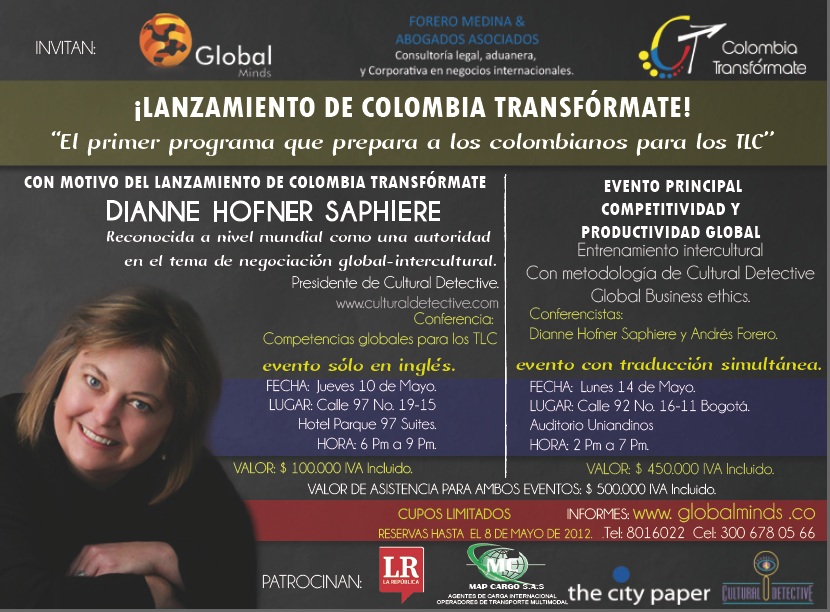
Global Competitiveness Events in Bogotá Colombia

Cultural Detective is very proud to partner in bringing several leading-edge intercultural events to Bogotá, Colombia. We hope you can join us! Please pass this announcement on to your professional and social networks so that we might let everyone know about these unique opportunities.

On Thursday May 10

We will officially launch the Colombia Transfórmate program and the Cultural Detective Colombia package. Cultural Detective President Dianne Hofner Saphiere will facilitate a workshop which will be followed by a cocktail reception. This terrific evening is not to be missed! Cultural Detective is very honored to be part of this incredible project.

On Monday May 14

We will hold a high-energy event designed to ready Colombians to reap the benefits of their recent Free Trade Agreements with Canada and the USA, and upcoming agreements with the European Union and South Korea. Anyone wishing to improve their cross-cultural business acumen will find attendance extremely valuable. We believe this is one of the first-ever public workshops on intercultural communication in Colombia. The workshop will be facilitated by Fernando Parrado of Global Minds, Andrés Forero of the Forero Medina Abogados Asociados, and Dianne Hofner Saphiere of Cultural Detective.

Sponsor These Two Events

Put your organization’s name in the hands of thousands of first-tier Colombians by purchasing a sponsorship. Show your commitment to global effectiveness, and to Colombia! Sponsorship opportunities start at an incredible US$1350, and include two seats at both the Thursday and Monday events, an exhibit table, an introduction of your organization, and your logo on event banners.

Act quickly, as these very affordable sponsorship opportunities will be available for only two weeks.

On Wednesday May 9

Dianne will also present a seminar on intercultural and global business competence for students and staff at Sergio Arboleda University. The seminar will take place on day three of the university’s fifth think tank entitled, Marketing, Sociedad e Interculturalidad: Una Mirada desde la Globalización.

Developmental Intercultural Competence

The ability to collaborate productively and enjoyably across cultures is more important than ever, whether we focus on communicating with elderly parents or teenaged children, or on building trust and producing results with colleagues at the next desk and across the planet. But what do theory and practice tell us about how to gain maximum effectiveness?

One exceptionally rapid and proven way to successfully improve cross-cultural competence is to use the MashUp: a natural and powerful combination of two leading intercultural competence development processes: Cultural Detective and Personal Leadership.

Starting in September we will conduct a four-month course that will transform your personal and professional practice. It will enable you to use the MashUp in a developmentally appropriate manner to support and stretch learners at all stages of intercultural development.

Coursework will be conducted virtually, allowing you to complete the assignments from your office, home, or during travels. There will be individual and pair assignments, in addition to online classes. Do not miss this opportunity to work with some of those who are doing leading intercultural competence work worldwide. Learn more.

Oldie but Goodie: Indigenous Contributions to Global Management

Because Cultural Detective is used by so many corporations, business schools, and management development programs, we are obviously very interested in strategies for broadening the scope of management teaching.

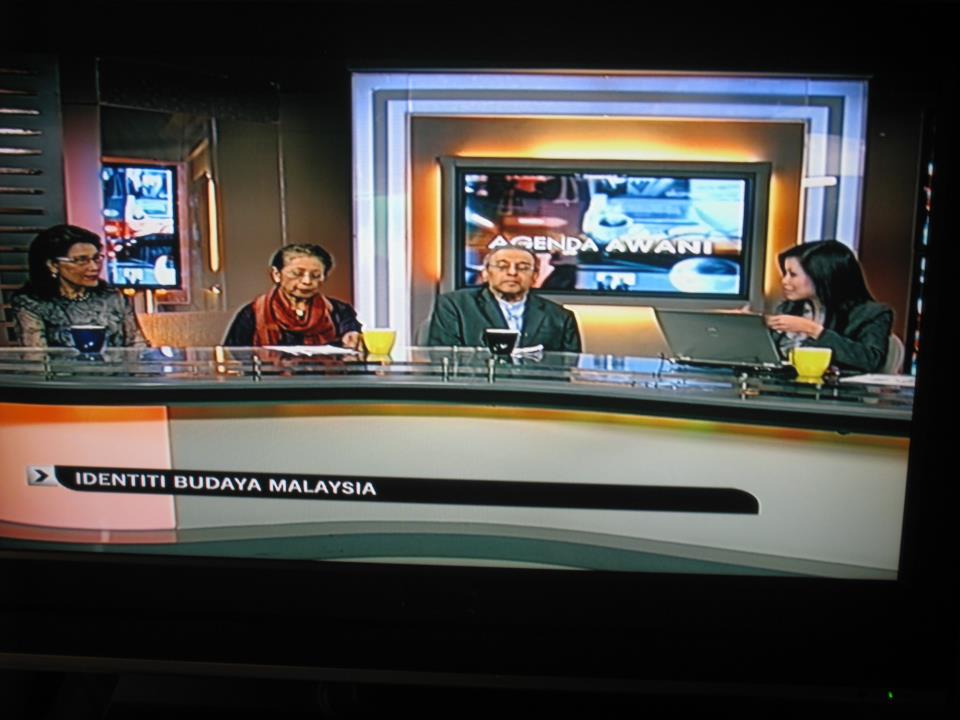
Recently I was perusing our archives, and found this terrific article from way back in 2005, authored for us by Cultural Detective Malaysia co-author Asma Abdullah. It focuses on indigenous contributions to global management, and I thought some of you might enjoy reading it, for the first time, or seeing it again with new eyes. Oldie but goodie, in my opinion!

Designing and Implementing Global Diversity

The global scene is expanding and our world has become borderless. Designing and implementing programs for global audiences presents unusual challenges. Familiar activities may be culturally inappropriate, simulations may need revision, or inherent cultural biases may limit our impact.

This five-day workshop will address strategies for adapting programs for highly diverse audiences, and for designing culturally responsive design and instruction. The facilitators will share a learning framework that will help you assess the impact of culture on teaching and learning. You will learn about the success, the challenges, and the next steps for preparing and delivering culturally sensitive global diversity programs.

To be held July 23-27 in Portland, Oregon, as part of the Summer Institute for Intercultural Communication, the workshop is designed for intermediate and advanced designers, developers, and others launching or anticipating launch of a global diversity program within organizations, whether corporate, nonprofit, NGOs, or educational institutions.

In this session, you will:
  • Learn to adapt simulations, games, blended learning and social media for multiple purposes by tailoring design, delivery, and debriefing.
  • Explore multiple approaches to delivering global diversity.
  • Assess how cultural biases impact design and implementation.
  • Identify learning challenges in implementing programs across cultures.
  • Adapt instructional design for culturally diverse populations.
  • Apply new skills to deliver culturally sensitive and culturally adaptive instruction.

The Summer Institute for Intercultural Communication is one of the world’s premier professional development venues. Be sure to join us in beautiful Portland, Oregon this coming July.

Global Success By Trial and Error?

The idea occurred to Dianne that a blog about “How to convince your boss to work with Cultural Detective” could spark some interesting conversation. Always in the mood for some good dialogue, I took the bait!

To those of us who live and breathe “developing cross-cultural competence,” it seems like a no-brainer. Who wouldn’t appreciate a deeper understanding of the cultural values that are most likely driving your international clients’ decision-making process? Isn’t it logical that understanding what makes our global clients, vendors or colleagues “tick” would translate into improved relationships and ultimately more or better business?

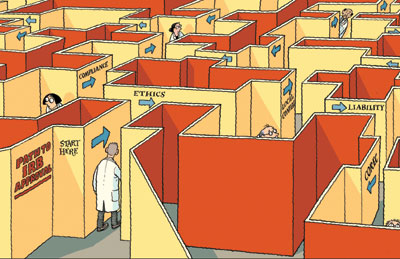
We know, by evidence of the shear number of cross-cultural mishaps resulting in project failures, job loss, plant shut-downs, etc., that millions  of dollars are lost annually by culturally inept managers following a path of trial and error versus embarking on a path of structured learning to develop competence for working across cultures. But because those dollars are not directly traceable to a lack of cultural competence, the trial by error path to global success continues to lead organizations through a maze of cross-cultural dilemmas which ultimately may or may not end well for the organization.

If you’re seeking the most direct path to your global success, it makes both personal and organizational sense to prepare the way by learning a core process for developing global competence. In fact, there was a 2007 Accenture study that involved interviews with global managers, who reported a belief that adopting a cross-cultural communication training program could improve business productivity by 26%! Most importantly, their belief was supported by actual improvements in productivity of 30% reported by organizations who did implement cross-cultural training programs.

The bottom line is that by using the Cultural Detective Method you are far more prepared for any cross-cultural situation, so that ultimately you will be more productive and effective in your job and for your organization. Better prepared employees feel more successful and have much better job satisfaction. What boss wouldn’t want that for their employees?

Our clients report feedback such as the following:
  • 30% increase in global customer satisfaction, due to training technical support representatives with the Cultural Detective
  • Alleviation of the typical “low” resulting from culture shock that many expats feel, and shorter time-to-competence on assignment, due to providing pre-departure training that includes the Cultural Detective
  • The Cultural Detective tools allow the flexibility to meet emerging needs/respond to time-sensitive opportunities because they provide “just in time” effectiveness in a cost-effective manner.
  • Cultural Detective training results in “positive and creative resolutions that bridge value differences.”

As I think more closely about this question, “How to convince your boss to work with Cultural Detective tools,” the answer clearly lies in the Cultural Detective Method and the Value Lens tools themselves! What does your boss value? And what does his/her boss value? Leverage whats important to them and put their values to work for you!

So, what do you think? How would you convince your boss? Let us hear from you!

Layering Lenses: We are All Multicultural Individuals

“As an ethnic minority woman working in a large multinational firm, too often I feel like I have to learn only, to fit in. For the first time since I’ve worked here, I can now see, and explain, the unique and valuable perspective that I have to contribute as well!” she said, her face positively glowing.

The privilege of experiencing such affirming responses from Cultural Detective customers is part of what makes my job so incredibly worthwhile. This woman had just spent time creating her personal Values Lens, using Cultural Detective Self Discovery as well as a selection of Values Lenses from various other CD packages.

While the core of Cultural Detective is its process, which enables ongoing learning, collaboration and conflict resolution, the Lenses play an invaluable supporting role. As shown in the diagram above, one important role the Lenses can play is to help us realize that we are all unique, individual composites of the various cultures that have influenced and helped form us over our lifetimes. We are not “just” Chinese or Brazilian; we are much, much more than a single story, as Chimamanda Adichie so well told us.

In international cross-cultural work such as I’ve done over the past 34 years, too often people limit their definitions of “culture” to “nationality.” Culture goes way beyond nationality. Since by definition culture is the shared norms, values and behaviors of a group of people, culture can also include ethnicity, language group, physical ability or mobility, sexual orientation, or gender identity. More often than not, in my experience, while nationality(ies) tend to have a strong impact on our behavior, professional training, the culture of the organization to which the person belongs, the team culture, their socioeconomic level, generation, their faith or spirituality … all of these influence behavior as much as or more than national birth culture. It’s worthwhile for all of us to know ourselves in all the layers of our cultures: why we are the way we are, how we got to be who we are today. In this way we can better predict how we’ll respond, and better explain ourselves and our motivations to others, powerfully transforming collaboration.

People often ask me, where does personality end and culture begin? As a practitioner, my response is, “Does it really matter? Is there an objective, accurate answer?” We are all unique individuals and we are all also influenced by the multiple cultures in which we’ve grown up, been educated and trained, worked and lived. If we can keep our values and our goals clearly in mind, we can be flexible in our behavior and creative in our approaches, in order to perform at our highest and best in a broad variety of contexts.