Using Our Perceptions to Discover Ourselves: Two Iconic Embraces

We often hear that feedback says as much about the person giving the feedback as it does about the subject of the evaluation.

Our perceptions can tell us loads about ourselves. Take a quick look at the photo below, and take a few notes on what you see.
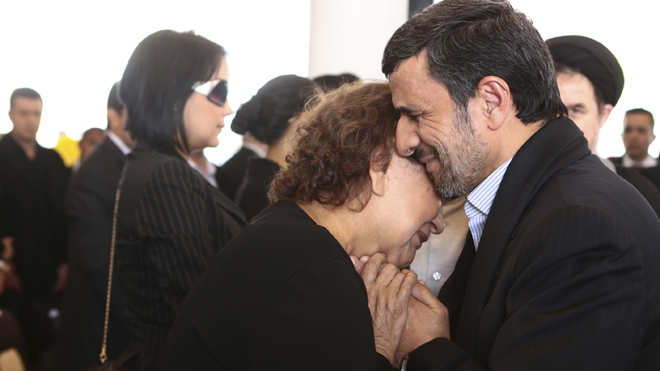
Mahmoud Ahmadinejad, Elena FriasKeep looking at the photo above. In case you do not already know, the photo was taken at the funeral of Venezuela’s President Hugo Chavez in March 2013. On the left is Chavez’s mother, Elena Frias de Chavez, and on the right is Iran’s President Ahmadinejad. Now, pause and take a few more notes on what you see in the photo.

Did your perceptions change between the first and second times you took notes? Before you proceed, take a moment to reflect on the values, assumptions, and beliefs that underly your perceptions.

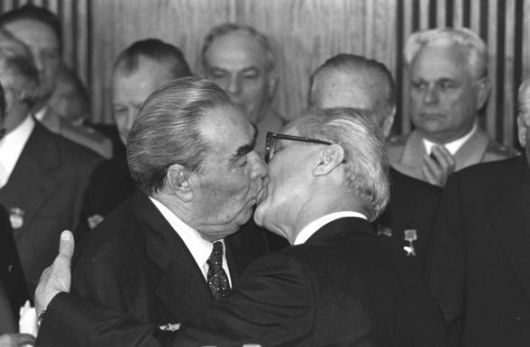
Once you’ve done that, how about looking at another photo? Same instructions: take a look at this photo, and jot a few notes about what you see. Perhaps you have already seen both of these rather iconic photos.
Breznev-Honecker_1979

Keep looking at the second photo. If you did not already know this, the photo was taken during the 30th anniversary celebrations of the Democratic Republic of Germany (East Germany) in 1979. On the left is Leonid Brezhnev, leader of the USSR, and on the right is East German President Erich Honecker. Now, take a few more notes on what you see in the photo.

Did your perceptions change between the first and second times you took notes? Before you proceed, take a moment to reflect on the values, assumptions, and beliefs that underly the perceptions you noted this second time around.

Finally, compare your perceptions, and your values, assumptions, and beliefs about both of these photos. In what ways did you respond similarly? In what ways differently? Why?

FIRST PHOTO
In fact, President Mahmoud Ahmadinejad was criticized for consoling Chavez’s mother in this way; she is not a member of his family, and thus, such touching is haram or forbidden. While my research shows the photo to be real, there are reports of the photo being doctored in order to cause problems. I personally find the actions captured in the photo quite believable: a man consoling a grieving mother and bridging cultures in the moment. Below are two sources for those of you curious to learn more about this photo and the response to it:

  1. Daily Mail article
  2. IranPulse English language news blog

SECOND PHOTO
It was quite commonplace for Communist leaders to kiss on the mouth as an expression of brotherhood and solidarity. This iconic photo was taken by Régis Bossu, a freelance photographer for European Stars and Stripes, Stern, Spiegel, and Sygma. Most observers of the time viewed this Brezhnev-Honecker kiss as more enthusiastic than usual. The photo was quickly and widely circulated.
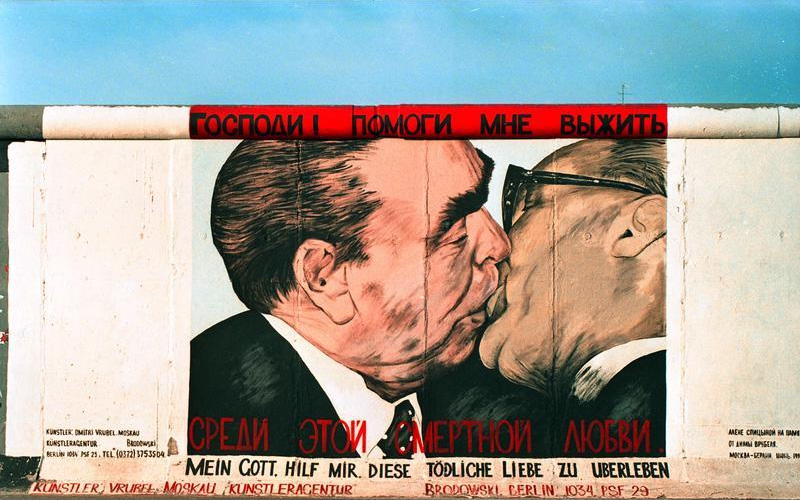
Berlin, East Side GalleryIn 1989, during the euphoria following the fall of the Berlin Wall, Dmitri Vrubel painted a replica of the kiss on the Eastern side of the Wall. If you wish to learn a bit more about the photo and the painting, here are a couple of links:

  1. Lite Strabo Stories from History blog
  2. Wikipedia

While we can learn much about history and politics from photos such as these, we can also learn about customs and values. And, perhaps most importantly, we can learn to see our own cultural filters and biases a bit more clearly. Exercises such as these can be used to complement the learning we gain about ourselves via the Cultural Detective Self Discovery.

Coincidentally, when she was proofreading this post for me, our editor, Kathryn Stillings, shared with me that she had just read this article, about our perceptions (socially constructed) of race: What Does “Black” and “White” Look Like, Anyway?: Obama and His Grandpa. I share it with you as it would seem to support, as well as build on, the point of this post. I particularly love the morphed photos at the bottom of the article.

Before I close, I’d like to thank a few of the members of SIETAR Argentina, who recently used the second photo above in a training, and reminded me of it after so many years.

And, in conclusion, I leave you today with a few quotes:

There is no truth. There is only perception.
—Gustave Flaubert

Science is nothing but perception.
—Plato

Studies have shown that 90% of error in thinking is due to error in perception. If you can change your perception, you can change your emotion and this can lead to new ideas.
—Edward de Bono
Foreign assigments and what it could feel like – a real life example

Very typical story, sadly, wasting everyone’s time, efforts and talent. I urge those of you with Cultural Detective Online subscriptions to debrief this story using a Worksheet! Thank you for sharing, Jenny Ebermann, and for your shout-out to our tools.


Global Statistics on Women’s Rights

I’m guessing you’ve heard of “One Billion Rising,” a global action project to end violence against girls and women. They hold a mirror up to us that shows a reflection oh-so-difficult to own: that one out of three women on our planet will be raped or beaten in our lifetime, for example. Where I live, in Mexico, women disappear in alarming numbers every day.

Today I saw this new video, which I feel speaks very well to the issue. While I don’t necessarily agree with the video’s conclusion that women are THE answer, all of our talents together, indeed, are the answer.

Please help this video gain some traction, if you would. Cross-cultural sensitivity is important because it helps us achieve respect for all, a voice for all, equity and sustainability. Cross-cultural sensitivity can not be used as an excuse to abuse fundamental human rights. We hope that Cultural Detective Women and Men, available in our online subscription system as well as via printable PDF, will help us learn to understand and value our differences.

Does Cultural Detective “Work” in a University Setting?

Simons-ESPEME

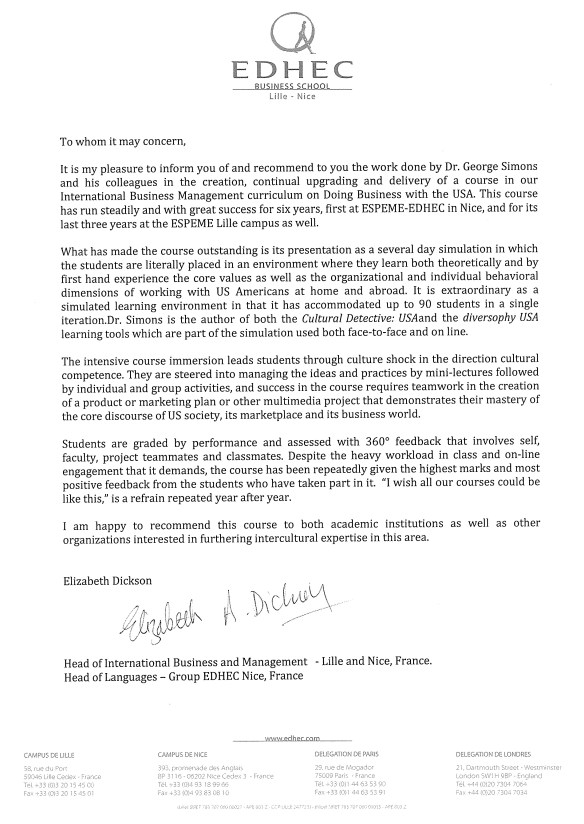
Click on the image to view a full-size version of this letter.

We are very proud to say that Cultural Detective has been an essential ingredient of the International Business Management Program in the ESPEME-EDHEC Business School in France over the past six-years. Dr. George Simons and colleagues have designed and delivered leading-edge courseware in fully simulated environments, spiraling around a Cultural Detective backbone. The results they have achieved have been remarkable. George has, over the years, most generously shared his experiences, his students’ projects (Blended Culture identity, comparative culture differences, movies, artwork, papers), and his designs with us.

I am thus quite eager to share with you this letter from Elizabeth Dickson, Head of the International Business Management Program at EDHEC Nice and Lille. I’m confident you’ll join me in congratulating George as well as his colleagues for the fine work they continue to do. I believe you will find it interesting to read Elizabeth’s letter, and to view what one head of a major educational institution feels have been the components of a successful international business course.

And, to answer the question in this post’s title, “Yes, by all means. There are quite a few universities on several continents using Cultural Detective to great effect.” It’s not just for business anymore.

There are quite a few other use cases that might prove interesting to you on our website.

Resumen de las principales diferencias culturales

CultDiffsMapSpanish

(English follows Spanish.)
En mayo de 2012 escribí un blog acerca de cuando trato con las dimensiones de cultura, frecuentemente las utilizo en forma de mapa, para ayudar a la gente a encontrar los factores que pueden estar en el camino de una mejor comunicación. He encontrado que esta es una excelente manera de trabajar las dimensiones.

Fernando Castro debriefing a critical incident using the Cultural Detective Worksheet

Fernando Castro analizando una historia con la Hoja de Trabajo Cultural Detective.
Fernando Castro debriefing a critical incident using the Cultural Detective Worksheet

Este mes he tenido la alegría y el privilegio de trabajar con Fernando Castro de AFS Argentina y Uruguay. Él generosamente tomó este mapa de las diferencias y lo tradujo al español para nosotros.

Invito a todos a utilizar esta nueva versión en español bajo la licencia Creative Commons. Esto significa que usted puede utilizar el gráfico y la información en el artículo, siempre y cuando mantenga los derechos de autor y URL original.

¡Mil gracias, Fer!

In May of 2012 I wrote a blog post about how I frequently use the dimensions of culture in map form, to aid people to locate the factors that may be getting in the way of better communication. I have found that this is a terrific way to put the dimensions to use.

Fernando Castro debriefing a critical incident using the Cultural Detective Worksheet

Fernando Castro debriefing a critical incident using the Cultural Detective Worksheet

This month I had the joy and privilege of working with Fernando Castro of AFS Argentina and Uruguay. He most generously took this Map of Differences and translated it into Spanish for us.

You are all welcome to use this new Spanish language version under a Creative Commons license. This means that you may use the graphic and the information in the article so long as you retain the original copyrights and url.

¡Mil gracias, Fer!

The Best-Kept Secret of Successful Teams

4 Phase ModelAlmost every team and community today is diverse in some way or another: gender, age, spirituality, professional training, ethnicity, nationality… While we respect other styles and cultures, most of us still get stuck at some point where we say, “OK, we’re different; now how do we work (or live) side-by-side? How do we harness our differences as creative assets? At a minimum, how do we simply keep from driving each other crazy?”

We might work with partners who view time as flexible and events as unfolding. This may mean that, to them, deadlines are mutable and subject to change. Meanwhile, we push ourselves and our bodies, working overtime to make sure we honor our commitment to an agreed-upon deadline. While we may respect our colleagues’ view of time management on a theoretical basis, and perhaps envy them their apparently healthy work-life balance, how do we succeed with partners who don’t seem to respect their commitments to deadlines?

Perhaps we have a neighbor or even a waiter at a favorite restaurant who communicates very directly, yet we prefer a bit more indirection, thank you. While we respect their communication style, it can get irritating and try our patience.

Too often we fail to actively seek to bridge differences because we see them as something negative, as something that separates rather than unites us. Yet, by ignoring our differences, by pretending they are not there, we imbue them with great power. Eventually they can get the best of us, surprising us at awkward moments and causing frustration and tension. Our reluctance to address differences may stem from a fear that acknowledging their existence may push us farther apart rather than allowing us to collaborate enjoyably.

So, how do we transform these differences into assets? How do we convert them from something to be denied, hidden, or tamped down, into something to be embraced and used for the good of the organization and the team?

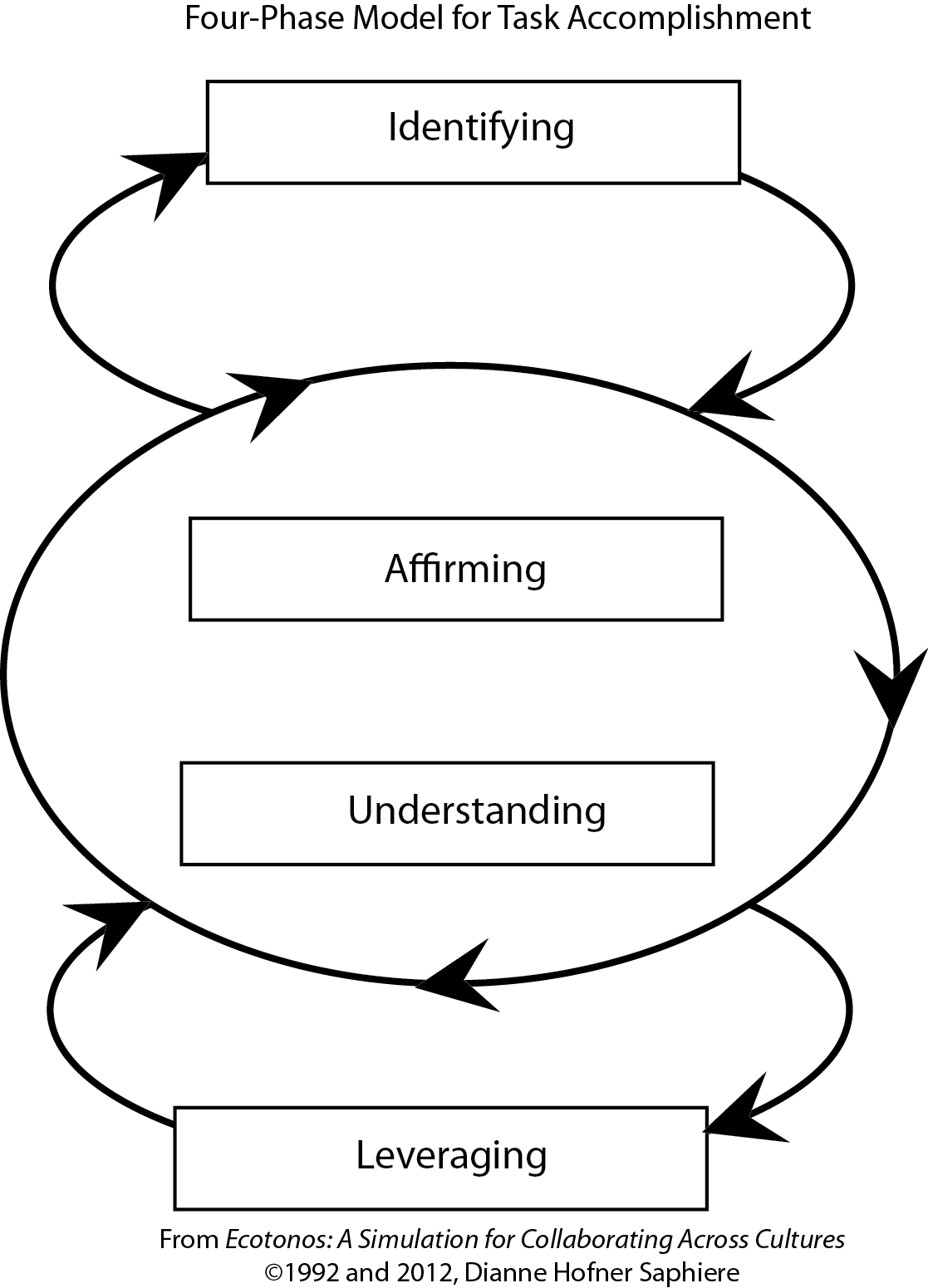
One model that has proven quite useful over the past two decades of use comes from the classic and widely used simulation, Ecotonos: A Simulation for Collaborating Across Cultures. Called the “Four-Phase Model for Task Accomplishment,” this very simple approach guides us to first identify the similarities and differences at play in our interaction, verbally affirm them, spend time understanding them and, finally, explore how to leverage them.

How a specific team leverages similarities and differences will depend on the members of the team and their shared goals and realities. Each team creates its own team culture, ideally based upon and growing out of the first three phases of this Four-Phase Model.

As you can see in the graphic above, the Four-Phase Model is not linear, but rather each phase weaves into and out of the other. For example, understanding may lead to further identifying, or leveraging may lead to added affirmation.

A text description of the Model accompanies Ecotonos and provides further elaboration of the graphic:

Identifying
  • Perceiving similarities and differences
  • Establishing which differences are divisive and which commonalties unite
  • Creating self-awareness of one’s own strengths and styles
  • Appropriate balancing of the tension between sameness and difference
Affirming
  • Confirming individual commonalties and differences
  • Substantiating that difference is desirable
  • Legitimizing difference in the eyes of the group
  • Welcoming conflict and paying attention
Understanding
  • Attempting to understand the other person’s perspective
  • Stepping into the other’s shoes
  • Mirroring/exploring and discovering together
  • Probing for deeper comprehension using various approaches
  • Seeing an issue from several vantage points
Leveraging
  • Defining how team members can contribute to goal accomplishment
  • Agreeing on methods for utilizing team expertise
  • Facilitating the generation of creative solutions
  • Creating a “team” culture
  • Focusing on efficiency and effectiveness

Once people become comfortable with the Identifying Phase, they may perceive the Affirming Phase as something unnecessary, a waste of everyone’s time. “We are all adults. We don’t need to give one another kudos.”

But my extensive experience proves, over and over again, that taking the time and effort to actively engage in the Affirming Phase is well worth the investment. Proceeding more slowly allows the team to accomplish more in less time, so to speak.

Below is one video that illustrates the value of affirmation in our lives. It is pretty long, but you’ll get the idea pretty quickly and I’m confident you’ll enjoy watching it.

The Four-Phase Model is one tool that can powerfully transform conflict into productivity and innovation. And, by the way, don’t forget that you are awesome!


El valor de las habilidades interculturales en el trabajo

Video sobre los resultados de un estudio realizado por The British Council, Booz Allen Hamilton e IPSOS Relaciones Públicas, basados en los aportes de un grupo de Gerentes de Recursos Humanos de 367 grandes empleadores en 9 países: Brasil, China, India, Indonesia, Jordania, SudAfrica, Emiratos Árabes Unidos, el Reino Unido y los Estados Unidos. “Los empleadores reconocen la importancia de las habilidades interculturales en el lugar de trabajo.”

Video producido por Cultural Detective, Dianne Hofner Saphiere. Traducido al español por Nathaly Moreno.

Nuestro resumen sobre este estudio, escrito en inglés. Versión del video en inglés. Link al estudio original.

Catalysts For Intercultural Conversations and Insights: Advertisements

Lipton tea Chinese flowersThis guest blog post is written by Joe Lurie, Executive Director Emeritus, University of California Berkeley’s International House.

Recently, I taught a course attended by Chinese and French students on the intercultural challenges of marketing across cultures. Midway through the course I asked students to select a print, web or YouTube ad describing how the following items reflected cultural preoccupations, values and behaviors in their cultures:

  • the product being promoted
  • the selection of words in the headers
  • the images and colors being used to reinforce the message

After analyzing the ad as a reflection of one’s culture, the student was to ask a fellow classmate from another culture why the ad would or would not work in their culture. In one example, a Chinese student demonstrated how Lipton tea is marketed in China. He noted that no tea bag was explicitly shown, as tea bags do not speak to the traditional way of preparing tea in China, and so not the best way to convince people to drink the Lipton product in China. Rather, the image was of green tea flowing from a cup on its side, producing green images in the style of Chinese paintings of mountains, fish and flowers, each with a particular symbolic value in Chinese culture. Lipton tea Chinese mountains The French student who was interviewed had no exposure to traditional Chinese painting and saw not lovely images, but rather incomprehensible splotches! He added that the ad would not work in France as tea drinkers are generally accustomed to black or brown teas.

Color in many other ads revealed the power and status implications of yellow in China, yet something to beware of in France where it often suggests infidelity. Below from a French student are two different ways that Volkswagon is promoted in China and France, reflecting a powerful individualistic/collectivistic contrast, and a terrific way for students to engage in a conversation of cultural discovery:

Below you will find an ad for a cleaning sponge selected by a French student, revealing what the student felt is a preoccupation with sex—reflected in explicit and other seductive ways in many other ads for other products in France. Sexual suggestions, so graphically portrayed, would not, according to the Chinese students in my class, be acceptable in Chinese product promotions. And in a French ad for BMW, a man is  shown making love to the body of a woman whose face is in fact a BMW!

BaijuuA Chinese ad for a very strong 38% alcohol rice beverage portrayed a bottle whose shape was interpreted by the French as a perfume bottle, and so it would not be a convincing way of promoting an alcoholic beverage there.

The bold red color signifying affluence and status for the Chinese was seen as over the top by the French students, who noted a preference in the French aesthetic for far more nuanced, muted colors. This prompted a spirited conversation between the Chinese and French in which it was revealed that ads with very high alcoholic content are discouraged or banned in France, but visual ads for condoms were common there, though not generally acceptable in China. That conversation ended with a comparison of toasting custom—the French “drink and sip” vs the Chinese GAMBAY or “bottoms up”—ALL at ONCE!

Should readers of this blog try this approach in their intercultural classes and training sessions, I hope you will consider sharing the fun and insights here….

—Joe Lurie
Executive Director Emeritus at the University of California’s International House, Joe is currently a cross-cultural communications consultant, university instructor and Cultural Detective certified facilitator. Contact Joe via email or LinkedIn.

Al ritmo de cadera

Latinoamérica es sin duda sinónimo de ritmos y movimientos. Las cadencias que se mezclan en esta tierra son reconocidas en el mundo entero. Los ritmos tropicales como la cumbia, el merengue, la salsa y la bachata están presentes en cada discoteca que se pueda imaginar. O, cantantes de moda como el colombiano Juanes y su canción La Camisa Negra,  la cual internacionalizó la música de carrilera de nuestra región andina y la vine a escuchar en su versión original en un sitio nocturno en las afueras de Atenas hace unos años. Yo veía estas rubias tan hermosas tararear “tengo la camisa negra” y decía Dios mío ¿sabrán lo que están bailando?

Y la música da para todo, aún para seguirme sorprendiendo. Acostumbro a ver las actualizaciones de estado de mis contactos en BlackBerry messenger, uno de esos estados decía: Interesados en clase de Zumba, favor contactarme.

Hasta ahí no hay nada especial, lo sé, pero mi contacto es de Mumbai y está a muchos kilómetros de distancia del origen de Zumba. Era justamente Happy Holi para ellos, fiesta de color, así que saludé a Krishna y le dije cuán soprendida estaba con su invitación a Zumba. Ella no sabía que este nuevo ritmo que se ha tomado casi todos gimnasios del mundo – y no exagero – había nacido en Colombia, por cierto que me dijo: Querida si estuvieras en India ¡podríamos ir juntas!. ¿Cuándo imaginaría su creador estar también en los gimasios de la India?

Yo no he tomado mi primera clase de Zumba y supe de esto por una entrevista radial. Me encantó escuchar la historia de su creador, quien en busca de oportunidades se metió de profesor de aeróbicos, los cuales fueron furor en los años 90 por esa moda del buen estado físico que nos llegó de Estados Unidos. Este joven profesor un día cualquiera en su natal Cali, Valle del Cauca (Colombia) no encontró su cassette para una clase y tuvo que ese día recurrir a lo suyo para remplazar el rock y demás que eran el “must” y, con salsa y ritmos latinos hizo sudar a más de una sin darse cuenta que ahí comenzaba el giro de 360 grados en su vida.

No soy muy nacionalista, o por lo menos eso creo, pero cuando Krishna citaba a todos sus amigos a tomar clases me dije, le tengo que contar que eso es de aquí.

Acabo de visitar la web http://www.zumba.com/ y me gozo mirando que hay nueve opciones idiomáticas, que hacen diferencia entre portugués de Brasil o Portugal, y lo propio con el español de México.

Sí, la música es universal y nuestro sabor tropical parece que también lo es, sin embargo este profesor de aeróbicos logró junto con sus socios crear una firma global. Hoy está radicado en Estados Unidos y tienen desde DVDs hasta ropa y programas de certificación. Una buena idea, un buen socio y una excelente aproximación intercultural hace que Zumba sea para todo el que esté dispuesto a disfrutar.

¡A mover las caderas todos y hasta pronto!

To the Rhythm of the Hips
By Maryori Vivas, translated by Dianne Hofner Saphiere

Latin America is without doubt synonymous with rhythms and moves. The mix of cadences in this land are known throughout the world. The tropical rhythms such as cumbia, merengue, salsa and bachata are found in every dance club imaginable. Popular singers such as the Colombian Juanes and his song La Camisa Negra internationalized the carrilera music of our Andean region; I even heard the original version in a nightclub on the outskirts of Athens some years ago. I saw those beautiful blondes humming “I have a black shirt” and I said to myself, “My God, do they know what they are dancing to?”

The music gives to all, even as it keeps surprising me. I regularly check the status updates of my contacts in BlackBerry Messenger, and recently one of them said: “Interested in a Zumba class? Please contact me.”

Up to that point there is nothing special, I know, but my contact is in Mumbai, quite a few kilometers’ distance from the origin of Zumba. It was just Happy Holi for them, the festival of colors, so I gave Krishna my regards and told her how surprised I was with her invitation to Zumba. She didn’t know that this new rhythm that had taken over almost every gymnasium in the world — without exaggeration — had been born in Colombia. She told me, “My dear, if you were in India we could go together!” I’ll bet that Zumba’s creator never imagined that it would be in gymnasiums in India!

I have not taken my first Zumba class, and I learned about it via a radio interview. I was fascinated to hear the history of its creator who, looking for personal development opportunities became an aerobics teacher, which was the fitness rage in the 90s that arrived from the United States. This young teacher, one normal day in his birthplace of Cali, Valle del Cauca (Colombia), couldn’t find the cassette with the required rock music for his class that day. So he had to rely on his own salsa and Latin rhythms that made everyone sweat, and which turned his life around 360 degrees without his even realizing it.

I am not very nationalistic, or at least I don’t think I am, but when Krishna told all his friends to take classes I told myself, “I must tell him that it’s from here.”

I just visited the webpage http://www.zumba.com and enjoyed seeing that there are nine language choices, that they differentiate between the Portuguese of Brasil and Portugal, and Castillian with the Spanish of Mexico.

Yes, music is universal and it would seem that our tropical tastes are as well. And this aerobics instructor, together with his partners, was able to create a global firm. Today he lives in the USA and they have everything from DVDS to a clothing line and certification programs. A good idea, a good partner, and an excellent intercultural approach have made Zumba available to everyone who is willing to enjoy it.

To move the hips, everybody, and see you soon!

Research Findings: The Value of Intercultural Skills in the Workplace


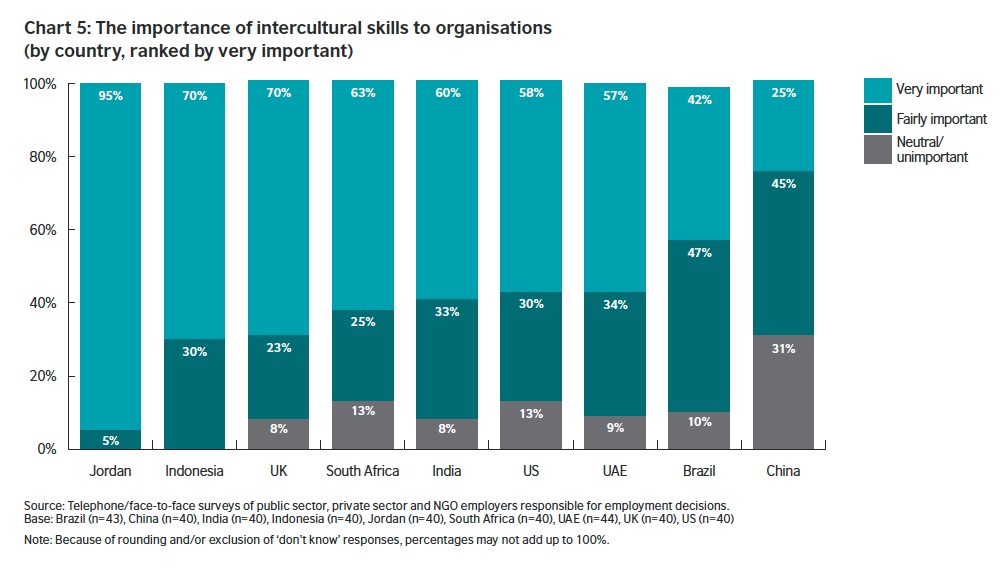
IC Skills importance
Culture at Work: The value of intercultural skills in the workplace
—A survey conducted by the British Council, Booz Allen Hamilton and Ipsos Public Affairs, of HR managers at 367 large employers in nine countries: Brazil, China, India, Indonesia, Jordan, South Africa, the United Arab Emirates (UAE), the United Kingdom (UK), and the United States (US)

The Report’s Conclusions

“Our ability to engage successfully with other countries, organisations and people will depend to a large extent on whether we possess the necessary intercultural and foreign language skills to make fruitful connections, whether in trade and investment, charity/NGO programmes or as government and international organisations. This is fundamentally changing the way in which employers value and seek to develop intercultural skills in the workplace.”

“More and more business leaders are identifying real business value in employing staff with intercultural skills. These skills are vital, not just in smoothing international business transactions, but also in developing long term relationships with customers and suppliers. Increasingly they also play a key role within the workplace, enhancing team working, fostering creativity, improving communication and reducing conflict. All this translates into greater efficiency, stronger brand identity, enhanced reputation and ultimately impact on the bottom line.”

“Employers believe that intercultural skills are integral to the workplace.”

“A common challenge shared by employers around the world is finding employees with adequate intercultural skills. Given that the operating environments of all organisations is increasingly global, it comes as no surprise that employers need employees who can understand and adapt to different cultural contexts.”

What is the international reality in the workplace?

The research shows that employees in most large companies surveyed engage in extensive interaction across international borders.

More than two thirds of employers report that their employees engage frequently with colleagues outside of their country, and over half say that their employees engage frequently with partners and clients outside of their country.

THE BUSINESS VALUE OF INTERCULTURAL SKILLS
Intercultural skills provide business value and help mitigate risk.

The research shows that HR managers associate intercultural skills with significant business benefits. Overall, the organisations surveyed are most interested in intercultural skills for the benefits they bring—benefits that carry significant monetary value to employers:

  • Keeping teams running efficiently
  • Good for reputation
  • Bringing in new clients
  • Building trust with clients
  • Communicating with overseas partners
  • Able to work with diverse colleagues
  • Increased productivity
  • Increased sales

Employers also see significant risk to their organisations when employees lack intercultural skills. Top risks that organisations surveyed are concerned about are:

  • Miscommunication and conflict within teams
  • Global reputational damage
  • Los of clients
  • Cultural insensitivity to clients/partners overseas
  • Project mistakes

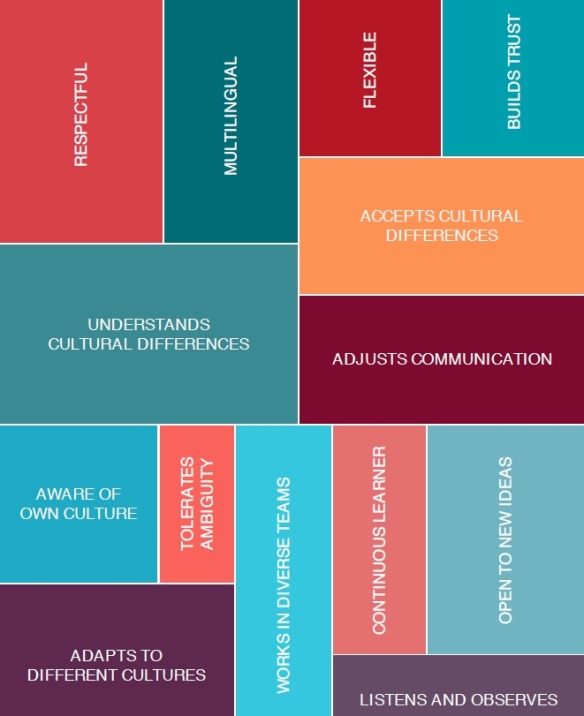
How do the organisations surveyed define “intercultural skills”?

The graphic below shows the words employers used, with size of the block equating to frequency of use.

define%22interculturalskills

The terms employers use to define intercultural skills
Source: Telephone/face-to-face surveys of public sector, private sector and NGO employers responsible for employment decisions. Base: Ipsos Public Affairs, 2012: Global (n=367).

In particular, employers highlight the following as important intercultural skills that they look for in job candidates:

  • the ability to understand different cultural contexts and viewpoints
  • demonstrating respect for others
  • accepting different cultural contexts and viewpoints
  • openness to new ideas and ways of thinking
  • knowledge of a foreign language.

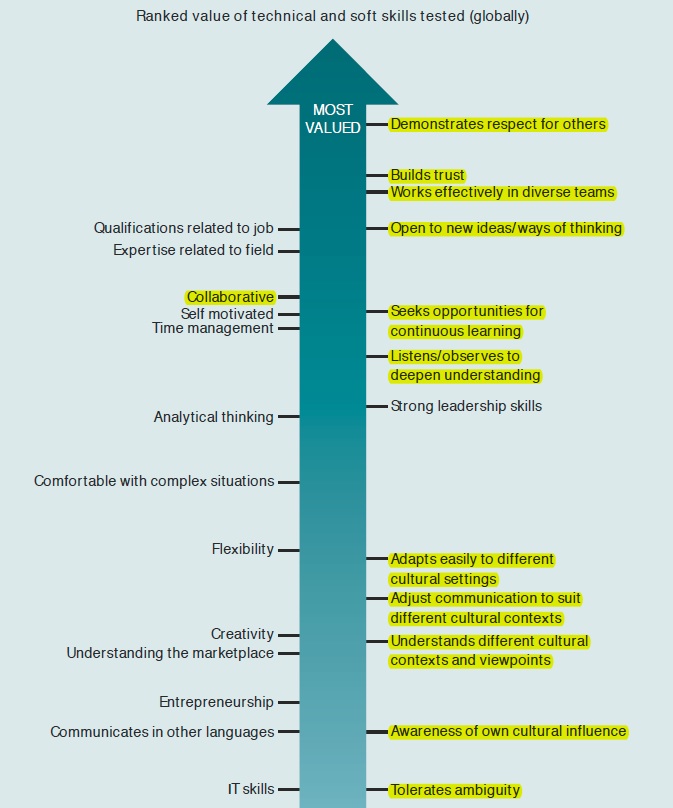
How employers rank different skills in terms of importance

valuedskills

Graphic © the original report, with yellow highlights added by Cultural Detective.

How does the research indicate these skills are developed?

Most employers report encouraging their staff to develop intercultural skills through in-house training, meetings and events. However, employers also say that educational institutions could do more to equip students with intercultural skills.

The findings suggest that policy makers and education providers could do more to contribute to the development of a workforce with the necessary intercultural skills through interventions, such as prioritising:

  • teaching communication skills
  • offering foreign language classes
  • availability of opportunities for students to gain international experience
  • development of international research partnerships.

This research suggests that there is significant opportunity for employers, policy makers and education providers to work together to strengthen the development of intercultural skills to meet the needs of an increasingly global workforce.