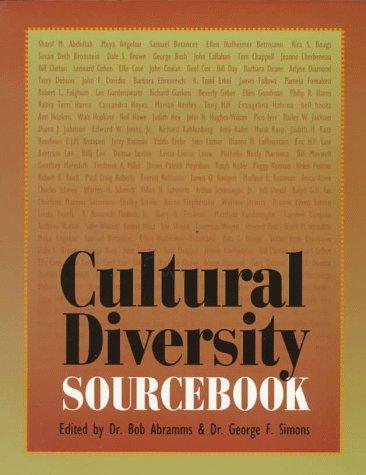
Now through 30 April download the award-winning Cultural Diversity Sourcebook for free using the coupon code “Sourcebook”, thanks to our friend at ODT, Bob Abramms, and Cultural Detective author extraordinaire, George Simons. Originally published in 1996, it was put into e-book form last year and remains a treasure-trove of excellent material. An edited volume of scholarly articles, classic essays, best practices and quotes from popular culture, poetry and music, I think you’ll find it well worth your time. Thank you for your generosity, gentlemen!
Category Archives: Resources & Reviews
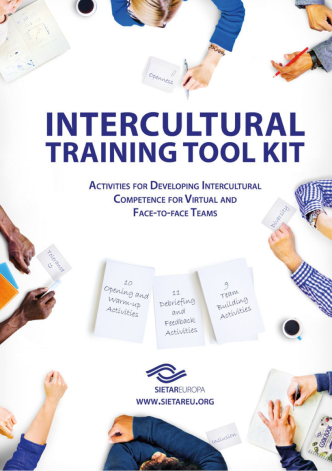
Intercultural Training Toolkit: Activities for Developing Intercultural Competence for Virtual and Face-to-face Teams

We are delighted to share the news of a newly published volume of collective knowledge from SIETAR Europa (Society for Intercultural Education, Training and Research): the Intercultural Training Toolkit: Activities for Developing Intercultural Competence for Virtual and Face-to-face Teams.
“Inspired by many discussions in the SIETAR network, the idea of publishing a collection of SIETAR intercultural training tools came to light. …our intention was to create a consolidated resource of SIETAR members’ favourite and most effective tools and methodologies” according to the book’s editors. They continue:
“Every moment in a training setting is an opportunity for those in the room to reflect on and develop their own intercultural competencies. How we learn about navigating culture is shaped by our professions, travels, and personal interests. With this publication we want to support your learning environment by publishing selected go-to training activities from SIETARians for virtual or face-to-face teams that integrate modern technologies and emerging practice styles with materials and instructions.”
This practical, useful collection of 29 activities is organized into three sections:
- Opening and Warm-up Activities
- Feedback & Debriefing Activities
- Teambuilding Activities
Two of the Teambuilding Activities are authored by Dianne Hofner Saphiere and explore ways to effectively use Cultural Detective. The first provides step-by-step instructions on how to use stories and critical incidents to explore and bridge cultural differences,. The second focuses on developing and using Personal Values Lenses as a method of increasing cultural self-awareness, teaming and collaboration.
The Intercultural Training Toolkit is available as a very reasonably priced ebook via Amazon; hard copies are currently available via Books on Demand or in mainland Europe through national amazon.com sites. We hope you will take the opportunity to check out this new collection of ready-to-use intercultural training activities.
Hansen, Elisabeth/Torkler, Ann-Kristin/Covarrubias Venegas, Barbara (eds.): Intercultural Training Tool Kit: Activities for Developing Intercultural Competence for Virtual and Face-to-face Teams, SIETAR Europa Intercultural Book Series, 2018. 76 pages. ISBN 9783752810073.
Excellent New Classroom Tool & a Great Read!

We are thrilled to announce that this award-winning volume is newly updated with application questions for each chapter and fully integrates with your Cultural Detective Online subscription! Purchase it now for your classroom or for holiday gifting.
—
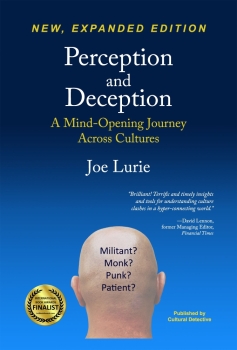
Perception and Deception: A Mind-Opening Journey Across Cultures, 2nd edition, by Joe Lurie, Cross-Cultural Communications Trainer, Speaker and Emeritus Executive Director of UC Berkeley’s International House
What do your experiences tell you when you’re in line behind a bald man: Is he a militant? A monk? A punk? A neo-Nazi?… Or perhaps a cancer patient?
With YouTube, tweets and fake news instantly crossing cultures without context in this time of globalization, it’s essential to understand the actual meanings and intentions behind words, images and actions that seem abnormal or provocative. In line, online and off-line, we’re meeting many more “strangers.” There’s new wisdom in the Lebanese proverb: “Every stranger is a blind man.” And so, we face an urgency to teach students and professionals far more about other cultures and give them the intercultural skills to navigate globalization’s turbulent waters. That’s why, in collaboration with Cultural Detective, I’ve greatly expanded the first award-winning edition of Perception And Deception, A Mind-Opening Journey Across Cultures.
Think globalization is bringing us closer together? Think again. With refugees crossing cultures without preparation on either side, the dangers of intercultural miscommunication are intensifying. Why do many refugees traumatized by violence find Western “talk therapy” alienating? As a Syrian refugee confided, “I can’t share my painful, humiliating stories with a stranger.” A Sudanese refugee was diagnosed “psychotic” because she seemed to be talking to herself; her Boston psychiatrist was unaware that in her world, conversing with ancestors is normal. Some French see a Muslim woman in a burkina—a full body suit—as oppressed or as a potential terrorist. Yet the woman considers her burkini liberating, because she can swim modestly. Recently, a UC Berkeley student with a Spanish last name was snidely asked when she’d return to Mexico. Her angered response, “I’m from Kansas and I don’t speak Spanish.”
To enable use of the well-received stories in the first edition as springboards for developing intercultural competence, I’ve added a broad array of interactive questions and activities at the end of each chapter in this expanded new edition, as well as a brand new chapter, “Globalization and its Disconnects—Convergence Without Context.” It focuses in large part on the spiraling misunderstandings across cultures, especially in the worlds of refugees, religion, and responses to technology.
To better cope with the disrupting forces of globalization, each chapters’ questions and activities are designed to develop and heighten cultural self-awareness and sensitivity to others, among students, individuals and groups of all backgrounds and professions. Some of the included interactive, personalized activities are available for those who take advantage of Cultural Detective‘s superb, research-based, internationally tested online platform providing access to nearly 70 packages of rich intercultural material: Cultural Detective Online; other questions are useful on their own, without a subscription.
Below is a two-minute video recorded at the Commonwealth Club of California, introducing the first edition:
May the new edition’s stories and interactive activities addressing the disrupting forces of globalization and migration offer positive paths for engaging with difference without fear and by seeing with new eyes!
For further information and reviews about the book, or to order it from Amazon, visit PerceptionAndDeception.com; and to learn more about Cultural Detective’s anytime, anywhere intercultural competence development toolbox and virtual coach visit: www.CulturalDetective.com/cdonline.
Book Review: How They Made it in America
Seven success values and the immigrant women who cultivated them by Fiona Citkin, due to publish in December 2018 by a Simon & Schuster affiliate
How They Made it in America is a welcome dose of reality amidst a very worrisome worldwide rise in nationalism and xenophobia. With 40.4 million foreign-born people living in the USA—one in every eight residents—this book is enormously important and timely, providing an inside look at the personal journeys of 18 women from five continents who emigrated to the USA.
The women interviewed represent all socio-economic origins, from some who grew up as daughters of government officials and business leaders, to those born into poverty, and everything in between. Some chose to emigrate; others’ lives depended upon doing so. Each has made her mark in disciplines as diverse as technology, development, business, education, journalism, and the arts; most of them are also philanthropists and community volunteers. The author’s choice of these specific women provides a broad and deep spectrum of experience in the book’s quick-reading 314 pages.
There are over one million foreign-born women business owners in the USA—that’s 13% of all women-owned firms in the country. This book offers an understanding of how starting a new life overseas not only changed these immigrant women themselves, but the economy and community as a whole—locally, nationally, and internationally. One woman’s impact comes from starting a company that has annual revenues of $3 billion, another developed a brand now sold at 10,000 stores in 68 countries, and another is changing the world through her micro-lending organization. We see how some immigrant women struggle to regain the status they had at home, while others begin on the ground floor and work their way up step-by-step.
Interview subjects include such well-known women as Chilean-born Isabel Allende and Ivana Trump, originally from the Czech Republic, to women I’d never heard of like social entrepreneur Alfa Demmellash from Ethiopia or Weili Dai from China, the only female co-founder of a major semiconductor company. By the end of the book most any US American reader will feel blessed to have such talented immigrants in our country!
We learn what these women love about the USA, what brought them in the first place, and what keeps them proudly living there. We gain insight about the effect immigration has on their relationships with those who stayed behind, with the children they birth in their new home, and with their American friends and colleagues. We hear about their struggles—from language, accents, and schoolyard bullying to the professional glass ceiling, assertiveness, and risk taking. Plus, we are privy to their hard-earned advice for others like them.
The author, Fiona Citkin, writes that she and her husband made the decision to immigrate because they wanted their 16-year-old daughter to “grow up in a country where she could fulfill her potential through her own efforts—not because of bribery, conformism, or her parents’ connections” (p. 7). Fiona’s first-hand experience informs the book deeply; she’s an immigrant who has had success as an academic, a corporate employee and executive, and an entrepreneur. “My own struggles in America have helped me understand what skills people need to develop in order to succeed in this U.S.—and the special set of challenges faced by immigrant women” (p. 8).
The book is divided into three parts, with two-thirds of it comprised of interviews with the women. From these interviews, Fiona distills seven “success values” that are explained in a second section, and the book concludes with an “Achiever’s Handbook” offered as a guidebook for immigrants wanting to succeed in the USA. Included is a Foreword by Cultural Detective extraordinaire George Simons and an Introduction by Carlos Cortés. The author has certainly done her research; the volume includes 15 pages of footnotes for those who wish to learn more.
Of particular interest and value to me was how the various women describe their blended culture experience. I most definitely wish I could share a copy of Cultural Detective Blended Culture with each of these women, individually and as a group! Most of the interviewees came across as “constructive marginals”—a term used to describe multicultural individuals who have integrated the positive aspects of their various cultural backgrounds into their identities.
- “I am an eternal transplant… My roots would have dried up by now had they not been nourished by the rich magma of the past,” states Isabel Allende (Chile).
- Verónica Montes (Mexico) tells us, “I had to reinvent my cultural practices in a different social and cultural context, and in that sense, I have consciously selected those practices that I find more significant and relevant to me. It is like becoming an orphan and needing to make your own cultural framework.” She sees herself as incorporating the best of American traits into Mexican culture, thereby enriching her world.
- Alfa Demmellash (Ethiopia) shares with us a frequent theme among the 18 women: “I consider myself a global citizen residing in America.”
- “Immigrants end up being hybrids with two hearts; two countries they love; two languages; and two cultures” is Ani Palacios McBride (Perú)’s take on the subject.
- Raegan Moya-Jones (Australia) relates, “My children will be culturally richer for having parents from Australia and Chile. Life and work are all becoming more global; this is nothing but a good thing for me personally and for my children.” Her proudest achievement, like mine, is raising “respectful, unbiased, globally-minded children.”
- Rohini Anand (India), tells us of her blended culture experience: “The U.S. is home, not India. I’m comfortable with my cultural mix and can navigate cultures comfortably. I love the sense of the extended Indian community and an associated support structure. If my family were here, it could change the whole dynamic for me.”
A couple of the interviewees, however, either shared more deeply and realistically, or perhaps have not yet found a way to make peace with the various facets of their multicultural selves. In the intercultural literature, this is called being an “encapsulated marginal.”
- Irmgard Lafrentz (Germany), like most others, has felt her traditional values change since moving to the U.S. “I feel more American [than German], but as I get older, I long for more belonging somewhere. I am rooted neither here nor in Germany. I am not sure whether it’s possible to become totally integrated, and if it’s an emotional or intellectual issue. There is a social identity that unites all immigrants, regardless of country of origin.”
- Elena Gogokhove (Russia), “My Russian brain does the speaking with my Russian friends and sometimes my daughter. My English brain takes over when it comes to writing. I write only in English. Like a spy, I live with two identities, American and Russian—two selves perpetually crossing swords over the split inside me. There is no bridge between the two lives.” Unlike most of the interviewees who discussed themselves as changing drastically after emigrating, Elena says, “Moving to America failed to make me a different person… Russia, like a virus, has settled in my blood and hitched a ride across the ocean.”
While references to feminism in each of the interviews are interesting, they aren’t very well-connected to anything larger and feel a bit out of place. That said, this is an interesting and remarkable work that offers valuable insight into the creativity and perseverance needed to be a successful woman immigrant in the USA. How They Made it in America would be a terrific holiday gift for friends and family, and for any immigrants you might wish to help. And, of course, the best gift of all would be to combine the book with a subscription to Cultural Detective Online!
Testing an Incredible New Process

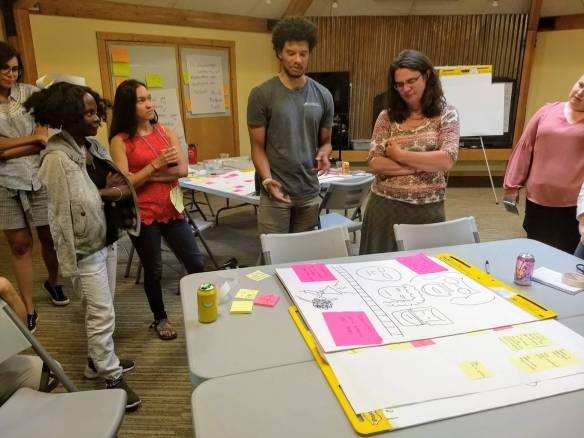
This chart paper contains words that describe the Spanish-speaking families. The client still has that sheet up in their conference room months after the training.
Guest blog post by Bego Lozano, who has lived and worked in different countries and cultures over the past 20 years. Right now, she calls home the Bay Area of California where she focuses on mindful leadership and coaching.
—
As a fan and user of both Cultural Detective® and Personal Leadership®, I was delighted to learn that there is a tool called EPIC (Essential Practice of Intercultural Competence) that combines both.
I recently used the EPIC Toolkit to design, deliver and facilitate a training for a California-based NGO that focuses on supporting those affected by Type 1 diabetes, an autoimmune disease that currently has no cure. This NGO had a unique challenge: funding for programs aimed at Spanish-speaking families had stopped with the 2008 financial crisis and had only recently returned. Their first attempt at organizing an event had fallen short of their expectations—both their internal expectations and those of their partners. They hired me to help make sure that didn’t happen again; they wanted to get the word out about prevention and treatment in powerful and meaningful ways. I turned to EPIC.
The beauty of EPIC is that participants develop awareness into what they personally bring to their work, plus gain insight and understanding of the core values of a culture different than their own. Quite often we forget that as human beings we bring our own cultural lenses to everything we do, and understanding a situation from our own perspective only gives us, at most, half the picture.
After an EPIC training, participants become more mindful of their own values and actions—why they respond in the ways they do. They learn to appreciate the values of the different culture, and most importantly, to build bridges to work better together.
EPIC is not a one-time fix; it is a process of continuous feedback and change, a mobius strip that has space for constant improvement and nuances. It is about competence, and therefore it includes practicing relentlessly and compassionately.
Last I checked, the programs for Spanish-speaking families were doing much better: employees had implemented small and significant changes that had increased participants’ engagement and comfort and their partner’s reported meaningful improvement. People were excited about their jobs and the positive impact they can have in their communities. If you’d like to learn more about EPIC or give it a spin yourself, it is available for license and is such a value!
Ecotonos is a great tool!
We would like to thank Nicole Martin of the Rocky Mountain Institute for this guest blog post about her work with a team from SEED: Sustainable Energy for Economic Development . We are honored and privileged to know our materials aid work of this kind!
—

I just wanted to pass on some feedback. My group of 17 really enjoyed running Ecotonos: A simulation for collaborating across cultures and identified it as a highlight of our day. Team members from SEED drew some valuable insights and connections to their real life work from it.
Since I had not seen Ecotonos run before, it is a credit to the materials that it went so well. I followed the directions and it worked! I really appreciated the clear and complete instructions.
I also wanted to share a tweak that I made. In the acculturation section, I had them create visual identifiers for their groups using craft materials. It helped them acculturate and get talking and moving.
Of course, my creative facilitation idea was sparked by forgetting the buttons back at the office 🙂 Here is a picture of a debrief. You can see the watch necklace (monochronic time group) and the mobius strip hat (polychronic time group) on the left side.
Thanks for the great tool!
—
To learn more about Ecotonos or to purchase the game, which you’ll be able to use for years to come and replay differently with the same group multiple times, click here.
Book Review: Why Travel Matters
The world is a book and those who do not travel read only a page.
—St. Augustine
Are you looking for a terrific graduation gift? Just published last week, this quick, thought-provoking read will encourage any beloved young adult in your life to challenge themselves to develop new perspectives and values by experiencing the world around them fully.
Why Travel Mattersis an in-depth exploration of how to ensure travel experiences transcend tourism and transform the soul. “Through the ages it has been observed that travel broadens your horizons, deepens your understanding and changes your perspective. How? What must be done when traveling to make sure these things actually happen?”
Nothing is comparable to the new life that a reflective person
experiences when he observes a new country. Though I am still always
myself, I believe I have changed to the very marrow of my bones.
—Goethe
The book is written in typical Craig Storti style: engaging prose, good humor, content based on sound concepts and theory, well explained with lots of stories and examples. I read it on one leg of my flight last week and have already purchased several copies for the graduates on my gift list.
Not a typical travel book, Storti talks to the reader about the consequences of the trip rather than the trip itself, the inner as well as the outer journey, using quotations, insights, reflections and commentary from travelers, travel writers, historians and literary masters including Mark Twain, DH Lawrence, Aldous Huxley, St. Augustine and Somerset Maugham. He reviews the history of travel, including the importance of the grand tour beginning in 16th century Europe.
He goes on to explain the rise of modern tourism in the 1840s, thanks to Thomas Cook injecting the four elements of speed, comfort, convenience and tour groups, scrubbing travel of experiences that might disturb or discomfort—and, thus, removing its transformative powers. For me, with a passion for travel, who has hired a tour guide but has yet to take a group tour, who lacks the patience to lead a group of tourists, and who values a liberal arts education heavily grounded in study abroad and cross-cultural competence, the message this book promotes is music to my ears.
They had learnt life in a different school from mine
and had come to different conclusions.
—Somerset Maugham
Storti defines tourism as escape, recreational travel during which tourists are served by locals. Tourism is relaxing; tourists see the sights. Travel, on the other hand, is arriving at a destination. Travel is educational, travelers meet with locals and are stimulated to understand.
Travelers don’t know where they’re going
and tourists don’t know where they’ve been.
—Paul Theroux
Storti weaves in recent discoveries in neuroscience and recounts powerful passages from some of the world’s greatest travel narratives to support his thesis, including the story from Saint-Exupery’s Wind, Sand and Stars of the first time the Moors realized the Sahara was a desert and so very dry compared to other parts of the world—after they’d travelled and seen their first waterfall (p. 35). The reader thus learns that impressions formed abroad change how we see home once we return. He presents and reframes basic intercultural concepts in the context of travel: “You don’t see what is in front of you; you see your brain’s perception of it” (p. 24), sharing with us how JG Farrell saw blood spatters on the pavement during his journey through India, when in reality the red he was seeing was betel juice (Indian Diary), or Storti’s own inability to identify what his eyes were seeing when he first glimpsed icebergs from the air.
Each act of seeing informs and enhances all subsequent acts;
the more we have seen, the more we are subsequently able to see.
—Why Travel Matters, p. 32
In Chapter 4 Storti provides a table of cultural dimensions, writing that travel helps “you realize most people behave logically most of the time. You may not approve of their logic… but once you realize there are reasons behind their behavior you begin to accept that it makes sense.” He does occasionally get over-zealous, in my opinion, continuing on to optimistically tell readers, “There will never be people you cannot understand.”
Knowledge of ourselves—what we at Cultural Detective call “subjective culture,” meaning knowledge of ourselves as unique individuals influenced by multiple layers of culture—gives us choice over who and how we are in this world.
One’s destination is never a place but a new way of seeing things.
—Henry Miller
Storti concludes in Chapter 5 by providing a list of eleven best practices or tips on traveling for personal growth. These include:
- Travel alone.
- Stay out of touch/off the grid; you can’t have an experience and share it at the same time, attempts at the latter diminish the former.
- Collect sights not sites.
- Secure an introduction, a friend of a friend or colleague, to provide you a look inside the life of a local resident.
- Frequent places where you’ll find locals.
- Be a regular.
- Get inside someone’s home.
- Read about the country before and during your travel.
- Enjoy yourself.
Why Travel Matters includes three appendices: an interesting collection of rules for travel from other authors; a selection of quotes from people who are against travel, which feels a bit out of place or forced; and a wonderful list of the world’s great travel books—several of which I’m confident you’ll want to add to your reading list. Here’s to enjoying and benefitting from the journey!
There is all the difference in the world between behaving academically,
with the intellect, and behaving personally, intimately,
with the whole living self.
Proverbs are platitudes until you have experienced the truth of them.
—Aldous Huxley

Focus on Responsible Tourism
We greet hundreds of thousands of national and international visitors each year on the west coast of México where I live. For years I have promoted cultural and religious tourism to the State Secretary of Tourism, trying to encourage travelers to get beyond the beer and beaches to experience a bit of the “real Mexico.”
Recently, a colleague in Milan, Maura di Mauro, told me about a special film track she coordinated in May at the SIETAR Europa Congress in Dublin entitled, Focus on Responsible Tourism. She cautioned me about how the culture of Mursi villagers in Ethiopia was changing due to tourism. Thanks to an influx of camera-toting tourists willing to pay for photos, the villagers increasingly exaggerate their traditional practices and even falsely embellish them, to make them more attractive to visitors. She also told me about Chinese tourists descending en masse on a small village in The Netherlands. Many of the Dutch residents welcome the added economic boost such international tourism provides, but there are also downsides to such tourism and, again, changes to the host culture.
Maura got me excited and I can not WAIT to view these two films!
The first documentary Maura told me about is called “Framing the Other” by Ilja Kok and Willem Timmers (25 min, English and Mursi with English subtitles, €445 for the film in an educational package with guide and readings on tourism’s impact).
The Mursi tribe lives in the basin of the Omo River in the south of the east African state of Ethiopia. The women are known for placing large plates in their lower lips and wearing enormous, richly decorated earrings. Every year hundreds of Western tourists come to see the unusually adorned natives; posing for camera-toting visitors has become the main source of income for the Mursi. To make more money, they embellish their “costumes” and finery in such a manner that less of their original authentic culture remains. The film contrasts the views of Mursi women and those of Dutch tourists preparing for a meeting. This humorous and at the same time chilling film shows the destructive impact tourism has on traditional communities. The film screening was followed by a Q&A with producer Ilja Kok. A preview follows:
The second film is called “Ni Hao Holland: The Chinese are coming” by Willem Timmers (25 min, Mandarin and Dutch with English subtitles, €395 for the film in an educational package with slides and readings on understanding Chinese tourists).
This is a documentary about Chinese tourists and their quest for the authentic Dutch experience. Cherry, the main character, has long dreamed of swapping her home city Beijing for the Dutch village Giethoorn. She has heard and read a lot about this mythical place. The day arrives that she and her friend hop on the plane in search of adventure. In the meantime, entrepreneurs from Giethoorn work hard behind the scenes to cater to this “Holland experience.” They want to make the most of the fast-growing flow of Chinese tourists to their village. How is this authenticity created by some and experienced by others? Below is a preview:
Maura also curated a third film for the festival at SIETAR Europa: “Holi-days” by Randi Malkin Steinberger (50 min). If you’re interested in tourism and its impact on culture, it looks very worthwhile.
Why do we visit pilgrim’s places, art capitols and tourist’s paradises en masse? Traveling from Jerusalem via Florence to Las Vegas, Steinberger takes the answers to these questions to an increasingly general plane. In Jerusalem (welcoming three million visitors a year) we see tourists visiting the holy places, buying souvenirs, and putting themselves through torments that Jesus Christ once endured. What they are looking for is elucidated in short statements by pilgrims, tour operators, church leaders, guides, scientists, and souvenir vendors. All these opinions put forward a few basic ideas: tourism and commerce overgrow religion, and sacred places and objects give people the feeling that they are part of some higher order. We could look at Florence in the same way, where annually six million tourists drink in the best of Renaissance Art. The street interviews allow the same conclusion as in Jerusalem: people feel dumbfounded and overwhelmed. The countless tourists and the massive trade in souvenirs “have turned the city into a congealed moment in time.” The climax of this film journey is reached in Las Vegas. In this city, 36 million people a year enjoy replicas of famous cities and monuments, cinematic reconstructions of historical moments, spectacular shows, and dazzling gambling palaces. Here, the reality, which people also look for in Jerusalem and Florence, is better and more typical (and even more soulless) than in reality.
Printable Maps for Use in Class
Do you work with people from an area of the world you know little about? Most of us aren’t that great at the geography of our own area of the globe, to say nothing about knowing the names of states, cities, or rivers half a globe away! It can be awkward when chatting with a colleague in another country and they talk about their weekend travels, but you have absolutely no idea whether they went to a city, the country, mountains, or seashore. Not the best way to build credibility! Even worse if your colleague is talking about organizational expansion plans, and you don’t know whether they’re talking north, south, east, or west! Learning some basic geographical literacy can be a great help in building relationships, trust, and productivity on a team.
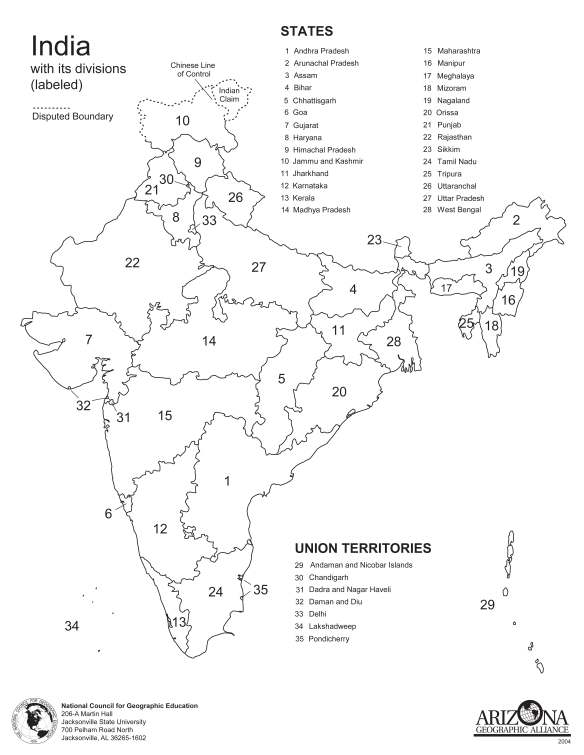
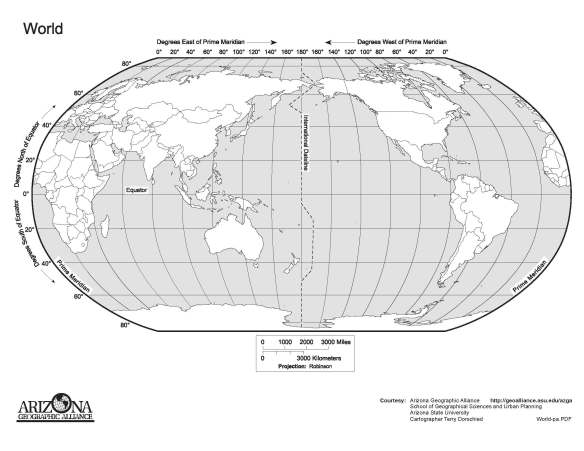
To that end, in trainings I sometimes print out a blank or unlabeled map of a country or region, and ask my learners to fill it in. What better way to realize how much we have to learn? I often use it as a warm-up activity: something for those who arrive early to do while waiting for the on-time arrivals; a way to engage and focus learners.
The problem is finding the maps. I want accurate maps that print in high resolution. And, ideally, I want maps with the “answers,” labeled maps, as well as the blank or unlabeled ones. I would also like them to be free of charge. Enter Arizona State University’s Geographic Alliance, which has free downloadable and printable maps that are very useful for training and education. Be sure to check them out! They have maps for all seven continents, major world regions, and quite a few countries.

The Alliance’s mission is to advocate for a geographically literate society. As such, they have elementary and secondary lesson plans focusing on Arizona, the USA, and the world. How wonderful is that? Foci of the lesson plans include GeoStem, GeoMath, GeoHistory, and GeoLiteracy. If you are an educator or play around with kids, be sure to check out their cool curricula! Samples include:
- Can You Hear Me Now? How a Country’s Wealth Influences Communication: students use scatter plots to discover relationships between the wealth of a country and the access of its citizens to modern methods of communication.
- Don’t Just Escape A Problem, Shape A Solution: An NBA Star’s Efforts to Fight Ethnic Hatred: students will identify the events that led to the formation of Group 7, Vlade Divac’s organization to aid child victims of war. Students will recognize how one person is able to identify a problem and make a positive impact on the world.
- From Around the Corner to Around the World: How Technology Helps in the Spread of a Product: students will examine the spread of one product (Coca-Cola) as aided by advances in technology. Students will mark on their maps their estimates of the spread of a product and then mark their maps again after receiving and discussing information. Students will culminate the lesson by writing a summary paragraph.
- Go, Buddha, Go: Patterns in the Spread of Religions: students will gain a better understanding of patterns of cultural diffusion, while also reinforcing their knowledge of where religions began and where they spread to.
- If These Walls Could Talk: Seeing a Culture Through Human Features: students will identify events that shape a culture, and identify human features in their own community.
Cultural Detective is a renowned process for developing intercultural competence by better understanding oneself, others, and bridging differences so that we harvest the added value of diversity. It is immediately applicable and theoretically grounded, and combines well with a host of other tools, activities and approaches. Maps are just one of these. To read some of our other articles about maps, click here.
Free and Effective Intercultural Assessment Instruments
The Freebies page of our website contains a plethora of downloads and resources we hope you’ll use. Today I’d like to focus your attention on one small portion of that page: Assessment Instruments.
There are, fortunately, loads of terrific intercultural assessment instruments on the market today. The instruments that we share do not compete with those but, rather, fill a different niche. There are just four of them, but they are important, IMHO.
- First, and most important, is the Diversity Collegium’s Global Diversity and Inclusion Benchmarks. With contributions from 95 Expert Panelists including me, this complimentary download is a tremendous resource for any organization or community aiming to improve the quality and caliber of its diversity and inclusion.
- Second, but also of great interest to our community, are the two Cultural Detective Competence Assessments. These tools are still in beta-testing and require your use and refinement, please! If you use Cultural Detective and would like to conduct pre- and post-tests to verify how well your learners have integrated the methodology into their daily thoughts and habits, give these instruments a go. And be sure to provide us your feedback and improvements/refinements!
- The final assessment tool is a quiz on world maps. It could be useful in training, or for your personal professional development. Maps obviously reflect the world views of their creators, and this quiz is aimed to help users realize that.
There are loads of other complimentary resources available from our site. Please put them to good and frequent use! Together we can make a difference, promoting respect, collaboration, innovation and justice.