Cultural Detective at the Summer Institute for Intercultural Communication

SIIC 2015The 39th annual Summer Institute for Intercultural Communication (SIIC) offers professional development opportunities for people working in education, training, business, and consulting, in both international and domestic intercultural contexts. One of the premier gatherings of professionals in the field of intercultural communication, SIIC presents a unique opportunity to explore the field and network with others in a stimulating and supportive environment. Cultural Detective is proud to have long played a role in SIIC, and 2015 will be no exception. Sign up now as workshops are filling quickly!

The workshops below will all include Cultural Detective components; the Certification focuses exclusively on the Cultural Detective Method.

11. Gaining Gaming Competence: The Meaning Is in the Debriefing
Monday-Friday, July 13-17, 2015
Dianne Hofner Saphiere and Daniel Cantor Yalowitz

Psychologist George Kelly has suggested that learning isn’t being in the vicinity of an event, it’s the sense we make of it. If this is so, then experiential learning through games and simulations requires special knowledge and skills to derive the most significant learning. This experiential workshop focuses on current best practices and theories for creating, facilitating, and debriefing meaningful intercultural games, activities, and simulations. We will emphasize the critical importance of debriefing, including the ethics of appropriate responses in challenging situations and a variety of successful strategies that you can use in diverse intercultural settings.

Redundancía and Demonstration of Cultural Detective Online
Tuesday July 14, 2015, Evening Session 7-9 pm
Dianne Hofner Saphiere

Redundancía is one of the most powerful nine-minute learning games you will ever play. It builds empathy for non-fluent speakers, helps develop listening and communication skills, and captures the dynamics of power in conversation. It is a tool that can be used in a broad variety of educational and training situations.

Cultural Detective® approaches cross-cultural collaboration as a process, not a set of dimensions. It looks at people as individuals affected by multiple layers of culture, including nationality, gender, generation, spiritual tradition, and sexual orientation.

After we play and debrief Redundancía, the facilitator will provide a short tour of the Cultural Detective® Online system.

3. Facilitating Intercultural Competence: Experiential Methods and Tools
Monday-Friday, July 13-17, 2015

Basma Ibrahim DeVries and Tatyana Fertelmeyster

One of the main challenges for trainers and educators is finding meaningful methods and tools to develop intercultural competence. Actively engaging with conceptually grounded and widely used approaches to intercultural communication competence, such as communication styles, conflict styles, learning styles, the Cultural Detective®, and Personal Leadership®, this workshop will equip you with creative methods for training and coaching for both culture-general and culture-specific contexts. We will focus on effective group dynamics, co-facilitation, adaptation, and strategic management of participants’ and clients’ needs, as well as the creation of your own activities. You can expect to be creatively, experientially, and reflectively engaged.

Cultural Detective® Facilitator Certification Workshop
Saturday and Sunday, July 18-19, 2015

Cultural Detective® is a core method for developing intercultural understanding, productivity, and effectiveness. It serves as a powerful design backbone for courseware, coaching, and teambuilding, or as a stand-alone tool for conflict resolution, learning and dialogue. A few advantages of the facilitator certification workshop include increased ability to:
  • Use Cultural Detective® as a backbone to design, reinforcing learning from a variety of activities and experiences in a coherent developmental spiral
  • Develop competence in a broad variety of international, cross-cultural situations
  • Foster collaboration and ongoing process improvement in organizations by using a consistent method and vocabulary in multiple locations

H. Gaming Agility: Getting More Out of Our Tools
Saturday July 18, 2015

Dianne Hofner Saphiere and Daniel Cantor Yalowitz

During this highly experiential workshop we will participate in a number of different intercultural simulations and games, and then re-introduce, conduct, debrief, or modify them for varying purposes. The day will be fast-paced and high energy. There will be much work in small groups, and participants will take turns facilitating the large group. We will emphasize the critical importance of debriefing and the ethics of proper debriefing, as we illustrate that using different questions and methods can make a single activity produce learning that is applicable to a diversity of purposes. Come ready to engage!

Ecotonos: A Simulation for Collaborating Across Cultures
Tuesday July 21, 2015, Evening Session 7-9 pm
Dianne Hofner Saphiere

The Intercultural Communication Institute now publishes this classic simulation on intercultural collaboration, teaming and decision making. Be sure it’s part of your repertoire!

Powerful and extremely adaptable, Ecotonos breaks the usual stereotypes and barriers. Participants improve their skills and strategies for multicultural collaboration and teamwork.

Ecotonos can be used multiple times with the same people by selecting a new problem and different variables, with each replay offering new and different cross-cultural perspectives.

38. Training Methods for Exploring Identity 
Thursday and Friday, July 23-24, 2015
Tatyana Fertelmeyster

Self-exploration is the most vital learning for anybody who wants to guide others in their identity work. You can expect to be engaged in two days of self-discovery processes, from icebreakers to individual and team exercises, which can be used to explore identity. We will examine different ways to set up and integrate identity exercises into programs that resonate with various work groups, and discuss both the ethical and practical considerations we need to keep in mind when doing identity work. We will address why identity work is essential in intercultural training, leadership development, and team building.
“On the Road with Migrants” Game

IMG_3100World Refugee Day is June 20th, and I am honored to be able to share with you a powerful new game available free-of-charge to help raise awareness and understanding of the refugee and migrant experience.

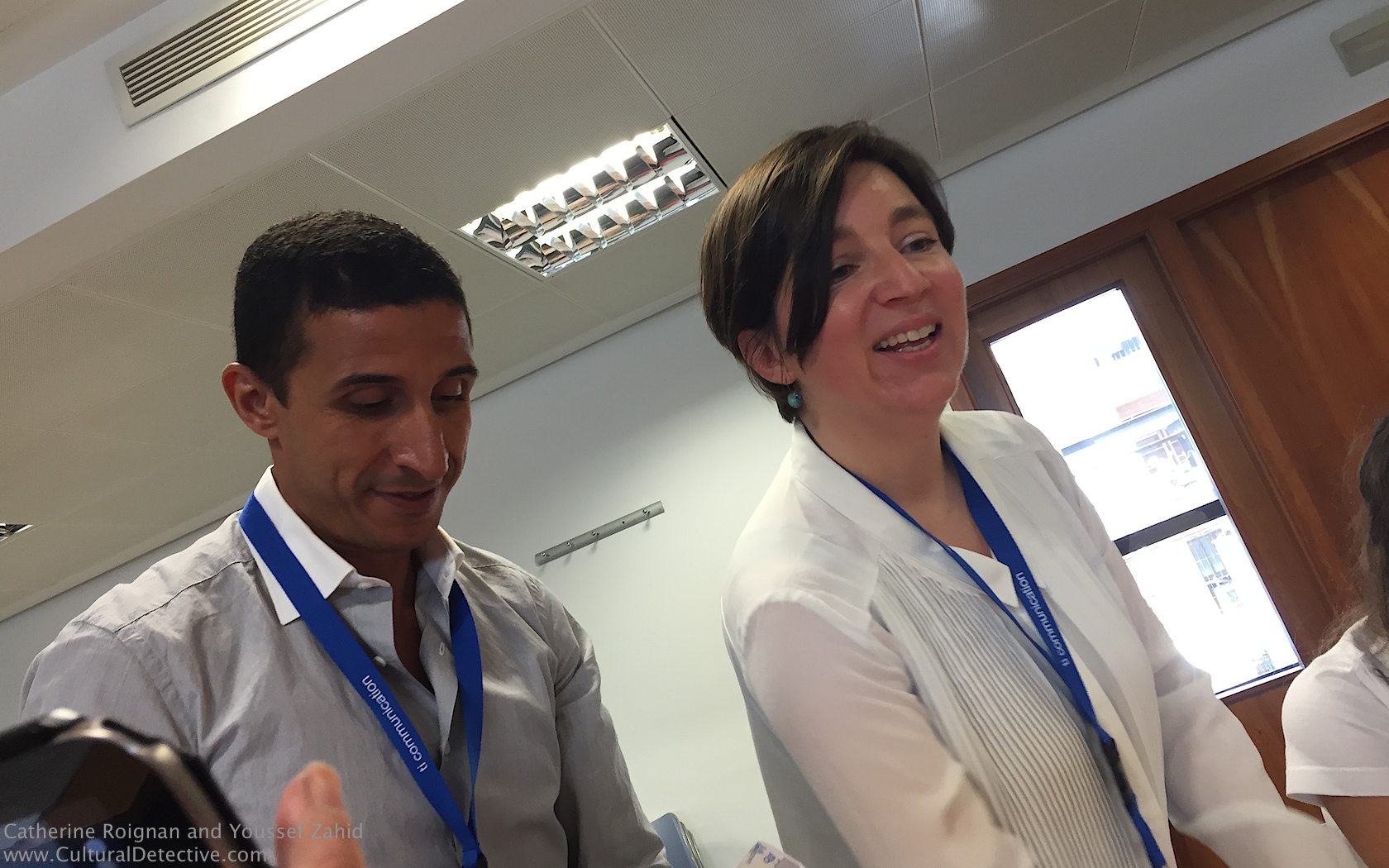
Catherine Roignan, co-author of Cultural Detective Morocco, conducted the game at the recent SIETAR Europa conference in Valencia, and it was my favorite session of the conference. Many people in the room had tears running down their cheeks, and in the days following we found ourselves often talking about the experience we’d shared.

The game is called On the Road with Migrants, and it was created by Caritas France, the Association des Cités du Secours Catholique or ACSC. At the conference we had only a brief 15-20 minutes to play, but it was remarkable!

Groups of us gathered at tables with game boards showing different continents of the world, including Africa, the Americas, Asia, and Europe. Each player had a pawn representing an immigrant, who was identified by name and story. We threw dice, drew cards and moved our pawns around the board according to the instructions on the cards and the dice.

Kudos to Caritas France for their brilliant work on this! It is a terrific game!

The materials are available for download free-of-charge; you print out the cards and boards, and add dice and pawns—1 die and 4 pawns (one color for each of four characters) per continent/board. Our SIETAR Europa group helped with the English translation—this is collaboration with a purpose!

Learn more and download the game in French, English, Portuguese or German: En route avec les migrants. I am leading a team that is translating the game into Spanish.

Please, share with us your resources and ideas for commemorating World Refugee Day and for building empathy for the migrant experience in this world of ours.

Rajel messouab ta hed ma y sed lou el bab. “All doors open to the person with good manners.”

morocco_purchWe are pleased to be publishing a wonderful addition to our series, Cultural Detective: Morocco. It’s perfect for those working with Moroccans, or wanting to do business in or relocate to Morocco. Perhaps, however, you are like me: you have seen tourist posters, watched Casablanca, eaten at Moroccan restaurants, and dreamed about visiting this seemingly exotic place. If so, then you will also enjoy wandering through our new package, even if you have no immediate plans to visit or do business in Morocco—at least not when you start reading the package!

One of the delightful things about Cultural Detective: Morocco is the feeling of almost participating in the culture that begins as you read the introduction. The oral tradition of Morocco is clear throughout the package, and the stories and examples show the hospitality and warmth of the people. To truly navigate successfully within Moroccan culture, you will need the advice of an inside perspective—a cultural informant—to help you develop and maintain the relationships and connections so necessary to doing business in this fascinating country. Cultural Detective: Morocco can provide you with that ongoing guidance, with ideas to save you from being unintentionally rude, and with suggestions that may help you communicate more comfortably and successfully with Moroccans. Click on any photo to enlarge it or view a slideshow.

Cultural Detective: Morocco has truly been a “labor of love,” coming to fruition due to the determination of two very dedicated professionals, Catherine Roignan and Youssef Zahid. Currently, one author lives in France and one in Morocco; both have a great deal of international experience, both have more than full-time jobs, and both have family responsibilities that take up every spare moment. In spite of these challenges, they wrote, revised, and wrote some more.

What is even more remarkable to me is that they wrote in French and then translated their work into English so I could read it. I made suggestions, did some editing, and then my suggestions were translated back into French for their consideration. (While the current version is in English, we will soon publish the French language version.) Of course, part of the authors’ discussion was also about Arabic words, as they explored the nuances of Moroccan culture and the particular choice of words used to describe it. This was a truly multilingual, multicultural creation process, weaving observations from inside and outside of the culture, and shifting worldviews as the authors worked to share the culture of Morocco with us.

One of the Moroccan values highlighted in the package is Daba baada (the present comes first): the only thing one can be sure of is today; one cannot know what tomorrow will be like, as things may change at any moment. We hope you will take the time today to explore this terrific new package, either via the PDF version or by viewing it as part of your subscription to Cultural Detective Online.

Ah Ha! I knew it! Bilingualism does pay!

benefits of being bilingual

“Not only are bilingual young adults more likely to graduate high school and go to college, they are also more likely to get the job when they interview. Even when being bilingual is not a requirement, an interview study of California employers shows that employers prefer to both hire and retain bilinguals.”
—Rebecca Callahan, Associate Professor of Bilingual/Bicultural Education, University of Texas at Austin

Those of us who have worked in and around international education think that learning more than one language is good for people. We think it helps open up the mind to other possibilities, other cultural points of view. We also believe that the “code switching” involved in speaking multiple languages helps develop skills that are useful in social situations and beneficial in keeping the mind sharp.

However, for years no data existed that supported the benefits of being bilingual. And for a long time in many US educational settings, children who did not speak English as their first language were not encouraged to keep their bilingualism. Why would you need a second language when you learned English? The benefits of being able to speak more than one language were not generally recognized in the US.

I was excited to read about some new research by Rebecca Callahan, Associate Professor of Bilingual/Bicultural Education, University of Texas at Austin. In a recent article in Quartz, she writes: “Speaking more than one language may confer significant benefits on the developing brain. Research has now shown that bilingual young adults not only fare better in the job market, but are also more likely to demonstrate empathy and problem-solving skills.”

What does this mean? For study-abroad students, it might encourage them to know that the effort spent in learning and using another language has long-term economic benefits—you are more marketable! This is, of course, in addition to the eye-opening, mind-expanding, life-altering experience of living in a culture different from your own.

For children of immigrants and refugees, it means that making an effort to retain their parents’ native language is beneficial. In reality, many immigrant and refugee children in the US serve as interpreters and cultural bridges from an early age. They are forced to be bilingual—learning English to be successful in the school system, while speaking another language at home. I remember one Cambodian mother telling me, through her son, that if she learned to speak English, her son would forget how to speak Cambodian now that he was here in the US.

“Currently, researchers have begun to use data-sets that include more sensitive measures of language proficiency to find that among children of immigrant parents, bilingual-biliterate young adults land in higher status jobs and earn more than their peers who have lost their home language.

Not only have these now-monolingual young adults lost the cognitive resources bilingualism provides, but they are less likely to be employed full-time, and earn less than their peers.”
—Rebecca Callahan

For many in the US educational system, acquiring a second or third language is not as highly valued as it is in many other parts of the world. I am always impressed (and a bit jealous) when I am around people who can switch among languages—often because they were required or encouraged to learn multiple languages when they were in school. And for a nation of immigrants, it seems strange that only one-in-four US American adults are conversationally proficient in another language, according to a recent Gallup poll. It reminds me of the old joke, so true that it is embarrassing:

Question: What do you call a person who speaks four languages?
Answer: Quadrilingual.

Question: What do you call a person who speaks three languages?
Answer: Trilingual.

Question: What do you call a person who speaks two languages?
Answer: Bilingual.

Question: What do you call a person who speaks one language?
Answer: An American!

Of course, this challenge isn’t just limited to US Americans. In an article last year in The Guardian, Vice-chancellor of Cambridge University, Leszek Borysiewicz, pointed out that one in six children in English primary school do not have English as their first language. He noted that their first languages:

“…are real languages: living languages that give people a huge insight into culture and give the children who can speak them additional opportunities.

Isn’t that what education is about – enabling every child to achieve the maximum potential? What I’d love to see is an emphasis that this is an added value that that child has, a talent, and we should aspire to allow other children who may be monolingual to strive to become as bilingual as they possibly can be.”

An article about a study conducted by researchers at University of Guelph in Ontario, Canada, indicates that merely knowing a second language can result in higher earnings. The researchers say that the results of their study, published in the journal Canadian Public Policy/Analyse de Politiques, has implications for bilingual policy in Canada:

“Efforts to promote French in the ROC [rest of Canada] should be continued, not so much because of the earnings advantage that bilingualism confers, but because it results in many social/cultural/political benefits, strengthening the fabric of Canadian society and serving as an example to countries torn by ethnic, religious and linguistic divisions.”

The cultural flexibility inherent in knowing two languages is a valuable ability and a resource to be cherished. If we are to move toward intercultural competence, we need the ability to think outside of our cultural box and explore other ways of seeing the world.

That is what we try to do with our Cultural Detective packages—provide insight into another view of the world, a small glimpse into a different cultural reality, a chance to perhaps understand, just a little, how others see us, and how to work together more effectively.

Are You an Expert?

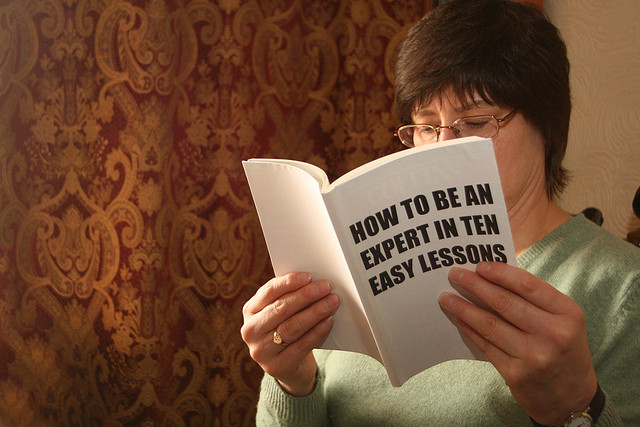
Clients want to hire experts. Are you an expert? I hope not! At least, not in the sense many of us traditionally think of “experts.”

Cross-cultural service providers need to be deeply competent in a variety of disciplines: intercultural communication, learning theory, the context of the organization or community, the people involved, etc. However, even though clients frequently push us into the role of “the expert with the answers,” assuming that role tends to be the wrong approach to building intercultural competence. That’s probably why I find the video below so amusing, and why Cultural Detective Facilitator Certifications focus on facilitation competence rather than information delivery.

Sure, cross-cultural effectiveness may require that we know how to tie a sari correctly, bow appropriately, or kiss the expected number of times. And we need to know the business at hand, e.g., the requirements of virtual teaming or methods of procurement—the specifics of what we’re involved in. It may require that we know how to draw red lines, as in the video. These things require information—a positivist approach. There may be a single “right” answer.

Most often, a client tells an expert what he wants, and then hopes the expert will simply “make it happen.” No need for the client to get overly involved; just leave it up to the expert. When a client (or student) asks an expert a question, they want a clear, specific answer—not “it depends.” Yet, in cross-cultural situations, so much does depend. “Correct” answers are contextual: how well do you know someone, are you meeting them socially or professionally, what country and region are you in, what social strata? Do you want to build market share or gain return on investment? Are you new to a market or have you been there for decades? What’s your reputation? A relativist approach allows for cultural and contextual differences—key to effectiveness and appropriateness.

While both positivism and relativism have their place in developing cross-cultural competence, the real change-maker is in a constructivist approach. The Japanese may generally do something a certain way, but that doesn’t mean an expat, immigrant, or visitor should or must do it that way. People need to find their way of being successful in a new environment—a way that works for them personally. True intercultural effectiveness requires client engagement, along with expert guidance.

Take my friend Doug. He is US American, and he has a loud and infectious laugh that he regularly engages in with a wide-open mouth and a slap on his leg. Most definitely not common Japanese practice, right? So, when he goes to Japan, do you take a positivist approach, and teach him a Japanese-style laugh? Will that be the key to his success in Japan? Do you compare Japanese laughter to US American laughter, or his friends’ laughter to his? In Doug’s case, when he moved to Japan he didn’t really adjust his laughter at all. His laugh is a core part of who he is, and most Japanese colleagues and friends love him for it. Sure, they may have been surprised at first. But his laugh is genuine, it’s him, and they understand that. Doug was highly successful in Japan, perhaps despite his loud laugh, but more probably, in part, because of it. He adapted his style in other ways.

Such is the constructivist nature of intercultural competence. Together, we co-construe, we “construct” our shared experience, and through that, we make sense of our relationships. Cultural Detective takes a constructivist approach. Yes, the CD Method contains elements of positivism (Values Lenses) and relativism (Worksheets), too, but they are used with the goal of learning about ourselves and others, and creating bridges that will enable each of us, and our organizations and communities, to be our best.

“The wise man doesn’t give the right answers,
he poses the right questions.”
—Claude Lévi-Strauss
French Anthropologist, 1908-2009

In dealing with a client that wants an “expert,” the clue to remember is what kind of expert you are. Effective intercultural facilitation is difficult, and we as facilitators do not have the “answers.” The “answers” reside in the client, the team members, community members, or key stakeholders. Our job is to bring the answers out, help make them known, help refine them so they are real and workable, and so that they enable intercultural effectiveness. This requires a high level of expertise: to help the client look inward and develop the answers themselves, when they are looking for a “magic” solution from an outside expert.

Learning opportunities to acquire good, effective intercultural facilitation skills are often hard to find. We are pleased to offer workshops that will help you gain and improve facilitation skills useful in intercultural contexts. Our Cultural Detective Facilitation Certification workshops are quite popular with both new and experienced facilitators, who always learn more than they expected. Three opportunities are scheduled this year:

  1. pre-conference of the SIETAR Europa Congress in Valencia, Spain,
  2. As part of the Summer Institute of the International Educators’ Training Program (IETP) at Queen’s University in Kingston, Ontario, Canada,
  3. And at the Summer Institute for Intercultural Communication (SIIC) in Portland, Oregon, USA. Click on any of the links above for more information or to register.

In addition, Daniel Yalowitz and I are offering a course at SIIC, “Gaining Gaming Competence: The Meaning Is in the Debriefing.” This experiential workshop focuses on current best practices and theories for creating, facilitating, and debriefing meaningful intercultural games, activities, and simulations. This is an excellent opportunity to gain a wealth of information in a short period of time. More information can be found here: http://www.intercultural.org/11.php.

Please join us for one of these upcoming events, to hone your intercultural facilitation skills to an “expert” level! In this way we can accomplish our shared goals of spreading intercultural competence to build understanding, collaboration, equity and justice in our world.

How Storytelling Affects the Brain

brainOnstorytelling OneSpot

I was recently tweeted this graphic, which research shows me is taken from a larger infographic on content marketing on OneSpot. https://www.onespot.com/blog/infographic-the-science-of-storytelling/

Storytelling is one of the oldest forms of both teaching and entertainment. It is the way history was traditionally recorded, how values were inculcated, and how families and neighborhoods bonded.

Storytelling is the core around which Cultural Detective is based. While the Cultural Detective Method is grounded in extensive intercultural theory, using Cultural Detective for development, learning, conflict resolution or team building involves listening to, telling, reading, or otherwise interacting with stories, or, in detective parlance, incidents. The debut of Cultural Detective The Netherlands involved a wine and hors d’oeuvres reception in Amsterdam, during which professionals acted out critical incidents for those attending. Trainers have turned their training rooms into theaters, acting out the stories in the Cultural Detective series with the learners. Why so much emphasis on stories?Why?

Let’s start by watching my interview with Kelli McLoud-Schingen, one of our CD team members, who is a professional storyteller and actress, as well as a dynamite diversity practitioner and interculturalist.

Storytelling does, indeed, link the head, heart and mind—an integration that is key to the development of intercultural competence. Interestingly for those working across cultures, however, science is now finding that stories help us to better understand others’ intentions and relate to one another better! My experience has shown that stories can help us to develop empathy, particularly with those very different from ourselves.

“There was substantial overlap in the brain networks used to understand stories and the networks used to navigate interactions with other individuals — in particular, interactions in which we’re trying to figure out the thoughts and feelings of others.

Scientists call this capacity of the brain to construct a map of other people’s intentions ‘theory of mind.’

Narratives offer a unique opportunity to engage this capacity, as we identify with characters’ longings and frustrations, guess at their hidden motives and track their encounters with friends and enemies, neighbors and lovers.”
—Dr. Raymond Mar, York University, Toronto

Furthermore, stories allow us to “practice,” even if in our own minds, how we might respond under various circumstances. Stories can “take us” to India, China or Brazil, and help us imagine ourselves in an interaction there, so that when we actually visit, it’s not as strange or confusing. Stories are a form of mental, rather than computerized, simulation.

“The brain, it seems, does not make much of a distinction between reading about an experience and encountering it in real life; in each case, the same neurological regions are stimulated. Keith Oatley, an emeritus professor of cognitive psychology at the University of Toronto (and a published novelist), has proposed that reading produces a vivid simulation of reality, one that ‘runs on minds of readers just as computer simulations run on computers.’”
—Annie Murphy Paul, The New York Times, “Your Brain on Fiction”

Finally, analyzing stories enables the learner to look at real people in real situations, in all their complexity—personality, age, gender, ethnicity, religious tradition, nationality—rather than as one-dimensional generalizations or stereotypes.

If you have not yet subscribed to Cultural Detective Online, or attended one of our complimentary webinars, you are missing out on an incredibly robust and affordable tool that includes hundreds of stories to support your learning! We hope to see you there soon!


SIETAR Europa, a Profile, Valencia, a New Book

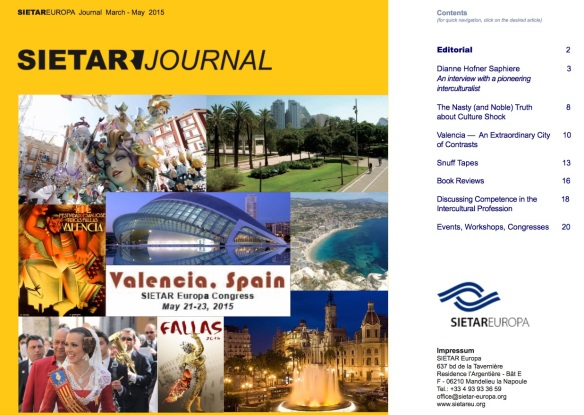
SE Journal coverThe March-May 2015 issue of the SIETAR Europa Journal is out today, and I thought some of you might want to take a look. Pari Namazie conducted a lengthy interview with me when I was last in Vienna, and it is published in the journal on pages 3-9. I find it flattering, embarrassing, encouraging and mortifying, all at the same time. It is humbling to have the honor to be profiled in this way. Thank you, Pari and Patrick Schmidt, editor. Perhaps it will give you insight into some of the experience that has contributed to Cultural Detective.

Also very important in this issue is news of the upcoming SE Congress in Valencia, Spain, 21-23 May. Please plan to attend! There are a wealth of terrific pre-conference workshops, including two focused on Cultural Detective, as well as incredible concurrent sessions, all in the gorgeous setting of Valencia. The full schedule is not yet posted, but you can register for the Congress now and then register later for any pre-conference workshops you want to attend. I hope to see you there!

Finally, I’m very excited that my old friend Joseph Shaules has published his much-anticipated book, The Intercultural Mind, and George Simons has written an insightful review of it on page 16.

You can find the issue of the Journal here.

Happy Thorri! Celebrate our new CD: Iceland package!

CD Iceland coverIt’s hard to believe that we have finally completed the Cultural Detective: Iceland package! This project spans more than five years, with some stops and starts. After working long hours in Iceland, in the USA, and on Skype, the emphasis was always on finishing what we started with high quality. We were both certain that, in spite of our busy work schedules, other duties, and familes, it would sort itself out, and we would manage to complete this project.

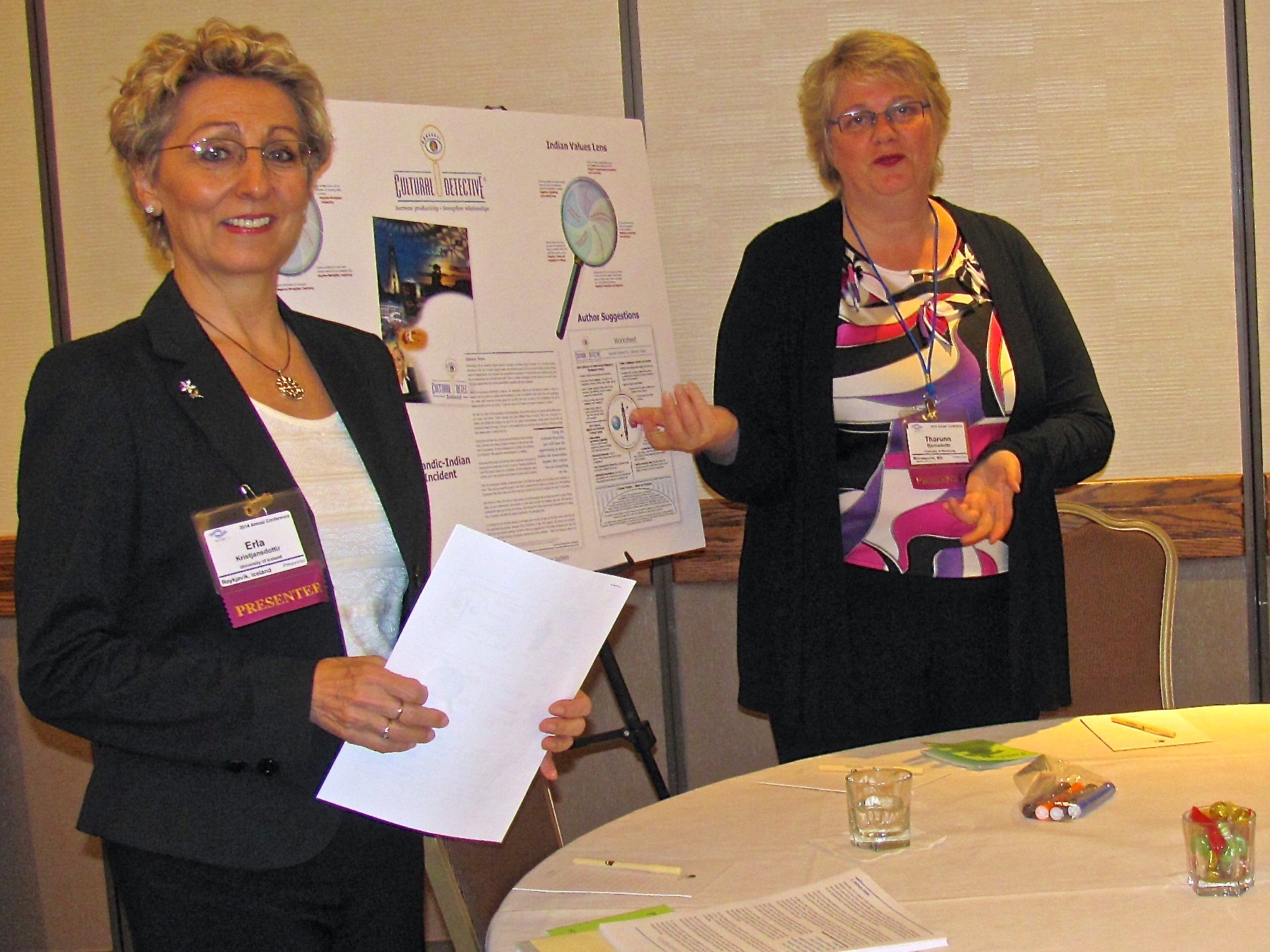
2014-10-23 12.10.15

Erla on the left, Thorunn on the right

We were introduced to each other on a beautiful sunny day in Iceland in 2008, and that very day Thorunn asked Erla if she would be interested in collaborating on the Cultural Detective: Iceland project. We immediately “clicked” and decided to meet again and discuss the idea of working together. Throughout this collaboration we learned a lot about ourselves, about each other, and about our culture and what it means to be an Icelander. Through thick and thin, stressful moments, a lot of laughter, travel between Iceland and North America, we established a wonderful friendship for life.

It is perhaps fitting that Cultural Detective: Iceland is announced on Facebook during Thorri season, when Icelanders celebrate in ways no one else in the Western World celebrates: by eating fermented food and using anise or caraway-flavored snaps to help swallow it!

Þorrablot dinner

Þorrablot dinner

This mid-winter season in Iceland is called Þorri (Thorri), and according to the historic Icelandic calendar it starts on January 23rd with Húsbóndagur (Husband Day) and ends on February 22 with Konudagur (Women’s Day). At this time of year, Iceland is cold, dark, and windy. But because the sun rises at about 9:30 am in the morning, it is a whole lot better than in December, when it rises at 11:30 am—so it is time to celebrate as a way to get through the Thorri season! The celebration is called Þorrablot or celebration of the Nordic God Þór (Thor).

These parties are usually attended by people belonging to the same social group such as a fireman’s association, an association of people from a particular fjord, or people who work for the same company, etc. The entertainment varies from a stage performance, to a comedian as Master of Ceremonies, to people making speeches and reciting Icelandic poetry, and usually ends with lots of dancing and singing of national songs. The staple foods at these parties are pickled ram’s testicles, boiled sheep’s head, blood sausages, liver pudding, smoked and cured lamb, and dried fish. Some people have to be “manned” into eating these things, and some parties have these delicacies as side dishes rather than as the main dishes.

Below is a video of Þorrablot at CCP, an international company headquartered in Iceland. A new employee from Denmark has been invited to this celebration. Can you imagine his culture shock?!!

So how do we translate our wonderful yet, at times, strange culture into a manageable frame for others to understand? This was our task as co-authors. It was not easy, but surprisingly rewarding. After interviewing foreigners living in Iceland, and Icelanders working abroad, we began to see the values system emerge.

We struggled quite a bit about which values to highlight through the Icelandic Values Lens. The more we talked to people, the clearer it became to us that Icelanders hold their language as central to the culture. So strong is this value that Icelanders believe that for anyone to be able to work in Iceland, even in menial jobs, they need to learn the language. To support this value, Icelandic companies who hire foreigners generally offer Icelandic lessons during the lunch hour.

Every culture has some things that cannot be translated. In Iceland, one of those things is the phrase, “þetta reddast,” literally translated into English as “it will work out.” However, in English, this phrase seems more of a hope than a reality. In Iceland, we understand the phrase to really mean “things will sort themselves out” and, in the end, they always do, somehow.

Because immigration is making the country more diverse and the travel industry is growing, there is a definite need to enable Icelanders to be more open and knowledgable about cultural differences and gain cultural competency. In addition, Iceland’s economy is export-driven and becoming more integrated into the world economy, so it is important for outsiders to learn how to work with these very direct, honest, and hard-working people with a great sense of humor.

Cultural Detective: Iceland is now included in Cultural Detective Online and also available in a printable PDF format. We are looking forward to using CD: Iceland in universites, companies, organizations, and any place people want to learn about our culture. If you get a chance, we hope you will visit our beautiful country. Meanwhile, we encourage you, a curious Cultural Detective, to learn about Icelandic culture by exploring the new CD: Iceland package!

Vinnan göfgar manninn. “Hard words break no bones.” (Icelandic Proverb)

CD Iceland coverI have the best job in the world: working with our Cultural Detective authors—I always learn so much! Recently, I had the pleasure of working with our authors on the Cultural Detective: Iceland package—the most recent addition to the CD series. This is a culture I know nothing about, therefore, I had no preconceived notions about how it would be to work with these bright ladies, or what I would learn.

Fortunately (from my US American point of view), being direct and straightforward is generally considered being honest, and is highly valued in Icelandic culture. When discussing a topic, everybody tends to share ideas (without evaluation) and then the best course of action is chosen. Questions are answered directly, and disagreement usually is not considered a personal attack. To those from a less direct culture, this style of communication may feel rude and blunt, while to Icelanders it’s just contributing their ideas.

The authors shared a delightful example of language and culture being intertwined: Icelanders do not use the word “love” as US Americans do. Their word for love is used in relation to family. It is a “very expensive/high value” term with a special use for a special purpose. Therefore, the use of “love” was very confusing to our authors when they first arrived in the United States. They were surprised that people loved their pets, loved ice cream, loved a movie, etc. In contrast, one of the authors told me that if her husband ever said he loved her, she would know she was dying! She told me, “Icelandic husbands love their wives so much that they almost tell them!”

This relatively small country (population 320,000) has seven universities, the oldest parliament in the world, and dynamic, high-energy, optimistic people. We look forward to introducing you to CD: Iceland, and a culture whose Viking roots impact the freedom and respect for the individual that are the heart of Icelandic values today. Be sure to check it out, put it to good use, and let us know what you think!

Four Steps to a Happier Life: Actions Don’t “Create” Reactions

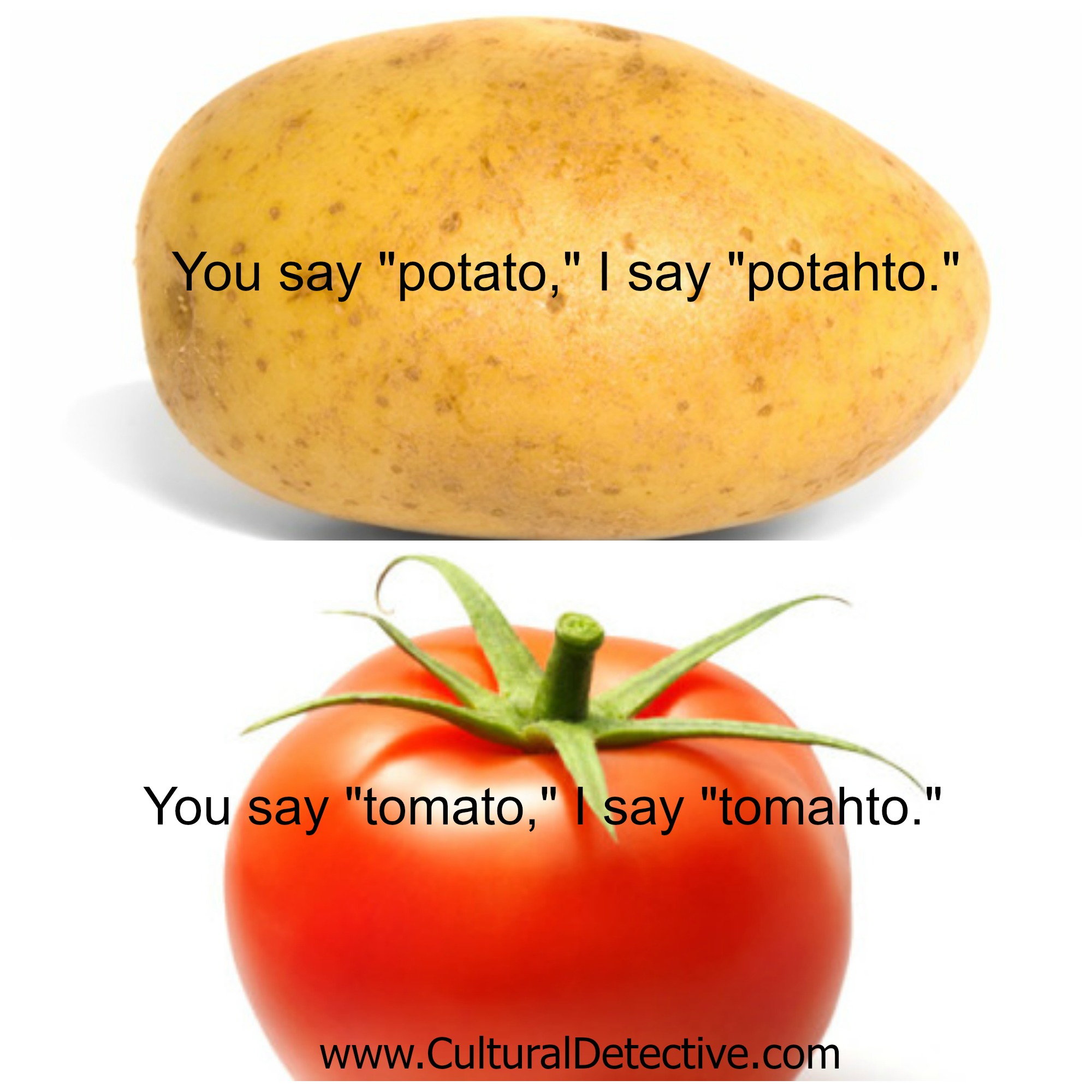
Potato-PotahtoDuring our monthly webinar, attended by people working in academia, NGOs, private enterprise, and a religious community, and geographically from Russia to Egypt to the USA and quite a few points in between, one of the participants summarized for us what she had learned. Cultural Detective had taught her, she said, “that actions don’t ‘create’ reactions; interpretation of actions creates reactions.”

Yes! That is brilliant and powerful learning! And it is crucial to understand this idea if we are to develop intercultural competence. It is a prerequisite to implementing the four steps to a happier life.

“Actions don’t ‘create’ reactions.
Interpretation of actions creates reactions.”

Your Story/My Story
To understand the concept better, think about a time when you had a painful miscommunication with someone, the type of miscommunication that haunts you for days or longer. The example I’ll share with you involves a family member, but yours might involve a friend, family member, important client, or colleague. Got your example? Okay, here’s mine.

Recently, a family member took exception to a text I sent him. It was classic miscommunication. He felt I had jumped to conclusions about him, specifically, that I had falsely accused him of wrongdoing. His negative judgments and assumptions about me made me sad. This is common; there is a downward spiral that so often happens in miscommunication. We want our family, friends, colleagues, and clients to give us benefit of the doubt, to assume we have their backs. It is upsetting when, instead, they think the worst of us.

Communication is a shared process. We send our messages and usually assume that the receivers of our messages understand us. But does our intention, the meaning, as conveyed by our message match the other’s interpretation? This, of course, is the crux of successful communication!

Think about your own example. What happened? How did each of you perceive the miscommunication? How did each of you feel? What was the outcome?

My relative’s upset was real, as was mine. We can’t and shouldn’t deny our feelings and our reactions. Yet, it was especially important to me that, as a family member, we not feel negatively toward one another. One good outcome of the exchange was that I learned something new about him, and now understand an area of sensitivity for him. That knowledge will inform my future interactions, and hopefully help me to communicate with him in ways he finds more supportive. I am confident that he learned something that will inform his future communication with me, as well.

So, did my text “cause” him pain? Did his response “cause” me sadness? Did our differing communication styles “cause” frustration? No, of course not! It is the manner in which we interpret differing communication styles that can cause us frustration and can waste our time, energy, enthusiasm and resources. Your mother may have told you when you were young that your friends can not make you angry; it’s your choice to become angry or not. Differing communication styles can actually strengthen teamwork, and they can add delight to friendships.

Now, think about your example of miscommunication. Did your behavior “cause” negativity for the other person? Did their behavior “cause” it in you? Or, rather, was it the way each of you interpreted the other’s behavior—the meaning you gave to it—that caused the grief?

In my example, there was no negative energy or assumption embedded in the initial text; I had no thought of accusation. Many times, however, our innocent actions result in hurt feelings or negative perceptions, just as they can also help people feel good. In hindsight my text could have been worded better. A lengthier, more explicit text from me (or, better yet, a phone call) may not have “caused” the reaction it did.

However, it was not the text itself but, rather, my relative’s interpretation of the meaning behind my text, that provoked his reaction. We cannot control how others will perceive us, though we can do our best to improve our communication skills. The distinction between behavior causing a reaction versus our interpretation of the behavior influencing us to react in a certain way is an important distinction for cross-cultural and intercultural communication effectiveness.

THE FOUR STEPS TO A HAPPIER LIFE
So, what are these four steps to a happier life, to improving your communication with others?

Step One
The first point to remember is that miscommunication happens—every day, even between loving couples, family members, and friends. How much more frequently can miscommunication happen, then, between strangers or those who come from very different cultural backgrounds?

When we find ourselves in an uncomfortable communication situation, we need to remember not to place blame. It’s happened; miscommunication is natural and normal. But we can use it as a learning opportunity—a chance to understand more about ourselves and others.

Step Two
As the Cultural Detective Method shows us, when we find ourselves involved in miscommunication, or feeling a bit frustrated or judgmental, we are wise to take a look within ourselves. What are my assumptions? What beliefs am I using in my interpretation of events? What does the way I feel tell me about what is important to me? What values do I hold in relation to this situation, and how do I link them to appropriate behavior?

Our past experience and “common sense” (really “personal cultural sense”) cause us to interpret actions in certain ways. Becoming aware of those filters, the ways we view the world, can help us know ourselves better, to be better able to understand and anticipate our own responses, and better able to explain ourselves to others.

Step Three
Once we’ve taken a look into ourselves, it’s time to try to put ourselves into the shoes of the other. Even though we might perceive behavior as negative, let us temporarily, while we think this through, give the benefit of the doubt. What might be other, positively intended reasons that the person did what they did?

Of course, I can also consider whether I know this person to “have it in” for me. Does this person have a history of attacking me, or of acting unprofessionally? If not, the above “positive intent” exercise becomes even more important.

Step Four
Finally, it’s time to reach out and take action to resolve the miscommunication. Preferably,  this includes a combination of apologies for discomfort, questions that seek to understand, explanation of intent, and summary of what has been learned. It should, also, ideally culminate with a path forward: how we’ll try to communicate more effectively with one another from this point on.

Looking at the above four steps, you will see they incorporate the three capacities that the Cultural Detective Model teaches us:

  1. Subjective Culture: Knowing ourselves as cultural beings
  2. Cultural Literacy: Empathy and the ability to “read” the intentions of others
  3. Cultural Bridging: The ability to bring out the best in ourselves, others, and the organization or community

If you haven’t yet joined us for one of our monthly webinars, please do. Those attending receive a complimentary three-day pass to Cultural Detective Online, a tool that can help you integrate these four steps so that they become second nature in your daily life. And, please, share the invitation with your friends, colleagues, and clients! Let’s make this world a happier and more interculturally effective place!

Part of the #MyGlobalLife Link-Up