Sample Half Day Global Competitiveness Program Design

Many of us have found ourselves in the difficult situation in which people ask us to equip others to be cross-culturally effective and globally competitive – and then give us just a few short hours to do so.

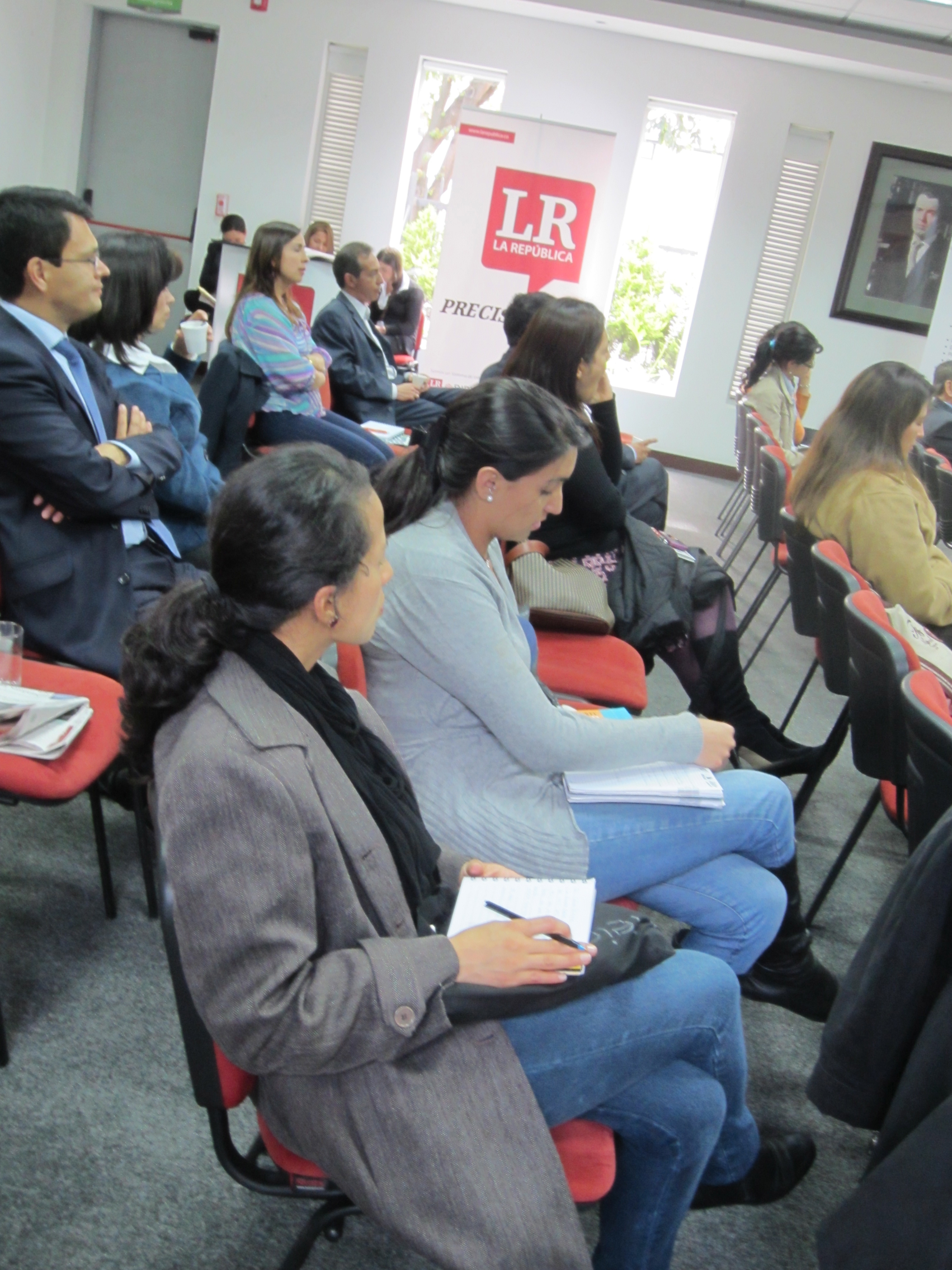
Such was my task recently in Bogotá. The Colombian government had just signed a Free Trade Agreement (FTA) with the USA, and I had been invited to work with a lawyer and a business consultant, so that the three of us could, in five hours (ok, we started a bit later than scheduled, so really 4-1/2 hours), better enable local businesses to make the most of this new opportunity. My colleagues were excellent, and thanks to terrific teamwork and generous sharing of expertise, we were able to take a very diverse group of enthusiastic participants a long way in a short time.

I thought some of you might find the design useful for adapting to your own needs.
Session Title: Global Competitiveness and Productivity

Advertised Session Objectives: Learn how to make the most of the new FTA, how to conduct business at international levels of quality and competitiveness, and how to negotiate effectively with US Americans.

Advertised Session Components: Legal context of the new FTA, negotiating with US Americans, and global business ethics.

OUR DESIGN
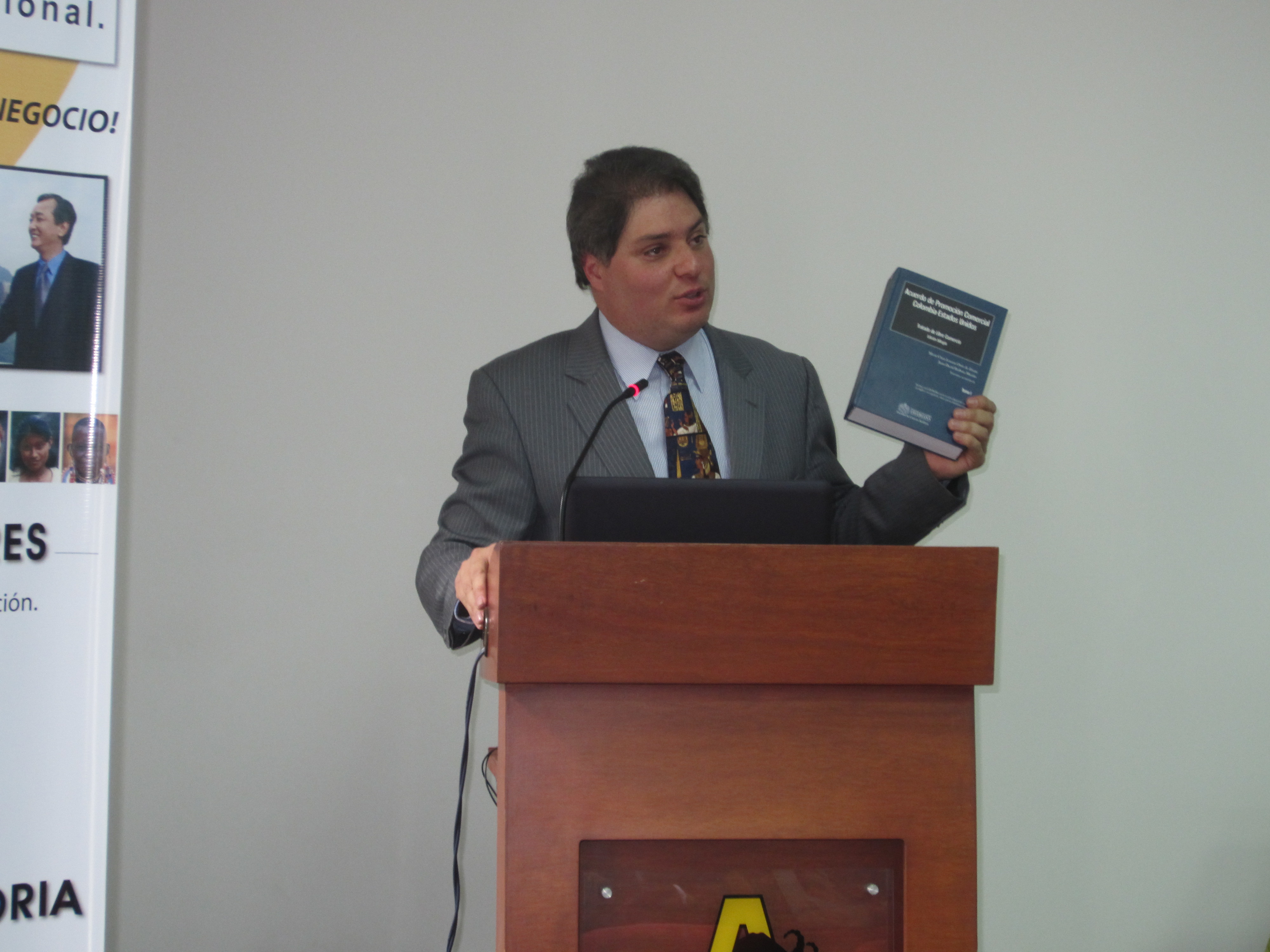
Legal Aspects of the FTA – one hour

First, a very talented international lawyer, Andrés Forero, based in Bogotá, walked us through the various aspects of the new FTA, including a summary of the opportunities it presents for Colombian businesses. This was a most interesting session; Andrés knows the FTA inside and out, and he knows Colombian business. He took the complex and made it practical and understandable. He motivated those in attendance by explaining about the huge opportunities. And he also scared us a bit, telling tales of cross-cultural failures that he’d witnessed. Of added interest was the fact that he had been involved in translating the text of the FTA into English, and showed the full two volumes to the public for the first time ever.

Negotiating with US Americans – 2 hours

The extremely talented business consultant with whom I was working, Ing. Fernando Parrado, and I decided that we needed to just “jump in” with this group and immerse them in a case study of a typical Colombian-US negotiation. So we did. We told the story, and we debriefed it using the Cultural Detective (CD) Worksheet. This took about 45 minutes.

Once we had the Worksheet completed, we urged the participants to reflect on what they had done. They saw two different world views, two different approaches, both “correct” and both with value. They saw connections between actions and values, and that values and beliefs motivate behavior. And they saw that really effective strategies use the resources provided by all parties. This took another 10 minutes.

From there we introduced the three intercultural capacities on which Cultural Detective is premised (subjective culture, cultural literacy, cultural bridge), and then reviewed instructions for using the CD Worksheet/the CD Method properly. This took another 15 minutes or so.

Focusing on the US American values section of the now completed Worksheet, we began talking about what is important to US Americans. We defined the concept of culture, cultural diversity, and cultures such as regional, ethnic, socioeconomic, gender, and generational. We made sure participants understood that when we generalize we want to talk about central tendencies of a group of people. We don’t want to stereotype, to “box” an individual into the central tendency of the group.

Then we introduced the concept of a Values Lens: that there are core values or central tendencies of a group of people. And that for each value there is a negative perception, that is, a way in which it can be viewed negatively by those who do not share the value or its expression. I told the participants, as I always do, about the danger of the Values Lenses. I cautioned them not to use them as yet another box into which to fit people, but rather as a tool for discovery, as clues for analysis. The values might apply to the situation, or they might not; they are a guide, a place to start.

These last two items took another ten minutes. It was quick. We covered a lot of territory in a short amount of time.

From here we introduced the US American Values Lens, sharing sample behaviors for each value, and sample negative perceptions. We asked participants if the Values Lens provided them any further clues to understanding the behavior of the US American in the case study, and indeed it did. Participants shared their stories of working with US Americans, and we were all able to learn from one another. This part took about 30 minutes.

Then we took a short break to eat some wonderful cheese-filled pastries and drink some of the famous Colombian coffee.
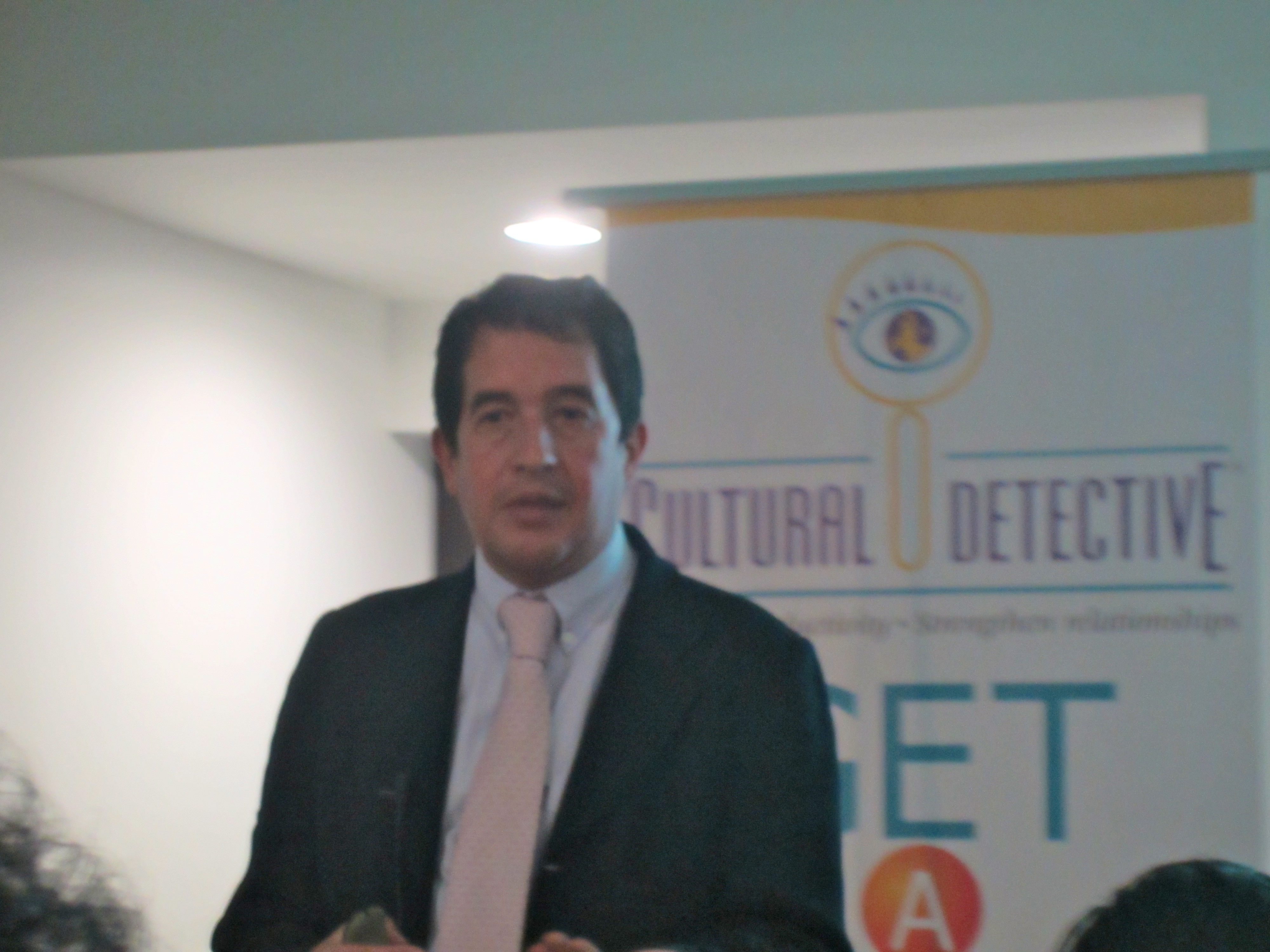
Understanding Colombians – 45 minutes

We came back from break ready to experience the debut of Cultural Detective Colombia. And what a debut it was! Fernando walked us around the Colombian Values Lens, sharing a story about each value, and explaining how to use it as a strength in working across cultures and making the most of the Free Trade Agreement. He also explained the Negative Perceptions for each value, again with illustrations, and positioning them as skills or competencies to develop when working internationally, at global standards.

Participants, who came in feeling that they had to “change” in order to be successful, now glowed with pride that they already held within them a heritage to be proud of, and onto which they could wisely add cross-cultural competence.

We again asked the participants if the Values Lens provided any further insight into the critical incident, and they found that it did. They enthusiastically declared the accuracy of the Colombian Values Lens. I felt very fortunate to be present for its debut.

This portion took about 45 minutes. While it was not requested by the client, it was an aspect we knew was very important if the participants were to achieve their objectives.
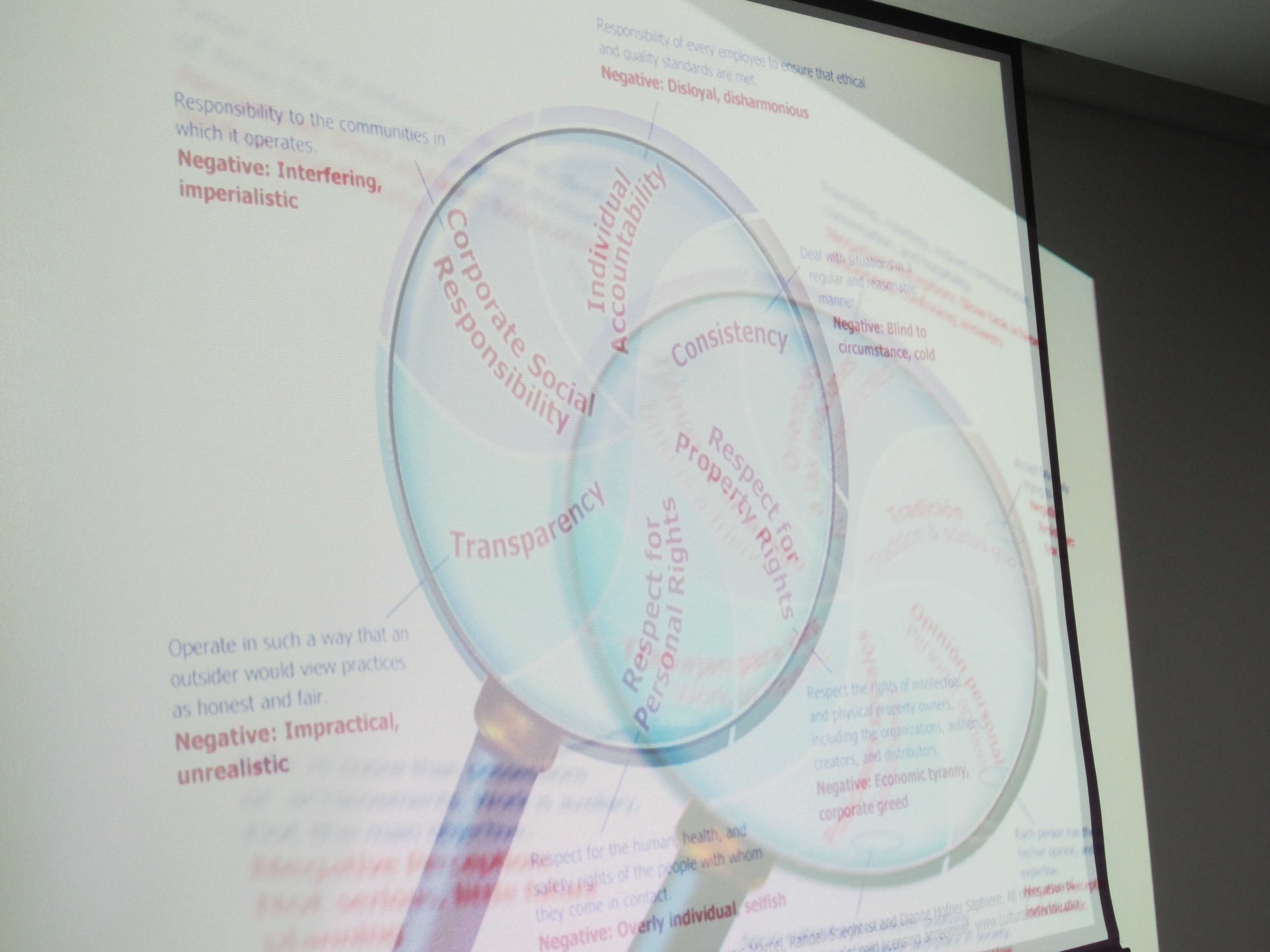
Global Business Ethics – 20 minutes

I am not an ethics professional, but the Cultural Detective Global Business Ethics enabled me to be able to define the topic of ethics in an understandable way. More importantly, I was able to explain the difference between compliant and ethical behavior, and the grey areas created by cultural differences: an action might be “non-compliant” yet seen as the ethical or right thing to do, or an action might be “compliant” but seen as unethical or wrong from a cultural perspective.

With the help of Andrés, our lawyer, we introduced the CD Global Business Ethics Values and Negative Perceptions, using real-life examples. We then asked participants if the values from this ethics lens provided further insight into the Colombia-US negotiation case study. Indeed it did! We also asked them to overlay the Colombia Lens with the Global Business Ethics (GBE) Lens, and the USA Lens with the GBE Lens, and the huge contrasts were apparent. They saw the difference that culture makes on perceptions of right and wrong. Unfortunately we were only able to spend about 30 minutes on this portion.

Personal Values Lenses – 30 minutes

Why such a short time on Global Business Ethics? Because I knew that, if these people were to succeed in global business, they also really needed a grounded understanding of who they were as individuals. Thus, we gave participants about 15 minutes to fill in their own Personal Values Lenses, using an exercise and Lens from Cultural Detective Self Discovery. They could then easily compare their Personal Lens to the Colombian Lens and the USA Lens, as well as the GBE Lens.
In closing, we passed out laminated copies of the 75 or so Lenses in the Cultural Detective series, so participants could get a feel for how they might adapt their approach to a German or an Israeli or South Korean marketplace.

All in all, it was a very fast romp across a very broad territory. But, oh, the insights the participants gained! They left the room in the evening standing tall and looking enthused, which I tend to take as a very good sign.

Fernando and Andrés, thank you so much for this opportunity to work with you both in this way. It is not often I have the pleasure of working with people for the first time and we are able to find such synergy of talents; it was truly a privilege and a joy!

Everyone: what do you think of this design? What are your strategies for doing the impossible in a very short amount of time? I’m eager to hear!
Going Global: International Expansion Strategies

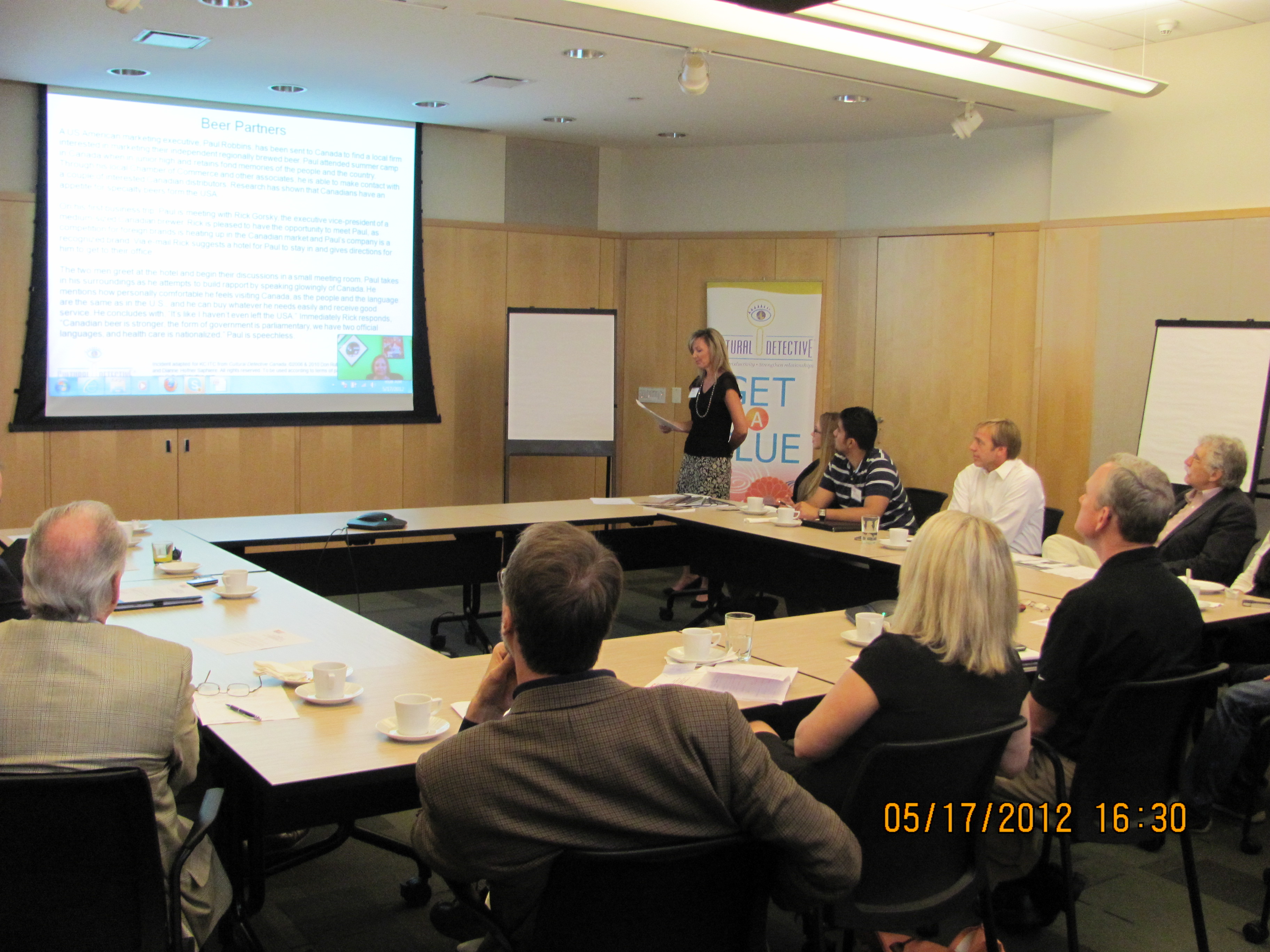
I recently had the opportunity to co-facilitate a Kansas City International Trade Council workshop focused on global expansion with Dianne Hofner Saphiere (via Skype from Mexico) and Janet Graham, who is currently a Baker University adjunct professor of International Business, Marketing, and Economics. We had a diverse group of business professionals, university professors, independent consultants and college students who actively participated in the workshop held at the beautiful Kauffman Foundation facilities.

Janet Graham brought a wealth of knowledge, discussing the various entry strategies when considering expanding globally. Some key decisions organizations must make in order to form a clear market entry strategy that she referenced include: which market to enter, when to enter the market and on what scale, and which entry mode to use? Great questions to which she provided some resources (such as globaltrade.net, globalEDGE, and WorldoMeters) to help direct the decision-making process. She quoted a local business leader from Hill’s Pet Foods who said the countries in which they have been most successful they’ve had a dedicated local distributor who markets and sells their products – and the relationship is key!

We then got to have fun bringing culture into the picture! Dianne pointed out that culture touches all parts of the strategy – communication, negotiation, competitiveness – and will ultimately affect how successful your business can be at expanding globally. I had the opportunity to showcase the Cultural Detective Method with the group by working through a global expansion incident involving a local specialty beer manufacturer exporting to Canada. We ended with an activity that tied the learning together by incorporating Values Lenses into developing strategies for expansion. The workshop was quick and to the point but brought together some true experts in the field and real world application of the Cultural Detective tools to meet local business needs.

The International Trade Council of Greater Kansas City was a gracious host and sponsor for the global expansion workshop – have you checked within your local community to partner with such organizations? It’s a great way to link the cross-cultural skill development to relevant community and business needs!

PTPI Americas Regional Meeting 2012

As I had just finished facilitating the PTPI (People to People International) workshop and entering the elevator with some PTPI attendees, I was pleased to hear a funny comment by one participant: “I am so glad this was about developing cross-cultural skills as I was afraid we might be participating in some sort of scavenger hunt!”

Well, it was in fact a hunt in some ways – we searched for clues about what motivates our friends and colleagues to behave the way they do and what motivates us to act and react the way we do!

Key learnings from group wrap up were described as:

  • Seek to understand others values and what’s really motivating their behavior
  • Look for similar values and use those to collaborate
  • Appreciate differences
  • Incorporate the strengths of all team members – there is no “right way” to get things done
  • Show up with an open mind

The PTPI Cultural Detective session was designed to help the PTPI  community members and their board of directors with strategies to improve their diverse recruiting – and it was received very positively with a quick post, “Incredible Presentation by Cultural Detective,” and the above photo from Liz Wegman, PTPI staff member. We had a group of about 35 PTPI leaders in attendance from all over the country and world who will return to their communities with fresh perspectives and strategies around building more diversity in their chapters.

Although diverse recruitment is not typically how I lead into discussions around working with the Cultural Detective tools, it certainly was an applicable organizational need which developing intercultural competence can help solve. Has PTPI’s unique application of the Cultural Detective approach spurred some ideas for you to assist your or your clients’ specific intercultural challenges?

Oldie but Goodie: Map of Key Cultural Differences

Intercultural communication is about how we can communicate effectively with one another. A frequent approach to improving intercultural communication is to develop our understanding of ourselves and of others. And probably the most common way of doing that is to teach about cultural differences, often referred to as the “dimensions of culture.”

There are many different versions of the dimensions of culture. I generally find them valuable as tools to help us compare cultures, or to cognitively learn about ourselves and others. And I also find they really limit us. While not intended this way, their use has a tendency to reify culture, to cause us to think about culture as a “thing” rather than a process. It’s why I’m such a fan of the Cultural Detective Worksheet: it’s a process for understanding self and others, for leveraging similarities and differences in order to collaborate in more innovative, rewarding, and satisfying ways.

Enough about that. This post is about cultural differences. In my training one of the ways I talk about cultural differences is to ask people to think of them as a map of the terrain, and to use them as a scanning tool. In a given interaction, which difference(s) got in the way? For example, was status important for her and not for me, and I just missed it? Was it a different sense of responsibility that really upset me? Maybe he likes to do several things at once, and I’m more one-thing-at-a-time? Was it the fact that I don’t think religion belongs in the workplace that caused him to think I’m not trustworthy?

That is how the map above came to be. It is a graphic summary of some of the cultural differences or dimensions, at least as I saw them back in 2008. It is available for you to use freely under a Creative Commons license. You can introduce the various cultural differences to your team and then, when you get mired in cross-cultural miscommunication, you can take out your map of differences and decipher just which dimension might be causing the problem. Or, maybe it’s something not even on the map.

Just click on the link above for a larger image, and to download the accompanying 11-page article entitled, “Detecting the Culprits of Miscommunication: Values, Actions and Beliefs.” Please feel free to copy and distribute, as long as you retain the copyright and source url.

I’m really interested to hear from you about how you use the dimensions of culture to promote effective interaction. What are your tools and techniques? Your dos and don’ts? And what do you think about this “map of the culprits of miscommunication” idea?

Why is Intercultural Competence Helpful? The Case of the Ion Exchange Resins

Is there a bottom-line business benefit to intercultural competence? As someone who has lived and breathed cross-cultural and intercultural business competency for well over thirty years, that question tends to elicit a chuckle in me. And today, the person on the phone who asked me that question reminded me of a story.

You see, just yesterday I received an invitation to an “OB-OL-kai” in Japan, a “get together of Old Boys and Old Ladies,” a reunion of a group of colleagues that I miss terribly and would love to party with, again, face to face. We went through a lot together. They are some of the most talented professionals I’ve had the pleasure of working with in my career. And a few members of that group were involved in the story I’m about to tell you:

Cultural Detective and the Case of the Ion Exchange Resins

We worked for a multinational business that globally sourced ion exchange resins. IERs are small beads used to separate, purify or decontaminate; they are used to make ultra-pure water, for example. Don’t worry about the technicalities; this story focuses on how the people worked together.

In this case, the IERs were produced in southern France, at a facility that was one of the absolute best in the world. My client imported the IERs to Japan, selling them primarily to the semiconductor manufacturing industry.

The Japanese customers had extremely high quality standards, and the French-produced IERs consistently met all the customer’s requirements. The product was well within spec. But, the Japanese customers were worried: occasionally the IERs they received from France would vary slightly in color. One shipment might arrive quite clear, the next shipment more yellow or orange. Always the specifications were met. The IERs functioned to their purpose. But the color varied.

“The color doesn’t matter,” the French vendor explained. “The color has absolutely no impact on the performance of the IER.”

“Yes, that is true. We understand that color does not affect performance,” came the reply from the Japanese customer. “But we are concerned about why there is a color variation? We feel it must indicate a variance in the production process itself. There must be some variable in production that is not consistent and could be improved.”

A classic cultural gap: a focus on result vs. a focus on process. Does the product perform as required? Or do we look at continuous improvement of the production process itself?

In this case, the argument could quickly produce a stalemate, with both supplier and customer insisting their view is “correct.” The French could insist that their IERs are the best the customer will find. As long as the customer doesn’t find an equivalent product, that could be ok. But, it’s not a very good answer on a global stage, where there always seems to be another supplier waiting in the wings, with cheaper cost, easier shipping, or more commitment to listening to the customer.

Possible results of the vendor insisting that color doesn’t matter?
  • Lost customer (and this was a lengthy and very lucrative relationship),
  • Lost business/profit/cash flow,
  • Lost investment in developing this customer,
  • Huge reinvestment to develop a new customer of the same caliber,
  • Loss of opportunity to improve their product and their production process,
  • Not to mention the human aggravation.

The Japanese, in turn, could blame the supplier. “They are not committed to being the best they can be. They are resting on their laurels, on their prior success. We need suppliers who strive to maintain their leading edge. We need a supplier who listens to us and respects us.”

Possible results of the customer insisting color variation matters?
  • Diminishing trust of, communication and collaboration with the vendor, leading to
  • Loss of a strategic vendor,
  • Loss of the investment in selecting and developing the vendor,
  • Huge reinvestment to source and develop a new vendor,
  • Major time and financial commitment to establishing a relationship and educating a new vendor regarding customer needs, in hopes that the new relationship might become a strategic partnership.

I have seen this push-pull occur so often in my career. It frustrates those involved, it causes aggravation, it wastes time, and it wastes money. Take a moment to put some money to the points above, to calculate the “bottom-line impact” of such a simple cross-communication. In this industry, it is easily in the millions of dollars. And why? Due to pride, to arrogance, but mostly due to ignorance: not really understanding cultural differences and how to navigate them effectively.

And what might an interculturally competent solution look like? We know it involves multi-directional bridging, and systemic as well as interpersonal solutions. And, usually, such interculturally competent solutions are win-wins for both customer and supplier.

How so? Well, the vendor could listen to the customer, learn from the customer, even though the customer’s points don’t pertain directly to the product performance. In this way, the vendor would:
  • Strengthen trust and teamwork with the Japanese customer,
  • Could very well improve the quality of its manufacturing process, which in turn
  • Could help ensure it remains best-in class.
  • The customer will refer more customers to the vendor, due to the strong relationship with and excellent quality of the vendor, and the vendor’s global markets will grow.
In turn, the customer could voice its praise for the vendor’s quality, and explain that it’s intentions are collaborative and collegial; to help both vendor and customer be the best they can be. The customer could apologize for the hassle, and offer its process expertise to the vendor. In this way, the customer would:
  • Strengthen a very lengthy and very strategic vendor relationship,
  • Improve the cross-cultural skills of its staff, enabling them to partner more effectively with other vendors,
  • Improve the customer’s reputation in the global marketplace, as one of collaboration and loyalty.

Thus, the French and Japanese could work together to manufacture more color-consistent IERs, grow their global markets, strengthen their partnership, improve their employees’  skills, and polish their reputations in the marketplace. Win-win-win.

In real life, what actually happened was somewhere in between. These people were smart enough to hire a full-time intercultural consultant, after all, which I believe is one demonstration of their commitment to success. They got advice, and they did their best to put it to good use. They realized that intercultural competence is a lifelong process, contextually based, and strived to always do a bit better. It’s one of the reasons I want to travel halfway around the world to go to that OB-OL-kai!

What do you think? I would love you to share with us why you believe intercultural competence is helpful? Do you have a Cultural Defective or Cultural Effective case to share?

People To People International Working with Cultural Detective to Diversify Chapter Recruitment

Over the past several years I have enjoyed developing a professional and personally meaningful relationship with the People to People International organization (PTPI). For those of you who are not familiar with PTPI, the organization was founded by President Dwight D. Eisenhower in 1956 and is now run by his granddaughter, Mary Jean Eisenhower. Their mission is “to enhance international understanding and friendship through educational, cultural and humanitarian activities involving the exchange of ideas and experiences directly among peoples of different countries and diverse cultures.” They are a dynamic group of dedicated staff and thousands of volunteers in over 135 countries truly working to promote the benefit of people working and living cooperatively together throughout our world. They are known by their tagline, “Peace Through Understanding.

Last year in November Cultural Detective had the privilege of sponsoring and designing the student curriculum for the PTPI Global Youth Forum 2011 (GYF). We focused on designing curriculum that would readily engage about 130 students and GYF leaders and most importantly inspire them to explore building relationships outside of their perhaps “look and act like me” group of students and friends in their local communities. Based on the testimonials of both students and teachers, we feel we did a pretty good job!

This spring I’ve been asked to present the Cultural Detective Method to PTPI Board Members and the PTPI Community at Large so they can focus their attention on recruitment of diverse leaders and members. In the upcoming session I hope to show how generational differences as well as national cultural differences impact with whom we as individuals may naturally gravitate to, which can limit the growth opportunities possible by confidently reaching out to people of multiple cultures. Stay tuned for more about the event in a future post!

The Connection between Creativity and Intercultural Competence

If I were to ask you what it takes to be effective across cultures, what comes to mind? If you are anything like me, then you have probably started to rattle off some of the classics: self-awareness, open-mindedness, curiosity, flexibility—maybe communication skills. All important.

But where is creativity in this picture? And why isn’t it closer to the top of the list when it comes to what it takes to be effective when working across cultures?

You could argue that creativity is an output of some of the above: if you are open-minded, curious, and flexible, you are likely to be able to be more creative, which will help you to be more effective. But I think it’s worth highlighting the importance of creativity as a stand-alone competency for working across cultures—especially when it comes not just to being aware of cultural differences, but being able to develop effective bridging solutions to differences you may experience.

Take Morfie, our newly named CD animal mascot, as an example. Sure, he may be curious as he scuttles across the ocean floor, but what makes him effective is his creative problem-solving in the face of challenging situations: his ability to morph himself into another sea-creature to ward off danger.

The importance of creativity is something I learned the hard way. When I first moved to Japan, I moved into an apartment subsidized by the company I was working for. There were all kinds of problems with the apartment when I arrived (for example, the heating was broken and it was the middle of winter in Sapporo—yes, the same location as the Winter Olympics in 1972). What would you do in this situation?

My initial instinct was to take a more ‘American’ approach—to take my contract in to my employer, highlight the conditions outlined in the contract that had not been met, and ask for these to be amended. But I wasn’t in the US. I was in Japan, a more relationship-focused and indirect culture. Surely going in and making these kinds of demands and pointing to a contract would not exactly start me off on the right foot with my employer, I thought.

So instead, I tried a more indirect approach. When they asked me how things were in the apartment, I remember trying to be subtle about naming some of the problems. I think at one juncture I might have even said something like, “This is the first time I’ve lived in an apartment where frost and ice forms on the insides of windows.” I kid you not. This raises a whole other topic of the ineffectiveness that can often happen when more direct speakers try to be more indirect.

The point of that story, beyond revealing how much I had to learn about Japanese culture when I arrived, was that I was far from creative in my solving of that situation. In my mind, I had two options: take the American approach, or take the Japanese approach (at least my limited understanding of it at that juncture). Be direct or indirect. It was bifurcated, dichotomized, overly simplified, and therefore ineffective.
  • What if I had invited some of my colleagues over to my apartment for a meal, during which they could have experienced the issues first-hand?
  • What if I had asked a colleague for a recommendation for a repair service? Or even asked them to call a repair company for me, since I had yet to learn the Japanese word for moldy?
  • What if I had written to the American colleague whose role I was taking over and asked him what he would do in this situation?

The point being, I could have and should have considered a lot more creative solutions here, but simply didn’t. And that’s really the point. Often when we are working across cultures, we stop at the first, most obvious answer, and that’s a limitation.

The good news is that my little housing adventure in Japan likely has helped me to become more creative—and it certainly proved the need for me to do so. Interestingly, recent research at Northwestern University in the US and INSEAD in France has highlighted that individuals who have lived abroad often demonstrate higher levels of creativity on classic ‘creative problem solving’ tasks.

That said, waiting until you are stuck in challenging intercultural dilemmas to flex your creativity muscles—or relying solely on living abroad to develop the muscle, doesn’t seem the right answer. It’s the kind of thing that you want to have so ingrained in you, that when you are faced with a tough situation, you naturally think through a number of different possibilities. In essence, it’s about learning to be Morfie-like, to be able to quickly run through a rolodex of possible options as to how to transform yourself effectively in those situations—and to continually be expanding your repertoire of possible options.

Developing your creative problem-solving skills is one of four main competencies we focus on in the newly released Cultural Detective Bridging Cultures for that reason. In the package, we go through a series of exercises that help people to expand their solution space—to really get beyond solutions of the generic, ‘he should get cross-cultural training, she should take the other person out to dinner’ nature. In an earlier post I shared with you an exercise to get started.

One really useful technique that we practice in the package comes from the work of Michael Michalko, a pioneer in creativity. It’s called challenging assumptions. The process is simple. When you are faced with a challenging situation, you name all the assumptions you are making about those situations and challenge those assumptions. The premise is that often the way we frame a problem limits the potential solutions to it.

If we go back to my Japan example, I made a lot of assumptions:
  • that I couldn’t take a typically American approach (yet my colleagues were very accustomed to working with US Americans)
  • that my colleagues were typically Japanese (they may have been attracted to the company I was working with very specifically because it wasn’t typically Japanese)
  • that the solution lied in me adjusting the way I communicated, from a more direct to indirect style (versus, for example, emphasizing another shared value we had), etc.

Challenging even just one of the assumptions would have opened up a lot of other options for me to effectively address this situation.

The experience I had in Japan was ten years ago now, but the lesson it taught me about the importance of creativity is invaluable. I now adopt a number of different creativity techniques regularly in my work. Beyond challenging assumptions, I also regularly change my physical location to prompt me to think about things differently, and I use techniques like thinking through analogies and wearing the hat of the other individual to help me identify more creative and effective solutions.

I would love to hear your experiences with creativity as they relate to intercultural problem solving: whether you’ve experienced situations similar to mine in Japan where it would have served you to be more creative; whether you’ve found other techniques that have helped you to continue to develop truly innovative intercultural solutions; even whether I should challenge the assumption I now have that creativity is a powerful, often overlooked skill in intercultural problem solving.

Global Competitiveness Events in Bogotá Colombia

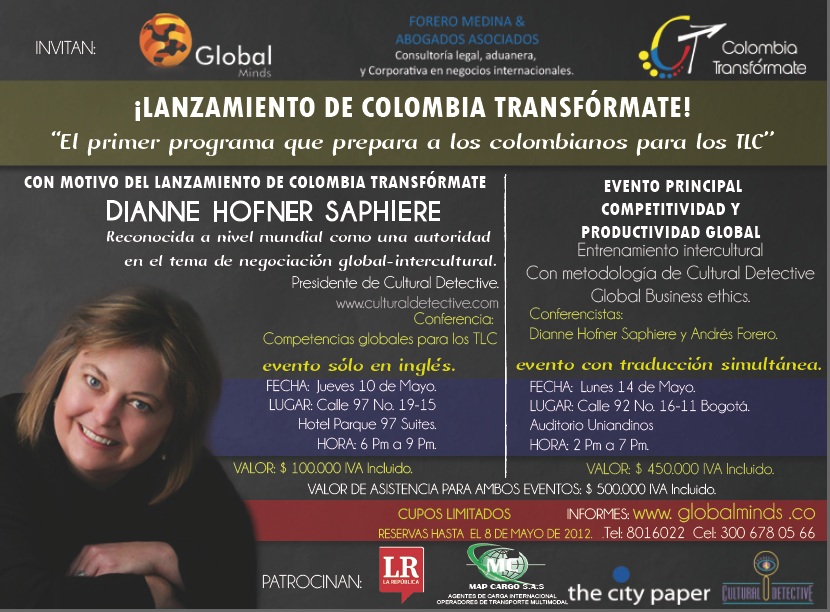
Cultural Detective is very proud to partner in bringing several leading-edge intercultural events to Bogotá, Colombia. We hope you can join us! Please pass this announcement on to your professional and social networks so that we might let everyone know about these unique opportunities.

On Thursday May 10

We will officially launch the Colombia Transfórmate program and the Cultural Detective Colombia package. Cultural Detective President Dianne Hofner Saphiere will facilitate a workshop which will be followed by a cocktail reception. This terrific evening is not to be missed! Cultural Detective is very honored to be part of this incredible project.

On Monday May 14

We will hold a high-energy event designed to ready Colombians to reap the benefits of their recent Free Trade Agreements with Canada and the USA, and upcoming agreements with the European Union and South Korea. Anyone wishing to improve their cross-cultural business acumen will find attendance extremely valuable. We believe this is one of the first-ever public workshops on intercultural communication in Colombia. The workshop will be facilitated by Fernando Parrado of Global Minds, Andrés Forero of the Forero Medina Abogados Asociados, and Dianne Hofner Saphiere of Cultural Detective.

Sponsor These Two Events

Put your organization’s name in the hands of thousands of first-tier Colombians by purchasing a sponsorship. Show your commitment to global effectiveness, and to Colombia! Sponsorship opportunities start at an incredible US$1350, and include two seats at both the Thursday and Monday events, an exhibit table, an introduction of your organization, and your logo on event banners.

Act quickly, as these very affordable sponsorship opportunities will be available for only two weeks.

On Wednesday May 9

Dianne will also present a seminar on intercultural and global business competence for students and staff at Sergio Arboleda University. The seminar will take place on day three of the university’s fifth think tank entitled, Marketing, Sociedad e Interculturalidad: Una Mirada desde la Globalización.

Link

Kevin and Rita Booker, very active Cultural Detective community members and extremely talented professionals, have put together a series of three articles on using film in intercultural education that I think you will find very helpful. If you use movie clips or YouTube videos in your coaching, training or teaching, or if you want to do that more, be sure to take a look. Lots of learning there.

By the way, if you love film, be sure to check out CDTV, our Cultural Detective channel on YouTube, with over 20 playlists. We welcome your recommendations (urls) on videos to add. Together we can build a convenient central repository of films to use to help our world become a more inclusive and collaborative place!

Developmental Intercultural Competence

The ability to collaborate productively and enjoyably across cultures is more important than ever, whether we focus on communicating with elderly parents or teenaged children, or on building trust and producing results with colleagues at the next desk and across the planet. But what do theory and practice tell us about how to gain maximum effectiveness?

One exceptionally rapid and proven way to successfully improve cross-cultural competence is to use the MashUp: a natural and powerful combination of two leading intercultural competence development processes: Cultural Detective and Personal Leadership.

Starting in September we will conduct a four-month course that will transform your personal and professional practice. It will enable you to use the MashUp in a developmentally appropriate manner to support and stretch learners at all stages of intercultural development.

Coursework will be conducted virtually, allowing you to complete the assignments from your office, home, or during travels. There will be individual and pair assignments, in addition to online classes. Do not miss this opportunity to work with some of those who are doing leading intercultural competence work worldwide. Learn more.