A Gift for You from Thorunn and Avrora

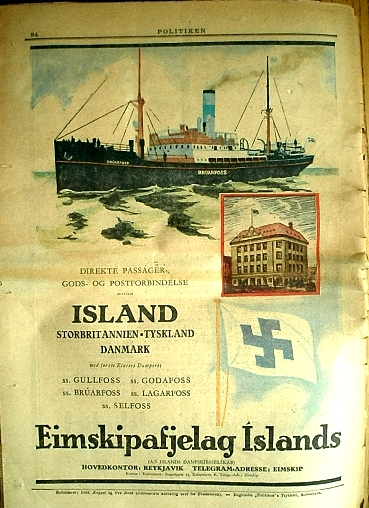
eimskip_1930.jpg

Photo credit to Vilhjálmur Örn Vilhjálmsson, https://fornleifur.blog.is
Used with permission.

The power of social media and online networking just keeps amazing me. Since starting this blog we’ve had soooo many great examples of how you all build on one another’s work and generously share with each other! It is our privilege to hold space here that helps do that.

You will remember our recent post entitled, More Cultural Appropriation: The Swastika? Well, a good friend and respected colleague of mine read it and said, “You know, Dianne, the swastika held a prominent place on a huge building, home to a major Icelandic shipping company, for decades. It’s gone now, though.” As we talked about it, she told me she’d used that story, with quite a few pictures, in a powerpoint slide presentation that she developed with a colleague.

With Thorunn and her co-presenter Avrora’s generosity of spirit, we are privileged to share with you a gift to all Cultural Detectives from them. Their slides summarize the swastika’s history, and include photos of its use in Bulgaria, Greece, Iceland, Native America, and Tibet, as well as the Nazi version. Thorunn and Avrora help you pull learning from these photos with slides explaining culture, judgments, and symbols.

Download their powerpoint slides here. And please let us know how you put them to use!

As an aside, I’d share with you that I recently met an incredibly interesting woman who is Indian and Austrian. Her stories about personal and family conflicts and learning around the swastika were really something to hear! Hopefully I might convince her to share some of them with you in a future guest post.

Subh Diwali!

Happy Diwali, everyone! The beautiful Festival of Lights is held this year November 13-17.

Diwali celebrates the victory of good over evil and light over darkness. It has major religious significance for Hindus, Sikhs and Jains, and is celebrated not only in India but by Indians living around the world. Want to learn more?

What Do You Mean?! I’ve Worked Abroad 20 Years and Score Low?!

Image from The Vegetarian Athlete

So many of you seemed to resonate with my blog post about intercultural fitness, Tweeting it, Scooping it and passing it around the social media networks, that I thought you might be interested in a short article I originally drafted back in 2005 that uses the metaphor of an athlete to explain intercultural competence.

Developmental Intercultural Competence and the Analogy of an Athlete

Milton Bennett’s Developmental Model of Intercultural Sensitivity (DMIS), first published in 1986, provides a well-regarded theory about the process people go through as they learn to make sense of the complexity of cross-cultural communication. In the late 1990s after much research, an assessment for measuring intercultural sensitivity based on the DMIS was developed. Version 3 of the Intercultural Development Inventory (IDI) is currently in use by qualified practitioners. Owners and users of the IDI have in turn used their results to revamp the DMIS into the Intercultural Development Continuum (IDC).

While such tools can be useful for measuring program effectiveness when used for pre- and post-testing, and can be hugely beneficial for individuals who want to improve their cross-cultural communication and collaboration, there are downsides. I’ve worked with career expatriates and global nomads, for example, who score quite low on the IDI. What this means is that the low-scorer may have a lot of experience, but has not yet engaged in systematic, structured sense-making of those decades of complex intercultural experience. I’ve also worked with quite a few individuals who value harmony as fitting in, and thus, on a scale that measures celebrating differences, they score comparatively low. Predictably, low scores can cause people to become focused on discrediting the instrument or rationalizing the assessment process, rather than on gaining benefit from what the results have to say.

To help learners focus on the guidance these tools can provide, I often use the analogy of an athlete. Just as athletes need multiple abilities to perform well, so do intercultural communicators. Both athletes and intercultural collaborators can use assessments to guide their performance improvement training.

Let’s say that the data on my athletic performance shows that I need increased flexibility. I dedicate several months to becoming more flexible, and then my coach tells me that I now need to shift my focus to building strength — of course while maintaining my flexibility. Months later, I may find that I need to refine my technique in order to make the most of my superior strength and flexibility. Or, I get injured, and I decide to add to my training a focus on my mental game: overcoming adversity, learning from mistakes, being fully present in the moment. Athletes thus focus on multiple abilities at different points throughout their careers in order to perform at their best.

In a similar way, the DMIS, IDI and IDC can be used to show us which issues we should focus on at a given point in time in order to maximally improve our intercultural performance. While developmental models and assessments are designed as measuring sticks or standards of comparison, their value for personal competence development is to highlight to us what competencies we should focus on building at each point in our careers in order to improve our overall performance.

Each of us has to balance the dynamic between comfort and stretch, challenge and support, growth and rest, in our own ways. Knowing what we are good at, as well as where we can improve, can help ensure we continue to develop. Using an assessment tool to gauge and target our intercultural development, in combination with a competence development tool such as Cultural Detective Online for ongoing, structured learning, is a powerful combination.

Empower Leadership to Embrace and Leverage Differences

Your seminar was a beautiful illustration of the effect of the quality of cultural response in an executive’s decision process.  The interactive example was instructive and memorable—not a person in the room hadn’t been in situations precisely like those we experienced in the practical exercise. Yet, we had in this case an opportunity to “unpack” the experience and follow its likely conclusion. You fulfilled every expectation that I had for the seminar—my only regret is that we didn’t have more time!
—Turner White, Executive Professor Helzberg School of Management

What processes and tools do your executives have at their fingertips to make those “game changing” decisions that affect important employee groups? Does culture play into their decision-making process? How do they adapt when working across cultures when we know that common sense is really culturally based?

In business today we almost all concede culture—at a minimum—has an increasing impact on real-world outcomes and ultimately the bottom-line. So developing the key skills necessary to make culturally informed decisions can mean the difference between profitability and losing loyalty of high potential employees.

Wouldn’t it be nice to learn a simple process that once learned can increase your leadership’s effectiveness in working across all cultural lines – from gender, national, ethnic, industry, functional role to even sexual orientation differences? A process so uniquely rich that, once internalized, it can be used for elevating a leader’s communication and decision-making effectiveness on a global scale?

It’s Cultural Detective. And for a special collaborative event we’ve teamed with KMA to offer you a taste of our Methodology and their web-based training focused on the LGBT culture. This facilitated online learning event led by industry expert, Rita Wuebbeler, teaches the core Cultural Detective Method and unveils the LGBT shared values which often motivate behavior—allowing you to focus on the differences that make a difference and promote inclusion and productivity.

Register for this virtual event to be held December 6th from 10am-11:30am Central USA Time, and bring this unique set of cross-cultural tools to your leadership today!

Respect for All Spiritual Traditions

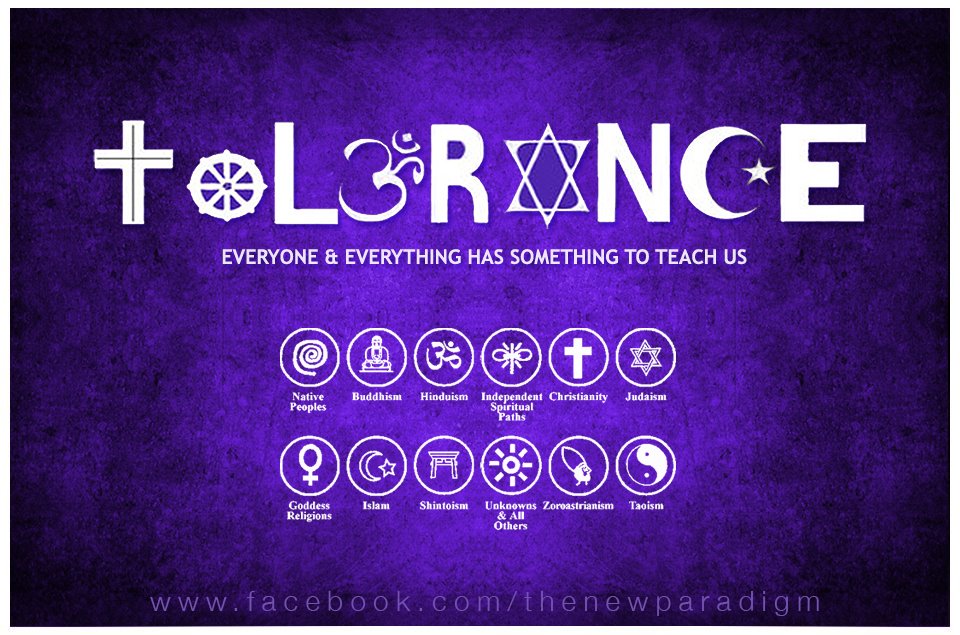
Our belief systems, particularly our spiritual beliefs and traditions, are increasingly important dimensions of culture. We must be able to bridge religious and spiritual differences if we are to live together in a collaborative, inclusive, respectful world. Yet this dimension is far too often overlooked and shortchanged in the intercultural literature.

Today, in this blog post, I offer up a few quotes that speak to me about this topic. It is my hope that taking a few moments to reflect might help each of us better do our part to promote inter-religious understanding.

We are fortunate that so many schools of divinity, congregations, spiritual communities and ecumenical groups use Cultural Detective to promote tolerance, understanding and respect. I’d welcome hearing from any of you about the efforts in which you’re engaged. Please, also, share with us quotes on this topic that speak to you.

“Impiety: Your irreverance toward my deity.”
—Ambrose Bierce

“When political conflict is religionized, it is absolutized.”
—Jonathan Saks

“Once you attempt legislation upon religious grounds, you open the way for every kind of intolerance and religious persecution.”
—William Butler Yeats

“So many Gods, so many creeds; so many paths that wind and wind; when just the art of being kind is all this sad world needs.”
—Ella Wheeler Wilcox

The joke (instead of a proverb) in Cultural Detective Jewish Culture that illustrates the value of “group solidarity” (CLASSIC cross-cultural miscommunication; enjoy!):

Several centuries ago, the Pope decreed that all Jews had to convert to Catholicism or leave Italy. There was a huge outcry from the Jewish community, so the Pope offered a deal. He’d have a religious debate with the leader of the Jewish community. If the Jews won, they could stay in Italy; if the Pope won, they’d have to convert or leave.

The Jewish people met and picked an aged and wise rabbi to represent them in the debate. However, as the Rabbi spoke no Italian, and the Pope spoke no Yiddish, they agreed that it would be a ‘silent’ debate.

On the chosen day the Pope and Rabbi sat opposite each other.

The Pope raised his hand and showed three fingers.
The Rabbi looked back and raised one finger.

Next, the Pope waved his finger around his head.
The Rabbi pointed to the ground where he sat.

The Pope brought out a communion wafer and a chalice of wine.
The Rabbi pulled out an apple.

With that, the Pope stood up and declared himself beaten, saying that the Rabbi was too clever. The Jews could stay in Italy.

Later the cardinals met with the Pope and asked him what had happened. The Pope said, ‘First I held up three fingers to represent the Trinity. He responded by holding up a single finger to remind me there is still only One God common to both our beliefs. Then I waved my finger around my head to show him that God was all around us. He responded by pointing to the ground to show that God was also right here with us. I pulled out the wine and wafer to show that God absolves us of all our sins. He pulled out an apple to remind me of the original sin. He bested me at every move, and I could not continue.’

Meanwhile, the Jewish community gathered to ask the Rabbi how he’d won. ‘I haven’t a clue,’ the Rabbi said. ‘First, he told me that we had three days to get out of Italy, so I gave him the finger. Then he told me that the whole country would be cleared of Jews and I told him that we were staying right here.’
‘And then what?’ asked a woman.
‘Who knows?’ said the Rabbi. ‘He took out his lunch so I took out mine.”
Facilitated Online Learning Sessions for Cross-Cultural Skills


How can you quickly develop the skills necessary to lead your global team, manage your global project or prepare for expansion to emerging markets, without leaving your desk?

The Cultural Detective team presents a two-part series of Facilitated Online Learning Sessions that will provide you with the keys to a proven, industry-changing and industry-leading toolset for developing your individual and organizational global competence and to ultimately succeed where “culture conflicts” caused failed ventures.

  • Learn how to build trust in your global relationships.
  • Develop highly productive global teams.
  • Complete projects on time and under budget.
  • Determine how to best enter and succeed in your targeted international markets.
  • Know how to deliver superior client service, globally.
  • Get the most from your international assignees by equipping them with the skills necessary to excel in any culture.

Sessions will be held Wednesday and Friday, February 27 and March 1, 2013! Click here for more information or to reserve your spot. Seats are limited.


Infographics on World Cultures and Immigration Trends

Our world is swimming in information, so much so that we often drown in it and find it difficult to make sense of. That’s why infographics play such a valuable role. Recently I’ve come across two different sets that I thought Cultural Detectives might be interested in seeing and using (or making your own for your own purposes).

Borrowing heavily from a concept by Danish designer Peter Orntoft, the Millward Brown Agency designed the two infographics below that put data in context. Interesting, no? More memorable than otherwise?

Photo by Millward Brown

Photo by Millward Brown

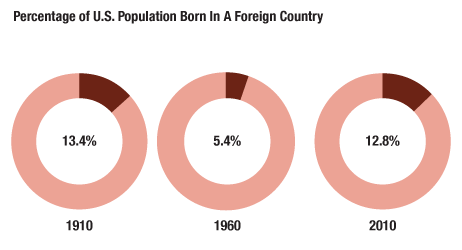
Secondly, Lam Thuy Vo of USA’s National Public Radio (NPR) created two graphics which clearly make the point that immigrants comprise about the same percentage of the US population as they did 100 years ago, though their geographic origins have changed.

Graphic by Lam Thuy Vo of USA’s National Public Radio (NPR)

Graphic by Lam Thuy Vo of USA’s National Public Radio (NPR)

Do you use infographics in your work? Please share! Have you created any? Strikes me that interculturalists could sure use this terrific approach to creating and communicating meaning.

Want to Get Interculturally “Fit”?


The image above is part of the “Got Milk?” ad campaign; the copyrights belong to their owners. We reproduce the image here to equate the ideas “Got milk?” and “Got intercultural competence?”

Got intercultural competence? Want to get interculturally “fit”?

Do you want to improve the success of your international negotiations? Mergers and acquisitions? Want to get more productivity and even joy out of your virtual teams and projects? How about jump starting the outcomes of study abroad and international education?

Intercultural competence is not something you attend a workshop about and then check it off your list. Just as physical fitness requires ongoing activity, practice, commitment and discipline, so does the development of intercultural competence. You do not become physically fit by exercising and eating right one week out of 52. Nor do you become interculturally competent merely by having lived abroad or having earned road warrior status or flight rewards. Intercultural competence requires that we take the time and focused reflection to make meaning of our experience, to apply it, and then to keep refining and upgrading it.

Physical and intercultural fitness both require ongoing, structured practice. Discipline. We can’t be physically fit if we don’t exercise and move our bodies regularly. We can’t be interculturally fit if we don’t regularly reflect on our own values and behavior, that of others, and on our skills and strategies for bridging similarities and differences and making the most of diversity by creating inclusive spaces.

Terrific. So you’re committed to the journey. You want to get started. How? Well, to become physically fit you might start monitoring what you eat. You might join a gym, or commit to an exercise program. Similarly, to develop intercultural competence you could subscribe to Cultural Detective Online. You start a structured exercise program or join a gym of intercultural competence. At less than $100/year, a subscription is definitely cheaper than most gyms!

But, as we all know, joining the gym does not give us physical fitness. We have to actually GO TO the gym! We have to actually get out of the lounge chair and move our bodies, regularly and repeatedly!  So, we promise ourselves to spend an hour or two a week for the next three to six months, going into Cultural Detective Online to reflect on our experiences, dialogue with our teammates, learn about ourselves and others, upload and debrief stories from our daily lives. Perhaps we form a group of like-minded friends and colleagues, to support and encourage one another. And, as we practice, we find we enjoy it! We come to crave it! We start to look forward to the learning and insight! The cycle feeds itself, propels itself forward; each step towards intercultural fitness encourages us on to the next.

Finally, just as on our journey to improved physical fitness we might consult a nutritionist, dietician, personal trainer or coach, once we are committed to developing intercultural competence we may find it helpful to hire a personal trainer or coach. You have access to many talented professionals via the Cultural Detective authoring team, the list of certified facilitators, and the SIETAR (Society for Intercultural Education, Training and Research) chapters worldwide (list of chapters with links is at lower left of the linked page), as well as various coaching associations. There are more and more classes taught worldwide that incorporate the Cultural Detective Method and CD Online. We very much encourage you to take advantage of these resources.

We would love to hear from you about your intercultural fitness regime! Please share with us so that we might learn from and be encouraged by your progress!

Cultural Detective Online is LIVE!!!!!!!!

Cultural Detective is proud to announce the new product launch of Cultural Detective Online! This tool is like having a virtual coach in your back pocket, successfully guiding you through the all-too-common missteps of cross-cultural negotiations and communications. Please check out the four videos on the home page. Today only (15-16 October, depending where you are on the planet) there is a 25% launch discount; enter promo code:   CDO-blog25  during checkout.

Huge thanks goes out to each of you who have worked with and incorporated the Cultural Detective Method into work with your clients or employee populations globally, as over the past eight years this tool has become a significant contribution to the intercultural field. Because of our clients and team, Cultural Detective has become globally recognized as one of the premier developmental tools of our time. Now we are on the cusp of very exciting and broader use of the tool through Cultural Detective Online! This new product launch furthers our mission of encouraging communities globally to prosper through intercultural understanding and collaboration.

Cultural Detective Online is useful in a broad range of contexts including global business negotiations and multicultural team effectiveness, international assignments and study abroad, and for successfully communicating within our families and communities, and within and across faith traditions.

A subscription to Cultural Detective Online offers the opportunity to explore the concepts of “culture” and “values” and how they impact communication in everyday life. It provides access to dozens of culture-specific Values Lenses and topic-specific Challenges Lenses, hundreds of real world cross-cultural incidents, and the easy-to-use Cultural Detective process for improving the ability to collaborate successfully across cultures, both on individual and organizational levels.

We are excited to announce that subscriptions are now available for individuals or groups, and we invite you to subscribe to Cultural Detective Online today by visiting http://www.culturaldetective.com/cdonline/ ! Subscriptions start at less than US$100/year, and are less for larger groups of subscribers. You will rarely find more value for your money.

More Cultural Appropriation: The Swastika

The story we published recently about cultural appropriation reminded me of one of my favorite incidents in our series. It resides in the Cultural Detective Global Business Ethics package, and involves a corporate newsletter publishing photos from the office in India. One photo, taken at a temple, shows a swastika.

Outraged, an anonymous writer emails the newsletter editor to complain about a lack of cultural sensitivity, a lack of commitment to diversity and inclusion. The newsletter editor is crestfallen; the comment saps all his energy. It is exactly his commitment to inclusion and diversity that has motivated him to include posts from offices worldwide! How much harder can he try?

The swastika is sadly a symbol of genocide and the Holocaust for many; something to be reviled. There was an unsuccessful effort to ban the use of the swastika in the European Union. Seeing this symbol can bring forth indescribable pain and outrage for many people.

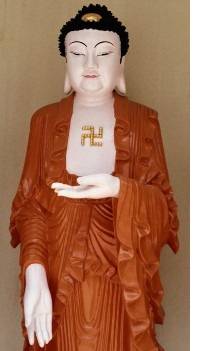
Swastika is a Sanskrit word, a religious symbol of good fortune used by Hindus, Buddhists, Jains and others worldwide. It can be seen in the art of the Egyptians, Romans, Greeks, Celts, Native Americans, and Persians as well.

To me, the swastika is one of the world’s most horrifying misappropriations of a cultural symbol! I’d welcome hearing from anyone who knows the history of Hitler’s and the Nazis’ appropriation of this symbol.

It is important for us to understand both of these very different realities. To some, the swastika symbolizes genocide and hate. To others it symbolizes beauty, the steps of Buddha. Does this therefore mean we should not use it? That we should? Can we transform its use through ongoing learning and dialogue?

Back to the incident, learning to make the most of learning opportunities such as these, to encourage cultures (organizations, communities) in which people listen to, respect and collaborate with one another, is what Cultural Detective is all about. Thank you all for joining us in this mission!