It’s in His Kiss… or is it?

kissingKissing customs vary by culture; we all know that—when greeting, do you kiss, bow, shake hands, hug, fist bump, or use some other gesture? If you do kiss to say hello, do you do kiss once, twice or thrice? Do you kiss the lips, cheek or air?

But when it comes to kissing a lover, to passionate or sexual kissing, well, suddenly we think that is surely universal.

But is it? Are statements such as those below ethnocentric?

Researchers have discovered kissing helps you choose the right mate and helps you live longer. They have found you use 146 muscles when you pucker up and swap 80 million new bacteria when you lock lips. And you will spend some 20,000 minutes — or two weeks — of your lifetime doing it.
The Washington Post

According to a recent study of 168 cultures worldwide, romantic-sexual kissing is actually far from universal. In fact, the study shows that only 41% of the world’s cultures engage in romantic kissing! Researchers on the project were anthropologists William Jakowiak and Shelly Volsche, of the University of Nevada Las Vegas, and gender studies researcher Justin Garcia, from Indiana University Bloomington. The paper, entitled, “Is the Romantic-Sexual Kiss a Near Human Universal?”, was published in The American Anthropologist in July, 2015.

Volsche told news.com.au that, “There is a marked absence of kissing in equatorial and sub-Saharan hunter-gatherer societies such as the Hadza, the Turkana, the Maasai, and the Yanomamo.” The Mehinaku of Brazil told one ethnographer that they thought kissing was “gross,” asking why anyone would want to “share their dinner.” This research found that kissing evolves in complex, post-industrial societies in which there is time for and interest in erotic play. Erotic kissing is not common in agricultural, pastoral and hunter-gatherer societies.

Many societies that do not have romantic kissing use other physical expressions of endearment, often an exchange of breath or mutual sniffing of cheeks and necks. The Oceanic Kiss involves passing open mouths, with no contact. It is usually a greeting, and occasionally part of the sexual repertoire. Are you curious about other sexual customs and beliefs that may be culturally relative? If so, check out this article in Bustle.

Cultural Detective is a terrific tool for exploring the methods you use to build trust with and confidence in others, whether they be romantic partners, work colleagues, neighbors or clients. We invite you to join us in one of our complimentary webinars to learn how.

Just Released! New Book: Perception and Deception

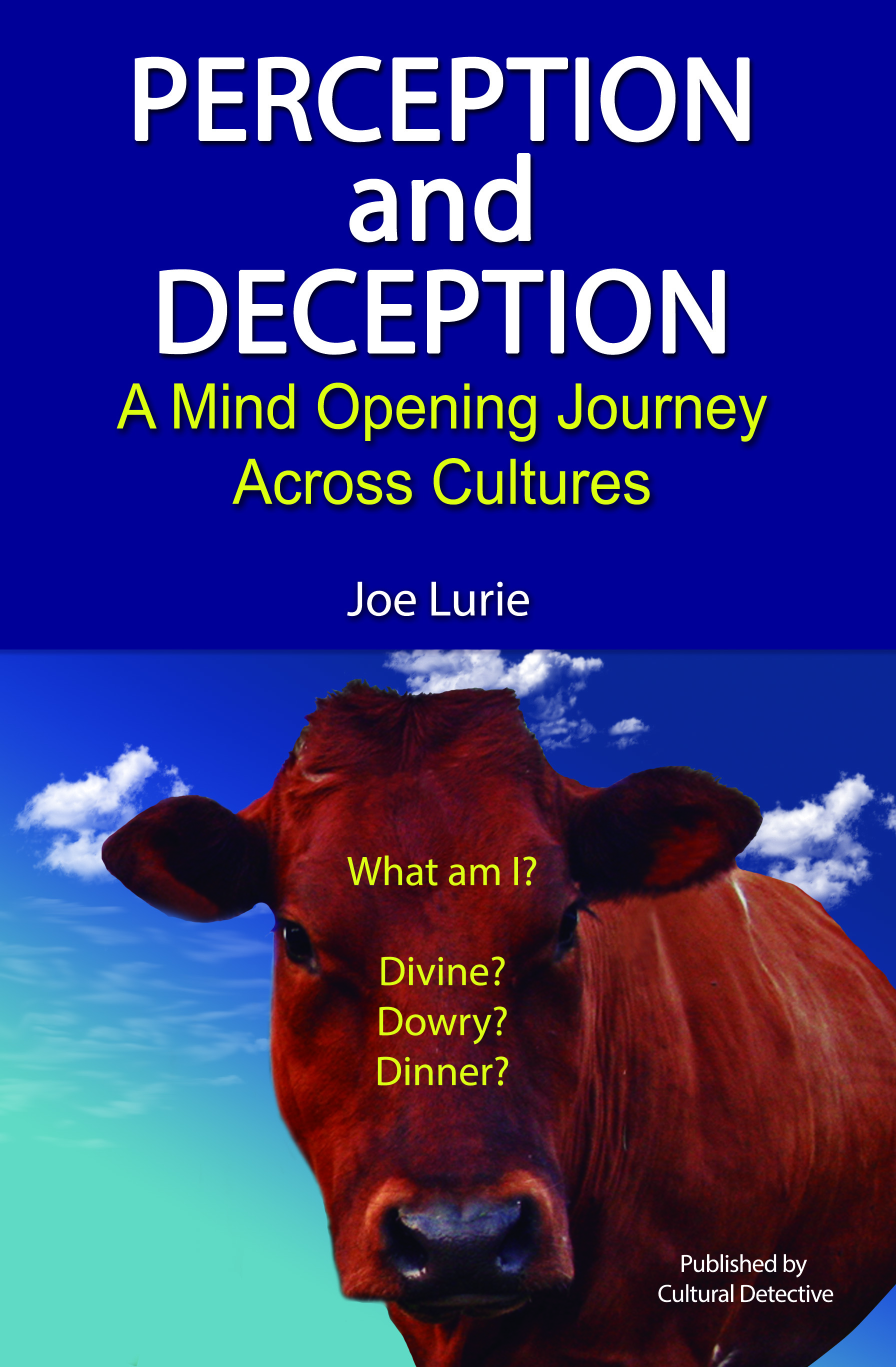
PERCEPTION AND DECEPTION COVER FACE 3Need a powerful story to illustrate your point about intercultural miscommunication? Want to help someone understand that different cultures may utilize the same word, concept, image, gesture, sound or touch to mean different things? Could you use a proverb that gives insight into another person’s cultural worldview? Search no more—Joe Lurie , intercultural trainer, Executive Director Emeritus at UC Berkeley’s International House, and former Peace Corps Volunteer, has got you covered!

Perception and Deception: A Mind Opening Journey Across Cultures, is an entertaining, eye-opening and easy-to-read book that contains dozens of intriguing intercultural experiences, gathered from Joe’s research and his decades living abroad and managing Berkeley’s International House, one of the largest, most diverse living centers on the planet.

In an informative and enticing manner, the author explains how he discovered that his perception of a situation could be “deceptive” when he looked at it simply through his own Lens. Joe’s growing self-awareness of the impact of culture is clearly illustrated through his humorous stories and striking culture clash examples from news reports across the globe. Better yet, these stories are indexed by culture! Joe also shares pearls of wisdom about perception, perspective and the nature of “truth” from his rich personal collection of proverbs and sayings from around the world.

Joe’s infectious curiosity in uncovering and understanding cultural differences will help readers, no matter their profession, age or cultural background, gain a fuller appreciation for the richness of human diversity, and the multiple things that can go wrong when trying to communicate across cultures. You, your students, colleagues, clients, friends, and family will all enjoy this engaging book, published by Cultural Detective, and now available in paperback. Kindle on Amazon and other e-versions from Barnes and Noble and Apple will be coming soon.

Perception and Deception is an engaging and insightful introduction to cross-cultural communication in a globalized world. For more information, reviews, a peek inside the book, and a link to purchase a copy, visit www.PerceptionandDeception.com.

Purchase the book now.

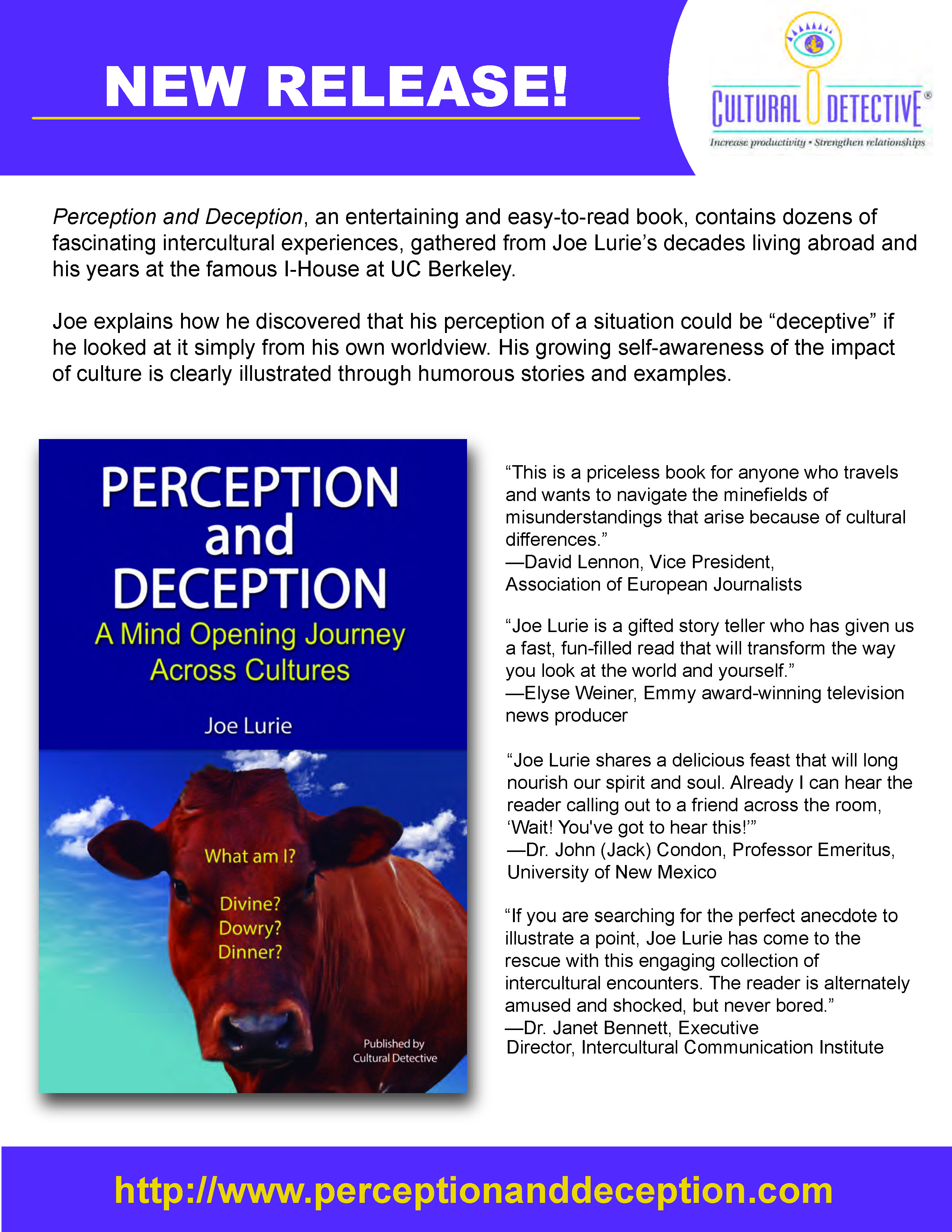
You are also welcome to copy and print the flyer below to share with your colleagues and friends.
Perception Deception Flyer White

What is Privilege?

Today a diversity and inclusion colleague I highly respect posted a link to an exercise in which participants line up side-by-side and then take a step back for each type of privilege they have not experienced in their lives. 35 types of privilege are listed in the article, and a short video about it is below. It’s a powerful exercise, filled with potentially transformative learning.

It’s also an exercise that I’ve had several successful people tell me over the years was a traumatic experience for them. Why? Because, experiential learning activities require proper debriefing! The woman in my story was actually told, when she was standing alone at the back of the room, “See how inclusive our company is? Even someone so lacking in privilege can be successful here!” Exactly the opposite of the desired outcome for the exercise!

The meaning we make of our experience is in the debriefing! It takes a skillful facilitator to speak up to a CEO, but ethics and learning require it be done.

Please join Daniel Yalowitz (vice-provost for graduate education at the SIT Graduate Institute) and me for a five-day session at the Summer Institute for Intercultural Communication, “Gaining Gaming Competence: The Meaning is in the Debriefing,” and/or a one-day session, “Gaming Agility: Getting More Out of Our Tools.”

We look forward to seeing you there, and to working with you to build inclusiveness, respect, collaboration and justice in our workplaces and communities!

Using the Body to Transform Conflict

Choreography of Resolution

Conflict happens. When different cultures and worldviews are involved, conflict can arise more frequently and, sometimes, more powerfully. It can also be more difficult to resolve or transform.

At the SIETAR USA Congress in Portland last October, Michelle LeBaron conducted a couple of exercises that I believe could be useful to some of our readers as we seek to create cross-cultural understanding, respect, and collaboration. The exercises very viscerally demonstrated how our thoughts, beliefs, and attitudes affect the way we hold and move our bodies, and that something so slight as a shift in our gaze can shift our perspective, opening us up to new experiences.

I have had the privilege of knowing Michelle for about twenty years, as we both teach on the faculty of the Summer Institute for Intercultural Communication. She is a specialist in cross-cultural conflict resolution who teaches at the University of British Columbia, and I greatly respect and enjoy her work.

Michelle’s recent research focuses on how the arts can foster belonging and social cohesion across cultural and worldview differences. She is one of three authors of a new book, The Choreography of Resolution: Conflict, Movement and Neuroscience, that investigates how dance, movement and kinesthetic awareness can enhance people’s capacities to transform conflict.

Instructions for Michelle’s activities follow.

Setting up the Activities

How does my body communicate to me? Let’s spend some time learning about our body’s ways of messaging us.
  • When we are out of step, off center, or in resonance, our bodies get our attention.
  • Our bodies help us heal splits, they connect our thoughts and feelings.
  • Our bodies help us connect with others via touch and closeness, depending on our cultural common sense.
  • We have habits and patterns that can be helpful or destructive; our bodies can help us re-pattern our habits and keep our brains plastic.
Shift, conflict resolution, is a physical event.
  • Our bodies shift us personally and interpersonally—”let me step towards you,” “I could breathe more easily,” “a great weight was lifted,” “the knot in my shoulder released.”
  • When we are “right,” we become stiffer, tighter, more brittle. We need suppleness, to be able to see gradations instead of just black and white.
  • Movement helps us realize that small movements can make a big difference. The body can show us the value of incremental change vs. an epiphany, e.g., rarely do we resolve conflict by saying, “He was right!” “Win-win” outcomes are rare; “mostly ok-mostly ok” outcomes are much more common.
Exercises:
  1. Have a group of participants stand and move around the room freely. Instruct them to hold up their arms like a bird, bringing their hands forward just far enough so they can see both their hands. Have them drop their hands but keep that level of peripheral vision and walk around. After doing this for a few minutes, conduct a short debrief about how that felt; how their bodies felt; how they perceived the group.
  2. After doing this for a minute or two, instruct participants to (nonverbally) find a tiger and a horse from among the other participants, and to move around so that they keep the horse between themselves and the tiger. After doing this for a few minutes, instruct participants to derole, and conduct a short debrief about how that felt; how their bodies felt; how they perceived the group.
  3. As a third step, instruct the participants to (again nonverbally) find a new tiger and a lamb from among the other participants, and move around so that you keep yourself between the tiger and the lamb. After doing this for a few minutes, instruct participants to derole, and conduct a short debrief about how that felt; how their bodies felt; how they perceived the group.

Michelle has an article, available online, called Bodies at Work: Moving Towards Alchemy, that might be of interest. In it she says, “The single most neglected truism in mediation, whether virtual or in person, is that it does not happen without bodies. We mobilize to engage and reach toward understanding while literally standing our ground.”

The concepts and activities that Michelle presents combine very well with the activities in Cultural Detective Online. I trust you’ll put them to good use building intercultural respect, understanding and collaboration!

Cultural Detective at the Summer Institute for Intercultural Communication

SIIC 2015The 39th annual Summer Institute for Intercultural Communication (SIIC) offers professional development opportunities for people working in education, training, business, and consulting, in both international and domestic intercultural contexts. One of the premier gatherings of professionals in the field of intercultural communication, SIIC presents a unique opportunity to explore the field and network with others in a stimulating and supportive environment. Cultural Detective is proud to have long played a role in SIIC, and 2015 will be no exception. Sign up now as workshops are filling quickly!

The workshops below will all include Cultural Detective components; the Certification focuses exclusively on the Cultural Detective Method.

11. Gaining Gaming Competence: The Meaning Is in the Debriefing
Monday-Friday, July 13-17, 2015
Dianne Hofner Saphiere and Daniel Cantor Yalowitz

Psychologist George Kelly has suggested that learning isn’t being in the vicinity of an event, it’s the sense we make of it. If this is so, then experiential learning through games and simulations requires special knowledge and skills to derive the most significant learning. This experiential workshop focuses on current best practices and theories for creating, facilitating, and debriefing meaningful intercultural games, activities, and simulations. We will emphasize the critical importance of debriefing, including the ethics of appropriate responses in challenging situations and a variety of successful strategies that you can use in diverse intercultural settings.

Redundancía and Demonstration of Cultural Detective Online
Tuesday July 14, 2015, Evening Session 7-9 pm
Dianne Hofner Saphiere

Redundancía is one of the most powerful nine-minute learning games you will ever play. It builds empathy for non-fluent speakers, helps develop listening and communication skills, and captures the dynamics of power in conversation. It is a tool that can be used in a broad variety of educational and training situations.

Cultural Detective® approaches cross-cultural collaboration as a process, not a set of dimensions. It looks at people as individuals affected by multiple layers of culture, including nationality, gender, generation, spiritual tradition, and sexual orientation.

After we play and debrief Redundancía, the facilitator will provide a short tour of the Cultural Detective® Online system.

3. Facilitating Intercultural Competence: Experiential Methods and Tools
Monday-Friday, July 13-17, 2015

Basma Ibrahim DeVries and Tatyana Fertelmeyster

One of the main challenges for trainers and educators is finding meaningful methods and tools to develop intercultural competence. Actively engaging with conceptually grounded and widely used approaches to intercultural communication competence, such as communication styles, conflict styles, learning styles, the Cultural Detective®, and Personal Leadership®, this workshop will equip you with creative methods for training and coaching for both culture-general and culture-specific contexts. We will focus on effective group dynamics, co-facilitation, adaptation, and strategic management of participants’ and clients’ needs, as well as the creation of your own activities. You can expect to be creatively, experientially, and reflectively engaged.

Cultural Detective® Facilitator Certification Workshop
Saturday and Sunday, July 18-19, 2015

Cultural Detective® is a core method for developing intercultural understanding, productivity, and effectiveness. It serves as a powerful design backbone for courseware, coaching, and teambuilding, or as a stand-alone tool for conflict resolution, learning and dialogue. A few advantages of the facilitator certification workshop include increased ability to:
  • Use Cultural Detective® as a backbone to design, reinforcing learning from a variety of activities and experiences in a coherent developmental spiral
  • Develop competence in a broad variety of international, cross-cultural situations
  • Foster collaboration and ongoing process improvement in organizations by using a consistent method and vocabulary in multiple locations

H. Gaming Agility: Getting More Out of Our Tools
Saturday July 18, 2015

Dianne Hofner Saphiere and Daniel Cantor Yalowitz

During this highly experiential workshop we will participate in a number of different intercultural simulations and games, and then re-introduce, conduct, debrief, or modify them for varying purposes. The day will be fast-paced and high energy. There will be much work in small groups, and participants will take turns facilitating the large group. We will emphasize the critical importance of debriefing and the ethics of proper debriefing, as we illustrate that using different questions and methods can make a single activity produce learning that is applicable to a diversity of purposes. Come ready to engage!

Ecotonos: A Simulation for Collaborating Across Cultures
Tuesday July 21, 2015, Evening Session 7-9 pm
Dianne Hofner Saphiere

The Intercultural Communication Institute now publishes this classic simulation on intercultural collaboration, teaming and decision making. Be sure it’s part of your repertoire!

Powerful and extremely adaptable, Ecotonos breaks the usual stereotypes and barriers. Participants improve their skills and strategies for multicultural collaboration and teamwork.

Ecotonos can be used multiple times with the same people by selecting a new problem and different variables, with each replay offering new and different cross-cultural perspectives.

38. Training Methods for Exploring Identity 
Thursday and Friday, July 23-24, 2015
Tatyana Fertelmeyster

Self-exploration is the most vital learning for anybody who wants to guide others in their identity work. You can expect to be engaged in two days of self-discovery processes, from icebreakers to individual and team exercises, which can be used to explore identity. We will examine different ways to set up and integrate identity exercises into programs that resonate with various work groups, and discuss both the ethical and practical considerations we need to keep in mind when doing identity work. We will address why identity work is essential in intercultural training, leadership development, and team building.

Rajel messouab ta hed ma y sed lou el bab. “All doors open to the person with good manners.”

morocco_purchWe are pleased to be publishing a wonderful addition to our series, Cultural Detective: Morocco. It’s perfect for those working with Moroccans, or wanting to do business in or relocate to Morocco. Perhaps, however, you are like me: you have seen tourist posters, watched Casablanca, eaten at Moroccan restaurants, and dreamed about visiting this seemingly exotic place. If so, then you will also enjoy wandering through our new package, even if you have no immediate plans to visit or do business in Morocco—at least not when you start reading the package!

One of the delightful things about Cultural Detective: Morocco is the feeling of almost participating in the culture that begins as you read the introduction. The oral tradition of Morocco is clear throughout the package, and the stories and examples show the hospitality and warmth of the people. To truly navigate successfully within Moroccan culture, you will need the advice of an inside perspective—a cultural informant—to help you develop and maintain the relationships and connections so necessary to doing business in this fascinating country. Cultural Detective: Morocco can provide you with that ongoing guidance, with ideas to save you from being unintentionally rude, and with suggestions that may help you communicate more comfortably and successfully with Moroccans. Click on any photo to enlarge it or view a slideshow.

Cultural Detective: Morocco has truly been a “labor of love,” coming to fruition due to the determination of two very dedicated professionals, Catherine Roignan and Youssef Zahid. Currently, one author lives in France and one in Morocco; both have a great deal of international experience, both have more than full-time jobs, and both have family responsibilities that take up every spare moment. In spite of these challenges, they wrote, revised, and wrote some more.

What is even more remarkable to me is that they wrote in French and then translated their work into English so I could read it. I made suggestions, did some editing, and then my suggestions were translated back into French for their consideration. (While the current version is in English, we will soon publish the French language version.) Of course, part of the authors’ discussion was also about Arabic words, as they explored the nuances of Moroccan culture and the particular choice of words used to describe it. This was a truly multilingual, multicultural creation process, weaving observations from inside and outside of the culture, and shifting worldviews as the authors worked to share the culture of Morocco with us.

One of the Moroccan values highlighted in the package is Daba baada (the present comes first): the only thing one can be sure of is today; one cannot know what tomorrow will be like, as things may change at any moment. We hope you will take the time today to explore this terrific new package, either via the PDF version or by viewing it as part of your subscription to Cultural Detective Online.

Ah Ha! I knew it! Bilingualism does pay!

benefits of being bilingual

“Not only are bilingual young adults more likely to graduate high school and go to college, they are also more likely to get the job when they interview. Even when being bilingual is not a requirement, an interview study of California employers shows that employers prefer to both hire and retain bilinguals.”
—Rebecca Callahan, Associate Professor of Bilingual/Bicultural Education, University of Texas at Austin

Those of us who have worked in and around international education think that learning more than one language is good for people. We think it helps open up the mind to other possibilities, other cultural points of view. We also believe that the “code switching” involved in speaking multiple languages helps develop skills that are useful in social situations and beneficial in keeping the mind sharp.

However, for years no data existed that supported the benefits of being bilingual. And for a long time in many US educational settings, children who did not speak English as their first language were not encouraged to keep their bilingualism. Why would you need a second language when you learned English? The benefits of being able to speak more than one language were not generally recognized in the US.

I was excited to read about some new research by Rebecca Callahan, Associate Professor of Bilingual/Bicultural Education, University of Texas at Austin. In a recent article in Quartz, she writes: “Speaking more than one language may confer significant benefits on the developing brain. Research has now shown that bilingual young adults not only fare better in the job market, but are also more likely to demonstrate empathy and problem-solving skills.”

What does this mean? For study-abroad students, it might encourage them to know that the effort spent in learning and using another language has long-term economic benefits—you are more marketable! This is, of course, in addition to the eye-opening, mind-expanding, life-altering experience of living in a culture different from your own.

For children of immigrants and refugees, it means that making an effort to retain their parents’ native language is beneficial. In reality, many immigrant and refugee children in the US serve as interpreters and cultural bridges from an early age. They are forced to be bilingual—learning English to be successful in the school system, while speaking another language at home. I remember one Cambodian mother telling me, through her son, that if she learned to speak English, her son would forget how to speak Cambodian now that he was here in the US.

“Currently, researchers have begun to use data-sets that include more sensitive measures of language proficiency to find that among children of immigrant parents, bilingual-biliterate young adults land in higher status jobs and earn more than their peers who have lost their home language.

Not only have these now-monolingual young adults lost the cognitive resources bilingualism provides, but they are less likely to be employed full-time, and earn less than their peers.”
—Rebecca Callahan

For many in the US educational system, acquiring a second or third language is not as highly valued as it is in many other parts of the world. I am always impressed (and a bit jealous) when I am around people who can switch among languages—often because they were required or encouraged to learn multiple languages when they were in school. And for a nation of immigrants, it seems strange that only one-in-four US American adults are conversationally proficient in another language, according to a recent Gallup poll. It reminds me of the old joke, so true that it is embarrassing:

Question: What do you call a person who speaks four languages?
Answer: Quadrilingual.

Question: What do you call a person who speaks three languages?
Answer: Trilingual.

Question: What do you call a person who speaks two languages?
Answer: Bilingual.

Question: What do you call a person who speaks one language?
Answer: An American!

Of course, this challenge isn’t just limited to US Americans. In an article last year in The Guardian, Vice-chancellor of Cambridge University, Leszek Borysiewicz, pointed out that one in six children in English primary school do not have English as their first language. He noted that their first languages:

“…are real languages: living languages that give people a huge insight into culture and give the children who can speak them additional opportunities.

Isn’t that what education is about – enabling every child to achieve the maximum potential? What I’d love to see is an emphasis that this is an added value that that child has, a talent, and we should aspire to allow other children who may be monolingual to strive to become as bilingual as they possibly can be.”

An article about a study conducted by researchers at University of Guelph in Ontario, Canada, indicates that merely knowing a second language can result in higher earnings. The researchers say that the results of their study, published in the journal Canadian Public Policy/Analyse de Politiques, has implications for bilingual policy in Canada:

“Efforts to promote French in the ROC [rest of Canada] should be continued, not so much because of the earnings advantage that bilingualism confers, but because it results in many social/cultural/political benefits, strengthening the fabric of Canadian society and serving as an example to countries torn by ethnic, religious and linguistic divisions.”

The cultural flexibility inherent in knowing two languages is a valuable ability and a resource to be cherished. If we are to move toward intercultural competence, we need the ability to think outside of our cultural box and explore other ways of seeing the world.

That is what we try to do with our Cultural Detective packages—provide insight into another view of the world, a small glimpse into a different cultural reality, a chance to perhaps understand, just a little, how others see us, and how to work together more effectively.

Three Never-Again Opportunities!

CustomBackgroundImage-1.jpgTo celebrate SIETAR USA’s 15th anniversary, Cultural Detective is partnering with SUSA to offer an incredible win-win contest. Want to get six months of service for the price of one? How about 20 months of service for the price of 12?

1. SUSA 15th Anniversary Contest: Detect Opportunities for Cultural Bridging

  1. During April subscribe for one-month to CD Online, giving you access to the complete packages including Values Lenses for more than 60 cultures.
  2. Upload your original critical incident on CD Online, do a debrief, download it all as a PDF, and then submit to SUSA@culturaldetective.com.
That’s all you need to do. What do you get out of it?
  1. Upon receipt of your completed Incident and Debrief, Cultural Detective will upgrade your one-month subscription to six months. This means you will get 5 months of Cultural Detective Online free!
  2. CD will determine Incident and Debrief winners, who will receive a one-year subscription to Cultural Detective Online!
  3. Winning Incident and Debrief will also be showcased in a webinar in which winners can promote their services/organization as well as teach others.
2. April SIETAR USA Member Product Discount In addition to the contest, SIETAR USA is offering their members a code for a 15-month subscription for the price of 12 months. If you are a SUSA member and participate in the contest, you’ll end up getting 21 months for the price of 12! Now that’s a YOU WIN! contest!

3. SIETAR USA 15th Anniversary Conference Proposal Submissions Being Accepted Through May 4th!

Want to earn the opportunity to present at this historic 15th annual conference, October 14-17, 2015 in Orlando, FL.? Session proposals will be accepted through May 4th. Be among the field’s leaders and submit yours now!

“If you act like a ripe plum, bats will eat you.”

(Proverb submitted by Lamar Gaye, Minnesota, USA, to BBC NEWS Africa website, Africa’s proverb of the day, 29 December 2014)

I so love proverbs—they give a view into a culture that cannot be obtained through any other source. They are tiny stories, gems in the midst of daily life. Although often I only read them in translation, they still provide valuable insight into my own and other’s values and worldviews.

Imagine my delight when I found a collection of African proverbs, contributed by folks from all over, to a site by BBC NEWS Africa. Featuring proverbs sent in during January 2015 and December 2014, I think you will find at least one that delights you or provides fresh insight into a situation.

800px-Monkey_family_in_moss_tree

By Irvin Calicut (Own work) [CC BY-SA 3.0 (http://creativecommons.org/licenses/by-sa/3.0)%5D

“Monkeys do not advise their young ones to be careful on trees. They just remind them of the distance to the ground.”
—Sent by Geoffrey Kosgei, Nairobi, Kenya to BBC NEWS Africa website, Africa’s proverb of the day, 5 November 2014

Did you know that buried within each Cultural Detective package are proverbs and sayings to illustrate the culture’s core values? We periodically convert some of these to graphic format and share them on social media, archiving them on the Cultural Detective Pinterest board and Facebook page. Our authors have fun remembering what their parents or grandparents said to them, and often are surprised when they find out they were each told the same thing—or a close variant of it—even though they grew up in different circumstances!

These “childhood messages” often echo in our minds for years and continue to influence who we are today. We may even find that our core values are reflected in those proverbs and sayings that were shared by important people in our past. Our popular package, Cultural Detective Self-Discovery, uses our favorite proverbs and sayings as one method to investigate our own personal values. Cultural Detective Online now includes Cultural Detective Self-Discovery, which allows you to build your own Personal Values Lens—just as beautiful as the others contained within our series—using a variety of investigative methods.

Of course, there are books with collections of proverbs, but the ones I like best are those that I happen upon in everyday speech. Keep your ears open and let us know what gems of wisdom you hear—from yourself and those around you!

How Storytelling Affects the Brain

brainOnstorytelling OneSpot

I was recently tweeted this graphic, which research shows me is taken from a larger infographic on content marketing on OneSpot. https://www.onespot.com/blog/infographic-the-science-of-storytelling/

Storytelling is one of the oldest forms of both teaching and entertainment. It is the way history was traditionally recorded, how values were inculcated, and how families and neighborhoods bonded.

Storytelling is the core around which Cultural Detective is based. While the Cultural Detective Method is grounded in extensive intercultural theory, using Cultural Detective for development, learning, conflict resolution or team building involves listening to, telling, reading, or otherwise interacting with stories, or, in detective parlance, incidents. The debut of Cultural Detective The Netherlands involved a wine and hors d’oeuvres reception in Amsterdam, during which professionals acted out critical incidents for those attending. Trainers have turned their training rooms into theaters, acting out the stories in the Cultural Detective series with the learners. Why so much emphasis on stories?Why?

Let’s start by watching my interview with Kelli McLoud-Schingen, one of our CD team members, who is a professional storyteller and actress, as well as a dynamite diversity practitioner and interculturalist.

Storytelling does, indeed, link the head, heart and mind—an integration that is key to the development of intercultural competence. Interestingly for those working across cultures, however, science is now finding that stories help us to better understand others’ intentions and relate to one another better! My experience has shown that stories can help us to develop empathy, particularly with those very different from ourselves.

“There was substantial overlap in the brain networks used to understand stories and the networks used to navigate interactions with other individuals — in particular, interactions in which we’re trying to figure out the thoughts and feelings of others.

Scientists call this capacity of the brain to construct a map of other people’s intentions ‘theory of mind.’

Narratives offer a unique opportunity to engage this capacity, as we identify with characters’ longings and frustrations, guess at their hidden motives and track their encounters with friends and enemies, neighbors and lovers.”
—Dr. Raymond Mar, York University, Toronto

Furthermore, stories allow us to “practice,” even if in our own minds, how we might respond under various circumstances. Stories can “take us” to India, China or Brazil, and help us imagine ourselves in an interaction there, so that when we actually visit, it’s not as strange or confusing. Stories are a form of mental, rather than computerized, simulation.

“The brain, it seems, does not make much of a distinction between reading about an experience and encountering it in real life; in each case, the same neurological regions are stimulated. Keith Oatley, an emeritus professor of cognitive psychology at the University of Toronto (and a published novelist), has proposed that reading produces a vivid simulation of reality, one that ‘runs on minds of readers just as computer simulations run on computers.’”
—Annie Murphy Paul, The New York Times, “Your Brain on Fiction”

Finally, analyzing stories enables the learner to look at real people in real situations, in all their complexity—personality, age, gender, ethnicity, religious tradition, nationality—rather than as one-dimensional generalizations or stereotypes.

If you have not yet subscribed to Cultural Detective Online, or attended one of our complimentary webinars, you are missing out on an incredibly robust and affordable tool that includes hundreds of stories to support your learning! We hope to see you there soon!