Using Our Perceptions to Discover Ourselves: Two Iconic Embraces

We often hear that feedback says as much about the person giving the feedback as it does about the subject of the evaluation.

Our perceptions can tell us loads about ourselves. Take a quick look at the photo below, and take a few notes on what you see.
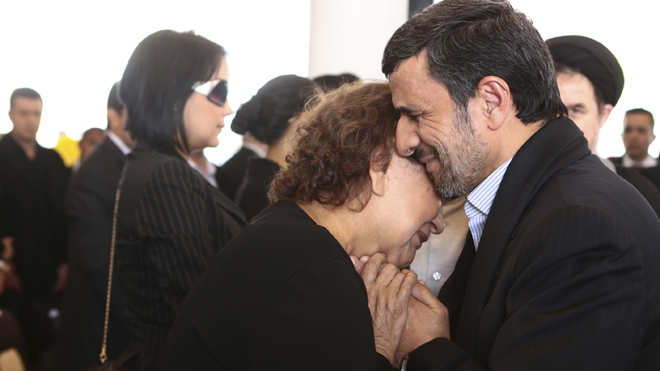
Mahmoud Ahmadinejad, Elena FriasKeep looking at the photo above. In case you do not already know, the photo was taken at the funeral of Venezuela’s President Hugo Chavez in March 2013. On the left is Chavez’s mother, Elena Frias de Chavez, and on the right is Iran’s President Ahmadinejad. Now, pause and take a few more notes on what you see in the photo.

Did your perceptions change between the first and second times you took notes? Before you proceed, take a moment to reflect on the values, assumptions, and beliefs that underly your perceptions.

Once you’ve done that, how about looking at another photo? Same instructions: take a look at this photo, and jot a few notes about what you see. Perhaps you have already seen both of these rather iconic photos.
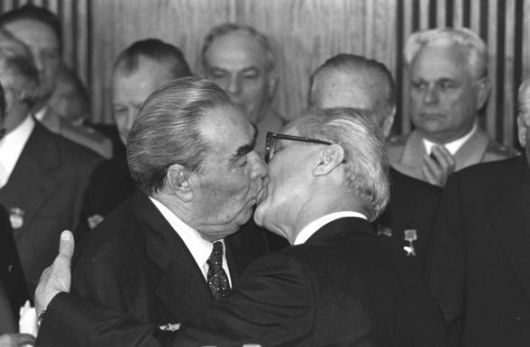
Breznev-Honecker_1979

Keep looking at the second photo. If you did not already know this, the photo was taken during the 30th anniversary celebrations of the Democratic Republic of Germany (East Germany) in 1979. On the left is Leonid Brezhnev, leader of the USSR, and on the right is East German President Erich Honecker. Now, take a few more notes on what you see in the photo.

Did your perceptions change between the first and second times you took notes? Before you proceed, take a moment to reflect on the values, assumptions, and beliefs that underly the perceptions you noted this second time around.

Finally, compare your perceptions, and your values, assumptions, and beliefs about both of these photos. In what ways did you respond similarly? In what ways differently? Why?

FIRST PHOTO
In fact, President Mahmoud Ahmadinejad was criticized for consoling Chavez’s mother in this way; she is not a member of his family, and thus, such touching is haram or forbidden. While my research shows the photo to be real, there are reports of the photo being doctored in order to cause problems. I personally find the actions captured in the photo quite believable: a man consoling a grieving mother and bridging cultures in the moment. Below are two sources for those of you curious to learn more about this photo and the response to it:

  1. Daily Mail article
  2. IranPulse English language news blog

SECOND PHOTO
It was quite commonplace for Communist leaders to kiss on the mouth as an expression of brotherhood and solidarity. This iconic photo was taken by Régis Bossu, a freelance photographer for European Stars and Stripes, Stern, Spiegel, and Sygma. Most observers of the time viewed this Brezhnev-Honecker kiss as more enthusiastic than usual. The photo was quickly and widely circulated.
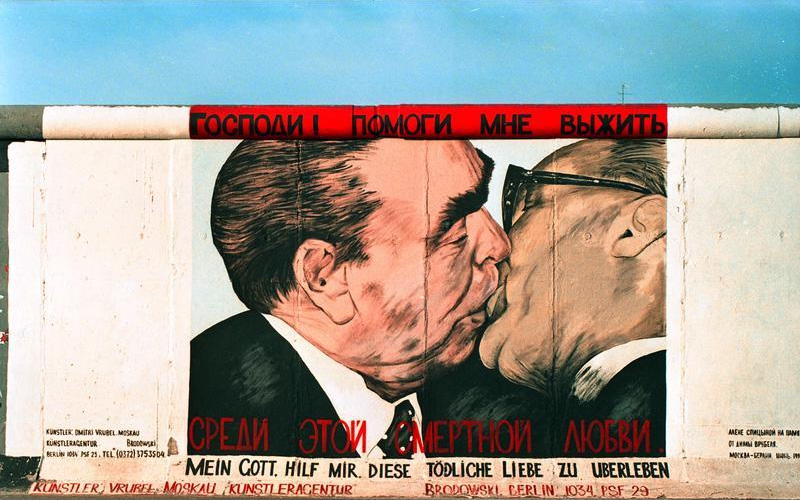
Berlin, East Side GalleryIn 1989, during the euphoria following the fall of the Berlin Wall, Dmitri Vrubel painted a replica of the kiss on the Eastern side of the Wall. If you wish to learn a bit more about the photo and the painting, here are a couple of links:

  1. Lite Strabo Stories from History blog
  2. Wikipedia

While we can learn much about history and politics from photos such as these, we can also learn about customs and values. And, perhaps most importantly, we can learn to see our own cultural filters and biases a bit more clearly. Exercises such as these can be used to complement the learning we gain about ourselves via the Cultural Detective Self Discovery.

Coincidentally, when she was proofreading this post for me, our editor, Kathryn Stillings, shared with me that she had just read this article, about our perceptions (socially constructed) of race: What Does “Black” and “White” Look Like, Anyway?: Obama and His Grandpa. I share it with you as it would seem to support, as well as build on, the point of this post. I particularly love the morphed photos at the bottom of the article.

Before I close, I’d like to thank a few of the members of SIETAR Argentina, who recently used the second photo above in a training, and reminded me of it after so many years.

And, in conclusion, I leave you today with a few quotes:

There is no truth. There is only perception.
—Gustave Flaubert

Science is nothing but perception.
—Plato

Studies have shown that 90% of error in thinking is due to error in perception. If you can change your perception, you can change your emotion and this can lead to new ideas.
—Edward de Bono

Resumen de las principales diferencias culturales

CultDiffsMapSpanish

(English follows Spanish.)
En mayo de 2012 escribí un blog acerca de cuando trato con las dimensiones de cultura, frecuentemente las utilizo en forma de mapa, para ayudar a la gente a encontrar los factores que pueden estar en el camino de una mejor comunicación. He encontrado que esta es una excelente manera de trabajar las dimensiones.

Fernando Castro debriefing a critical incident using the Cultural Detective Worksheet

Fernando Castro analizando una historia con la Hoja de Trabajo Cultural Detective.
Fernando Castro debriefing a critical incident using the Cultural Detective Worksheet

Este mes he tenido la alegría y el privilegio de trabajar con Fernando Castro de AFS Argentina y Uruguay. Él generosamente tomó este mapa de las diferencias y lo tradujo al español para nosotros.

Invito a todos a utilizar esta nueva versión en español bajo la licencia Creative Commons. Esto significa que usted puede utilizar el gráfico y la información en el artículo, siempre y cuando mantenga los derechos de autor y URL original.

¡Mil gracias, Fer!

In May of 2012 I wrote a blog post about how I frequently use the dimensions of culture in map form, to aid people to locate the factors that may be getting in the way of better communication. I have found that this is a terrific way to put the dimensions to use.

Fernando Castro debriefing a critical incident using the Cultural Detective Worksheet

Fernando Castro debriefing a critical incident using the Cultural Detective Worksheet

This month I had the joy and privilege of working with Fernando Castro of AFS Argentina and Uruguay. He most generously took this Map of Differences and translated it into Spanish for us.

You are all welcome to use this new Spanish language version under a Creative Commons license. This means that you may use the graphic and the information in the article so long as you retain the original copyrights and url.

¡Mil gracias, Fer!

Crowd-sourcing a New Map for the Buckminster Fuller Institute

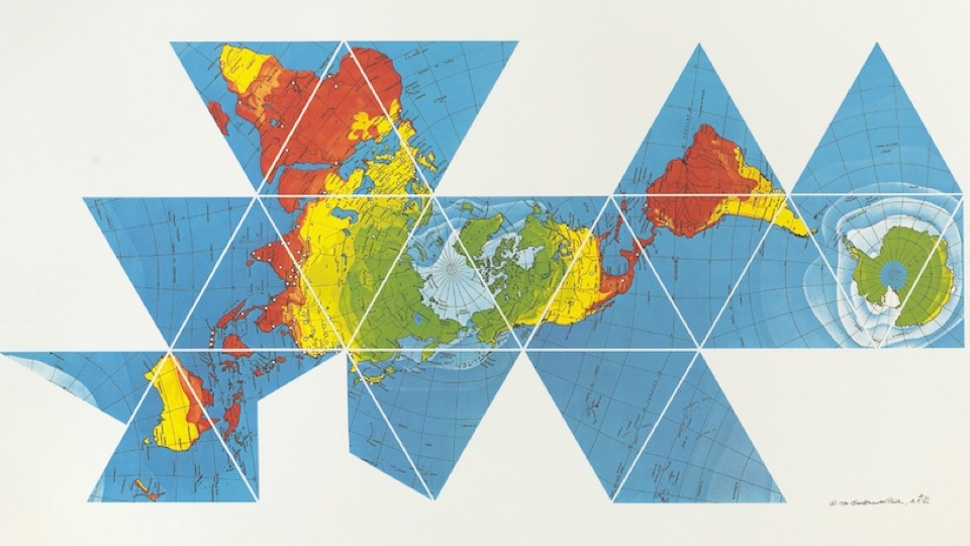
Fuller's Dymaxion Map
I have many times used Buckminster Fuller’s Dymaxion World Map in my global leadership and international management training sessions. I especially like the small, foldable, cardboard versions of this map that I purchased years ago. I often put several in the center of each work table in the training room, and participants enjoy folding and unfolding them. It reminds people how interconnected our world is, and how beneficial it can be to think differently. (I do not find these in their store currently, sorry to say, but there are links below to postcards and magnets.)

Dymaxion_2003_animation_small1

Since I have found this map so useful, I’m pretty confident you all will be interested in this cool contest the Buckminster Fuller Institute and our dear friend Bob Abramms over at ODT Maps have arranged. Below are the details I received this morning. Good luck, Cultural Detectives! Do us proud!

Disclaimer: We do not receive any “kickback” and have no financial involvement in BFI or ODT. We post the below offers because we feel they may interest you.

Famed futurist Buckminster Fuller’s Dymaxion World Map appeared in Life Magazine seventy years ago. With an undistorted projection of the Earth’s surface, ability to be easily reconfigured and transform from a 2-D map to a 3-D globe, the Dymaxion Map (patented in 1946) was a cartographic breakthrough and its iconic design has inspired generations since.

In celebration of the map’s publication anniversary, the Buckminster Fuller Institute (BFI) is calling on today’s graphic designers, visual artists, and citizen cartographers to create a new an inspiring interpretation of the original Dymaxion Map.

BFI will publish accepted entries within an online gallery, feature the selected finalists in a gallery exhibition in New York City and select one winning entry to be produced as a 34″ x 22″ poster. BFI is seeking submissions across the creative spectrum and will be selecting the winner based on originality, aesthetic beauty and informative qualities. The contest is open to all and will provide entrants with a high-res image to use as ‘canvas’.

DETAILS HERE     ENTRY FORM HERE 
Submission Deadline: June 14, 2013   •   Winners Announced: July 12, 2013

All entries will receive a PDF copy of ODT’s new e-book (see below) and the contest winner will receive an autographed copy of the paperback!

Just want to order the map? Click HERE

Dymaxion postcards and magnets are also available.

SPECIAL: Order a Dymaxion wall map before June 1st and get five free Dymaxion postcards

Or order new Dymaxion T-shirts from BFI here.

Fuller’s Dymaxion map is also featured on the cover of (and inside) our forthcoming paperback book: The BFI contest winner will receive an autographed copy.

Stay tuned for our pre-publication special to be announced in the next 5 weeks!

The Best-Kept Secret of Successful Teams

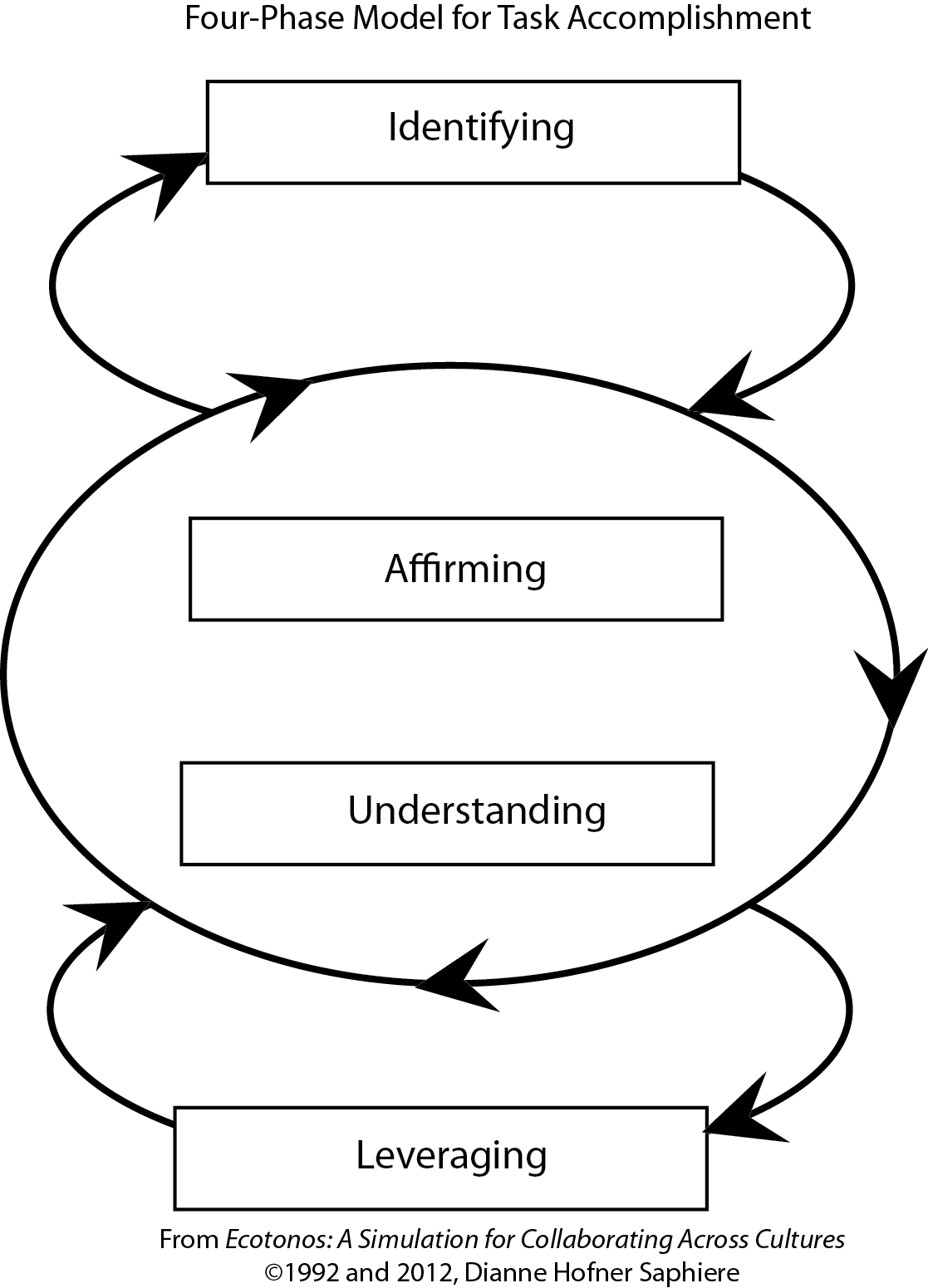
4 Phase ModelAlmost every team and community today is diverse in some way or another: gender, age, spirituality, professional training, ethnicity, nationality… While we respect other styles and cultures, most of us still get stuck at some point where we say, “OK, we’re different; now how do we work (or live) side-by-side? How do we harness our differences as creative assets? At a minimum, how do we simply keep from driving each other crazy?”

We might work with partners who view time as flexible and events as unfolding. This may mean that, to them, deadlines are mutable and subject to change. Meanwhile, we push ourselves and our bodies, working overtime to make sure we honor our commitment to an agreed-upon deadline. While we may respect our colleagues’ view of time management on a theoretical basis, and perhaps envy them their apparently healthy work-life balance, how do we succeed with partners who don’t seem to respect their commitments to deadlines?

Perhaps we have a neighbor or even a waiter at a favorite restaurant who communicates very directly, yet we prefer a bit more indirection, thank you. While we respect their communication style, it can get irritating and try our patience.

Too often we fail to actively seek to bridge differences because we see them as something negative, as something that separates rather than unites us. Yet, by ignoring our differences, by pretending they are not there, we imbue them with great power. Eventually they can get the best of us, surprising us at awkward moments and causing frustration and tension. Our reluctance to address differences may stem from a fear that acknowledging their existence may push us farther apart rather than allowing us to collaborate enjoyably.

So, how do we transform these differences into assets? How do we convert them from something to be denied, hidden, or tamped down, into something to be embraced and used for the good of the organization and the team?

One model that has proven quite useful over the past two decades of use comes from the classic and widely used simulation, Ecotonos: A Simulation for Collaborating Across Cultures. Called the “Four-Phase Model for Task Accomplishment,” this very simple approach guides us to first identify the similarities and differences at play in our interaction, verbally affirm them, spend time understanding them and, finally, explore how to leverage them.

How a specific team leverages similarities and differences will depend on the members of the team and their shared goals and realities. Each team creates its own team culture, ideally based upon and growing out of the first three phases of this Four-Phase Model.

As you can see in the graphic above, the Four-Phase Model is not linear, but rather each phase weaves into and out of the other. For example, understanding may lead to further identifying, or leveraging may lead to added affirmation.

A text description of the Model accompanies Ecotonos and provides further elaboration of the graphic:

Identifying
  • Perceiving similarities and differences
  • Establishing which differences are divisive and which commonalties unite
  • Creating self-awareness of one’s own strengths and styles
  • Appropriate balancing of the tension between sameness and difference
Affirming
  • Confirming individual commonalties and differences
  • Substantiating that difference is desirable
  • Legitimizing difference in the eyes of the group
  • Welcoming conflict and paying attention
Understanding
  • Attempting to understand the other person’s perspective
  • Stepping into the other’s shoes
  • Mirroring/exploring and discovering together
  • Probing for deeper comprehension using various approaches
  • Seeing an issue from several vantage points
Leveraging
  • Defining how team members can contribute to goal accomplishment
  • Agreeing on methods for utilizing team expertise
  • Facilitating the generation of creative solutions
  • Creating a “team” culture
  • Focusing on efficiency and effectiveness

Once people become comfortable with the Identifying Phase, they may perceive the Affirming Phase as something unnecessary, a waste of everyone’s time. “We are all adults. We don’t need to give one another kudos.”

But my extensive experience proves, over and over again, that taking the time and effort to actively engage in the Affirming Phase is well worth the investment. Proceeding more slowly allows the team to accomplish more in less time, so to speak.

Below is one video that illustrates the value of affirmation in our lives. It is pretty long, but you’ll get the idea pretty quickly and I’m confident you’ll enjoy watching it.

The Four-Phase Model is one tool that can powerfully transform conflict into productivity and innovation. And, by the way, don’t forget that you are awesome!


“Collide-o-culture” or “Kaleid-o-culture”: GPS for Human Beings

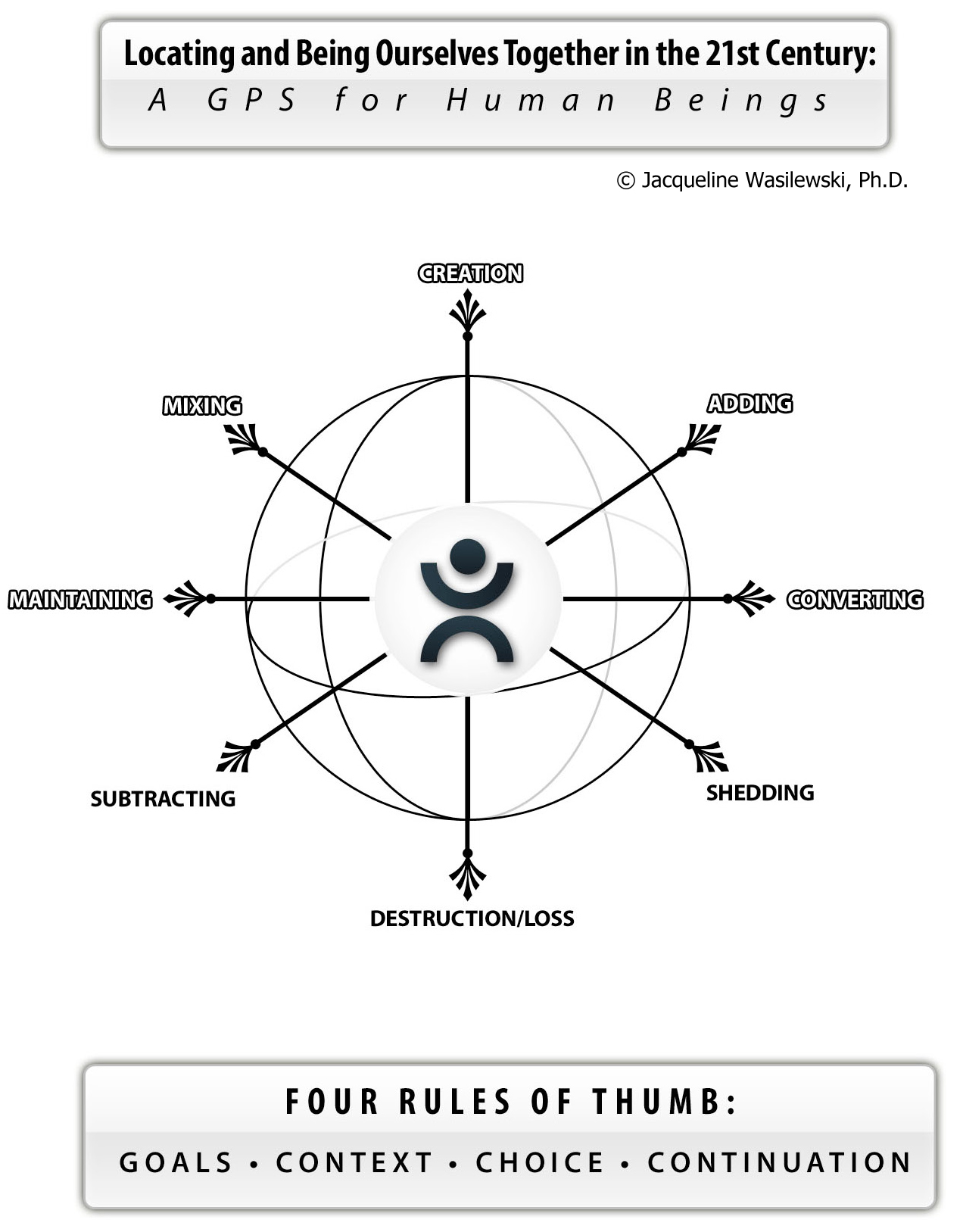
This graphic and the concepts underlying it are the work of Jackie Wasilewski.

“Collide-o-culture” or “Kaleid-o-culture”

I have long been a fan of Jackie Wasilewski’s. She is one of the brightest shining stars in our intercultural field, plus an all-around terrific human being and friend.

Her investigations are motivated by a couple of key objectives that dovetail beautifully with our work at Cultural Detective®:

  • How to include everyone (in her extended family at her holiday dinner table) in their full authenticity?
  • How to reconcile highly contrastive content (how to bridge), when it seems impossible to please everyone simultaneously?

Values ≠ Traditions
One point she makes is that values are not the same as traditions, and the two must not be confused. Values can be held while behavior is changed—a la Cultural Detective. Jackie told us in Spokane that when cultures get threatened, they get reified. That when cultures stop changing, they die. So, our quest needs to be, how to preserve and change, simultaneously?

GPS for Human Beings
Way back when Jackie conducted her Ph.D. research, she analyzed the personal histories of 192 multicultural people. That approach—learning from the inside-out rather than the outside-in, is also the Cultural Detectiveapproach.

One of the outcomes of her research was the graphic shown above, a “GPS” outlining paths to multiculturalism. The negative paths at the bottom of the sphere used to have only one label, subtracting, but over time this label has come to include destruction/loss and shedding, and Jackie tells us that the “choice” of this direction is often the result of oppression. However, this cluster of negative pathways also has a mysterious connection to the creation option at the top of the choice sphere. Sometimes the old has to be wiped away for the new to come into existence. At Cultural Detective we usually aim for mixing, creation, or adding. The final two options in her framework are maintaining and converting/assimilation. Here is a quote from the paper she presented:

To use this “GPS” effectively, each of us has to examine our goals and the characteristics of the context in which we are making the choice. Where do we want to end up? What are the opportunities and constraints of the environment in which we find ourselves? Where are our “degrees of freedom”? What are the costs and benefits of taking each direction? Which “direction” will lead us nearer our goal?

We have to imagine that we are like an aikido master standing in the center of a sphere consisting of the six options or “directions” [maintaining, converting, mixing, adding, creating and the subtractive cluster]. At each choice point, we have to consider all our options, just as if we were considering them for the very first time. None of these directions is better or worse. None is of higher or lower rank. Some are more complex to enact in a given context or set of circumstances. But the best choice is the appropriate one for enabling us to continue towards our goal in that particular context.

To manage these options productively people need a support network; a supra-ordinate goal; the ability to acknowledge their own complexity; the ability to transform negative emotional energy into positive energy; the ability flexibly to use the six options stated above; and at certain key moments, the ability to publicly stand for their full complexity so that new social space can be created.

“Collide-o-culture” or “Kaleid-o-culture”?
One of her definitions of “people power” is the web or sphere of interpersonal relationships we hold. Jackie tells us that if we think in relationships, then when we meet another individual we will realize that we are bringing together two communities. In her words, will it be “Collide-o-culture” or “Kaleid-o-culture”? If we see the relationships, we will be more motivated to try to understand.

Indigeneity and Respect
The concept of “indigeneity” emerged from work conducted by LaDonna Harris, a Comanche woman and political advocate, and Alexander Christakis, a systems scientist. They discovered that indigenous people and 20th century knowledge management specialists had similar approaches to the management of complex problems. The four principles they identified for organizing societies that are both inclusive and just are: Relationship, Responsibility, Reciprocity, and Redistribution. The result of these four R’s is a fifth: Respect. Goals of the ongoing work that has now been taken worldwide include maximum autonomy and maximum choice for the smallest units of society. To again quote Jackie’s SUSA paper:

Physician, therapist and healer, Brenda Davies (2007) says there is “nothing but communication.” Our truth, as we know it, is always what we are communicating. However, we have to be willing to update our truth every second. Our integrity is also a function of our truth as we know it. Each of us has a unique integrity based on our experiences. It constitutes our personal set of rules, but it too is always moving. Understanding another person’s integrity is the best we can do, and it allows us to love them separately from their behavior. The key would seem to be to create discursive spaces like the ones discussed above where we can all update our truth together and enable our mutual integrity to rise exponentially.

This is a VERY brief overview and of course does not do Jackie’s work adequate justice.  I trust it will motivate you to learn more about her work, and to use what she knows in order to use the Cultural Detective method and materials to the highest benefit. You can download a full copy of the paper she presented that this article summarizes.

(This post is taken in major part from an article I wrote in 2010.)

Catalysts For Intercultural Conversations and Insights: Advertisements

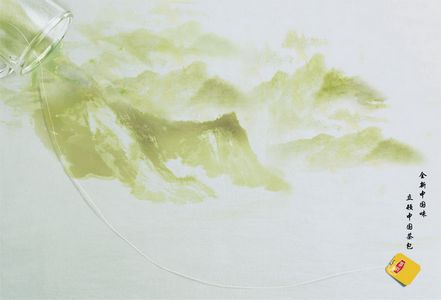
Lipton tea Chinese flowersThis guest blog post is written by Joe Lurie, Executive Director Emeritus, University of California Berkeley’s International House.

Recently, I taught a course attended by Chinese and French students on the intercultural challenges of marketing across cultures. Midway through the course I asked students to select a print, web or YouTube ad describing how the following items reflected cultural preoccupations, values and behaviors in their cultures:

  • the product being promoted
  • the selection of words in the headers
  • the images and colors being used to reinforce the message

After analyzing the ad as a reflection of one’s culture, the student was to ask a fellow classmate from another culture why the ad would or would not work in their culture. In one example, a Chinese student demonstrated how Lipton tea is marketed in China. He noted that no tea bag was explicitly shown, as tea bags do not speak to the traditional way of preparing tea in China, and so not the best way to convince people to drink the Lipton product in China. Rather, the image was of green tea flowing from a cup on its side, producing green images in the style of Chinese paintings of mountains, fish and flowers, each with a particular symbolic value in Chinese culture. Lipton tea Chinese mountains The French student who was interviewed had no exposure to traditional Chinese painting and saw not lovely images, but rather incomprehensible splotches! He added that the ad would not work in France as tea drinkers are generally accustomed to black or brown teas.

Color in many other ads revealed the power and status implications of yellow in China, yet something to beware of in France where it often suggests infidelity. Below from a French student are two different ways that Volkswagon is promoted in China and France, reflecting a powerful individualistic/collectivistic contrast, and a terrific way for students to engage in a conversation of cultural discovery:

Below you will find an ad for a cleaning sponge selected by a French student, revealing what the student felt is a preoccupation with sex—reflected in explicit and other seductive ways in many other ads for other products in France. Sexual suggestions, so graphically portrayed, would not, according to the Chinese students in my class, be acceptable in Chinese product promotions. And in a French ad for BMW, a man is  shown making love to the body of a woman whose face is in fact a BMW!

BaijuuA Chinese ad for a very strong 38% alcohol rice beverage portrayed a bottle whose shape was interpreted by the French as a perfume bottle, and so it would not be a convincing way of promoting an alcoholic beverage there.

The bold red color signifying affluence and status for the Chinese was seen as over the top by the French students, who noted a preference in the French aesthetic for far more nuanced, muted colors. This prompted a spirited conversation between the Chinese and French in which it was revealed that ads with very high alcoholic content are discouraged or banned in France, but visual ads for condoms were common there, though not generally acceptable in China. That conversation ended with a comparison of toasting custom—the French “drink and sip” vs the Chinese GAMBAY or “bottoms up”—ALL at ONCE!

Should readers of this blog try this approach in their intercultural classes and training sessions, I hope you will consider sharing the fun and insights here….

—Joe Lurie
Executive Director Emeritus at the University of California’s International House, Joe is currently a cross-cultural communications consultant, university instructor and Cultural Detective certified facilitator. Contact Joe via email or LinkedIn.

Some Cultural Detective Training and Coaching Activities

Exploring how we value our own and each other’s cultural values–another step in CD sleuthing.

All too often we trainers are apportioned a less than useful amount of time for impacting the attitudes of our trainees. This affects our use of Cultural Detective as well as many other tools that we may choose or not choose to use under the pressure of diminished schedules.

When using Cultural Detective, I find it ever more important to differentiate what we do with the Values Lenses and the indigenous discourse that lies behind them from a lot of other intercultural training approaches that focus on dimensions and increasingly lead to stereotyping. When we speak about the values in Cultural Detective, it is important to remember that these have been developed through and by the inner language and feelings of the very members of those cultures that the instruments represent.

Nonetheless, when speaking of values, it is becoming increasingly common for us to have individual participants who question them, who do not identify with them, or who even dismiss them as stereotypes. Given that the best way of dealing with resistance in a pedagogical context (as well as many other contexts) may be to flow with it and direct its energies, I have developed a few approaches that I feel may help us in these somewhat challenging situations. I’ve described them as they might be used in a teaching or training context, but they may be adapted to individual and team coaching situations as well.

First, wherever possible, I use Cultural Detective: Self-Discovery, or at least an exercise or two from it, so that participants can at least claim some inheritance of cultural values and identify them as their own. This legitimizes the discussion of culture where it might be resisted. It usually overcomes or at least mitigates the participant’s temptation to see him or herself as acultural and the tendency to vaunt oneself as a global citizen, uncontaminated by inherited culture. This is not to deny, but to affirm the fact that TCKs and others like them may be digesting a smorgasbord of cultural influences as well as generating certain cultural features pertinent to their common experiences (explored in Cultural Detective: Blended Culture and CD Generational Harmony). Often elements of cultural identity are denied because they have caused pain in growing up and finding social inclusion. Once culture is legitimated as a topic of discussion and a relevant problematic for the individual being coached or the group being trained, other things become possible.

Here are some approaches that we use when one culture is trying to learn about another specific culture, as for example, when working with teams resulting from mergers and foreign acquisitions and installations. In such cases cultural conflicts and misunderstandings are often the elephant in the room, potentially touchy subjects. While Cultural Detective may be the ideal tool for pursuing understanding on both sides, it is not always a given that participants will spontaneously identify with the values of their own culture as they are presented in the Cultural Detective materials.

So, let’s say, for example, that we are dealing with German and US cultures, either in an organizational relationship or collaborative team. Daimler-Chrysler has already demonstrated that even a good bit of upfront diversity work and intercultural instruction may not be adequate to deal with our own deeply rooted values and our perceptions of others unless they are continually identified and addressed. Thus the Cultural Detective process must be mastered and practiced and in many cases facilitation must be applied on an ongoing basis until a functional collaborative culture is established. This can take quite a while.

Facing the possibility of denial of difference as well as the possibility of participants rejecting their own or the others’ cultural Values Lens as stereotypical or just plain wrong, here are a few strategies that I’ve found to be successful. Perhaps some of you have already discovered these on your own. If so, I would be interested in hearing your versions.

  1. Evaluating the strength of the discourse and the value that sums it up. I ask participants to study their own culture’s Lens and then rate on a scale of 0 to 5, weak to strong, their own sense of how they’ve personally appropriated and express in everyday words and actions each of the values described. Then I ask them to share this with their compatriots as well as with the representatives of the other culture who are participating with them. This is a matter of not only sharing their numerical rating of the values, but talking about how each cultural value expresses itself in their thinking and behavior, as well as what parts of it don’t seem to fit or which they don’t like to identify with. This may or may not resemble or relate to the “Negative Perceptions” found on the Lens itself.
  2. Identifying commonalities: Following this discussion, I ask the individuals of each culture to study the other culture’s Lens and to do two things. First, again on a scale of 0 to 5 to assess whether, and if so, the degree to which they identify with each of the cultural values of the other group as found on the lens. Then, secondly, and this is extremely important, to identify and jot down the keywords of their own inner conversation or discourse about the importance they accord to the values they seem to share and the ways in which they may practice each of them.  Thirdly, depending on the size of the group, ask them to share their results either individually, or to conduct a discussion within their same culture group and then have the groups report out their results to each other. Here is where the essential value is gained from seeing how people would express their appropriation of elements belonging to the other culture.
  3. How do we like to be treated? Given adequate time, here is another very valuable activity that could occur at this point, but might be even better to use after the group has resolved a critical incident or two. Ask each separate culture as a group to meet together to discuss and identify and list both the attitudes and kinds of treatment that they appreciate coming from the other culture, as well as those kinds of speech and behavior that they may find uncomfortable or even damaging to the collaborative and social relationship they are trying to create with each other. The previous activities at various points are likely to lead toward the identification and discussion of stereotypes, giving rise to another possibly useful activity. I have found that frequently trainers and teachers, perhaps out of a misguided sense of political correctness avoid the discussion of specific stereotypes or stereotypical expressions, missing a valuable learning opportunity.
  4. Investigating stereotypes: We’ve long accepted the fact that stereotypes contain a kernel of truth, but that the perspective with which they are expressed maybe overgeneralized and conducive to negative judgment. So, instead of dismissing stereotypes out of hand, we can use them as starting points for deeper discussion and further understanding. So, when stereotypes surface, I ask participants to discuss questions like the following ones:
    • What is the truth in them, however small? What do you think brought them about in the first place? What perpetuates them? What insights or cautions do they deliver to us? What is the discourse that we carry about self that makes them true for us when they are about us?
    • What exaggeration do they contain? What is the discourse that makes them noxious, conflictual, etc.? When are they likely to be painful or damaging? What limits do they place on our knowledge and our inquiry about others?

So, as I mentioned above these are some of the useful practices that I keep in my tool bag for enhancing the effectiveness of Cultural Detective.  It would be good to hear what others of you have developed or ways in which you view similar activities.

What Do You Mean?! I’ve Worked Abroad 20 Years and Score Low?!

Image from The Vegetarian Athlete

So many of you seemed to resonate with my blog post about intercultural fitness, Tweeting it, Scooping it and passing it around the social media networks, that I thought you might be interested in a short article I originally drafted back in 2005 that uses the metaphor of an athlete to explain intercultural competence.

Developmental Intercultural Competence and the Analogy of an Athlete

Milton Bennett’s Developmental Model of Intercultural Sensitivity (DMIS), first published in 1986, provides a well-regarded theory about the process people go through as they learn to make sense of the complexity of cross-cultural communication. In the late 1990s after much research, an assessment for measuring intercultural sensitivity based on the DMIS was developed. Version 3 of the Intercultural Development Inventory (IDI) is currently in use by qualified practitioners. Owners and users of the IDI have in turn used their results to revamp the DMIS into the Intercultural Development Continuum (IDC).

While such tools can be useful for measuring program effectiveness when used for pre- and post-testing, and can be hugely beneficial for individuals who want to improve their cross-cultural communication and collaboration, there are downsides. I’ve worked with career expatriates and global nomads, for example, who score quite low on the IDI. What this means is that the low-scorer may have a lot of experience, but has not yet engaged in systematic, structured sense-making of those decades of complex intercultural experience. I’ve also worked with quite a few individuals who value harmony as fitting in, and thus, on a scale that measures celebrating differences, they score comparatively low. Predictably, low scores can cause people to become focused on discrediting the instrument or rationalizing the assessment process, rather than on gaining benefit from what the results have to say.

To help learners focus on the guidance these tools can provide, I often use the analogy of an athlete. Just as athletes need multiple abilities to perform well, so do intercultural communicators. Both athletes and intercultural collaborators can use assessments to guide their performance improvement training.

Let’s say that the data on my athletic performance shows that I need increased flexibility. I dedicate several months to becoming more flexible, and then my coach tells me that I now need to shift my focus to building strength — of course while maintaining my flexibility. Months later, I may find that I need to refine my technique in order to make the most of my superior strength and flexibility. Or, I get injured, and I decide to add to my training a focus on my mental game: overcoming adversity, learning from mistakes, being fully present in the moment. Athletes thus focus on multiple abilities at different points throughout their careers in order to perform at their best.

In a similar way, the DMIS, IDI and IDC can be used to show us which issues we should focus on at a given point in time in order to maximally improve our intercultural performance. While developmental models and assessments are designed as measuring sticks or standards of comparison, their value for personal competence development is to highlight to us what competencies we should focus on building at each point in our careers in order to improve our overall performance.

Each of us has to balance the dynamic between comfort and stretch, challenge and support, growth and rest, in our own ways. Knowing what we are good at, as well as where we can improve, can help ensure we continue to develop. Using an assessment tool to gauge and target our intercultural development, in combination with a competence development tool such as Cultural Detective Online for ongoing, structured learning, is a powerful combination.

More Cultural Appropriation: The Swastika

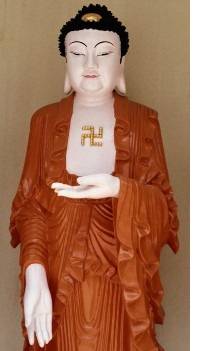
The story we published recently about cultural appropriation reminded me of one of my favorite incidents in our series. It resides in the Cultural Detective Global Business Ethics package, and involves a corporate newsletter publishing photos from the office in India. One photo, taken at a temple, shows a swastika.

Outraged, an anonymous writer emails the newsletter editor to complain about a lack of cultural sensitivity, a lack of commitment to diversity and inclusion. The newsletter editor is crestfallen; the comment saps all his energy. It is exactly his commitment to inclusion and diversity that has motivated him to include posts from offices worldwide! How much harder can he try?

The swastika is sadly a symbol of genocide and the Holocaust for many; something to be reviled. There was an unsuccessful effort to ban the use of the swastika in the European Union. Seeing this symbol can bring forth indescribable pain and outrage for many people.

Swastika is a Sanskrit word, a religious symbol of good fortune used by Hindus, Buddhists, Jains and others worldwide. It can be seen in the art of the Egyptians, Romans, Greeks, Celts, Native Americans, and Persians as well.

To me, the swastika is one of the world’s most horrifying misappropriations of a cultural symbol! I’d welcome hearing from anyone who knows the history of Hitler’s and the Nazis’ appropriation of this symbol.

It is important for us to understand both of these very different realities. To some, the swastika symbolizes genocide and hate. To others it symbolizes beauty, the steps of Buddha. Does this therefore mean we should not use it? That we should? Can we transform its use through ongoing learning and dialogue?

Back to the incident, learning to make the most of learning opportunities such as these, to encourage cultures (organizations, communities) in which people listen to, respect and collaborate with one another, is what Cultural Detective is all about. Thank you all for joining us in this mission!

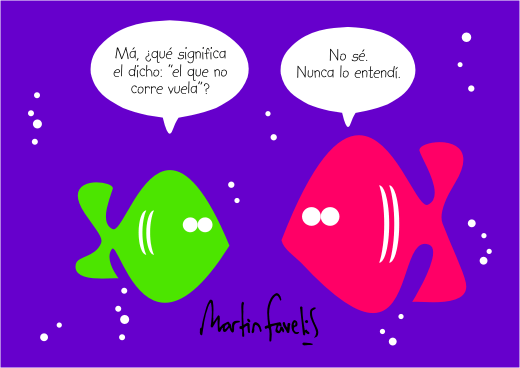
Me han dicho un dicho…


“Mom, what does that proverb mean, ‘he who doesn’t run flies’?”
“I don’t know. I never understood it.”

(English follows Spanish)

Nada refleja con tanta precisión la sabiduría popular como los dichos y refranes. Una herramienta a la que acudimos de manera natural y nos ha sido heredada básicamente por tradición oral. Son también los refranes una reflexión propia y tal vez inconsciente de muchos de nuestros patrones culturales y por qué no, un paso elemental en la construcción de nuestro propio camino hacia la inteligencia cultural.

La inteligencia cultural es definida por Thomas & Inkson como la capacidad de interactuar de manera efectiva con personas de diferentes antecedentes culturales, una competencia múltiple que consiste en el conocimiento cultural, la práctica de atender (podría añadir la aprehensión mental del conocimiento adquirido) y una serie de habilidades en el comportamiento.

Y entonces, ¿qué tienen que ver los refranes con toda esta teoría? Yo insisto que mucho, pues son una guía de origen popular que nos orientan en conocimiento, aprehensión del conocimiento y por supuesto el comportamiento. Veamos algunos.

  1. No todos los dedos de la mano son iguales. Por supuesto, todos lo hemos visto y sabemos que cada uno difiere en tamaño y funcionalidad. Nos dice brevemente que somos diferentes e iguales a la vez, todos son parte de una mano (unidad) pero todos son diferentes (diversidad) y conviven armónicamente, se necesitan mutuamente. Una mano sin dedos no es mano, y una mano que no tenga cinco dedos no funciona bien. Por cierto, ¿recuerdan el gringo chévere? pues me encontré el anti-chévere en la misma empresa. Definitivamente, no todos los dedos de la mano son iguales.
  2. A la tierra que fueres haz lo que vieres. Nada más cierto. Cuando nos enfrentamos a un nuevo entorno (corporativo, geográfico), nos enfrentamos a muchos comportamientos que tal vez nos sean ajenos. Hacer los que vemos, no se limita a imitar sino promueve la adaptación de nuestro comportamiento al nuevo lugar. Detrás de este cambio por supuesto debe estar el conocimiento (el por qué) y la aprehensión mental del mismo (entendimiento). Si se cuenta con estos dos últimos, muy seguramente “hacer lo que vemos” no será motivo de choques culturales.
  3. Cría fama y échate a la cama. Cuántas veces no somos relacionados por buena o mala fama que nos corresponde. Los latinos tenemos fama de impuntuales, y también de alegres. Esto corresponde a los estereotipos, que si bien son reales y ciertos, también lo es el hecho que basarnos sólo en estos puede llevarnos a juicios y malentendidos que generen choques personales, culturales y sociales.
  4. De tal palo … Tal astilla. Somos herederos de genotipos y fenotipos que determinan nuestra apariencia física, pero también heredamos comportamientos, valores, creencias que nos hacen parecer (la gran mayoría de veces) a nuestras familias (padre, madre, hermanos, abuelos, etc). Sin duda alguna heredamos patrones culturales, que se modifican únicamente con la determinación de aprender nuevas habilidades, de interactuar con entornos diferentes a los de nuestra infancia y sin embargo, muchas de nuestra formación de casa permanece para toda la vida, ya saben hijo de tigre sale pintado.

Y los anteriores son tan sólo un ejemplo de tantos que hay en cada lugar, por esto todos los paquetes Cultural Detective contienen refranes/dichos de cada cultura. Le invito a que piense en sus refranes más recurrentes y que descubra cómo se relaciona con lo que podría describir como su cultura. Le invito además a que publique los que quiera compartir y nos comente cómo estos refranes se relacionan con los temas que tratamos diferentes autores en este blog.

Amanecerá y veremos…

They have told me a saying…

(translated by Dianne Hofner Saphiere)

Nothing reflects popular wisdom with as much precision as do proverbs and sayings. Proverbs are tools that we come by naturally and that we basically inherit through oral tradition. Proverbs are a reflection of ourselves and our often unconscious cultural patterns. They can also serve as a key step in our own path towards cultural intelligence.

Cultural intelligence is defined by Thomas & Inkson as the capability to deal effectively with people from different cultural backgrounds. It is a multifaceted competency consisting of cultural knowledge, the practice of mindfulness, and a repertoire of behavioral skills.

But what do proverbs have to do with all this theory? In my opinion a lot; they are a popularly originated guide to knowledge, to recognition of our knowledge, and to behavior. Let’s look at a few.

  1. Not all fingers on a hand are equal. Of course we all know that each finger is different in size and function. This brief saying tells us that we are all different and yet all the same. We are all part of one hand (unity) and each of us is unique (diversity). Unity and diversity live together in harmony and mutual necessity. A hand without fingers is not a hand; a hand without five fingers doesn’t function well. Do you remember, “El gringo chévere/The cool gringo”? Well, I met the anti-cool-gringo in that same organization. Definitely not all the fingers of a hand are equal!
  2. When in Rome do as the Romans do. Nothing could be truer. When we find ourselves in new places (corporations, geographies), we may be faced with many behaviors that seem strange. When we see differences, do we mimic the behavior we see, or do we truly try to adapt our behavior to the new place? Underneath any effective adjustment must be knowledge (the why) and mental comprehension (understanding). If we remain conscious of these two things, “doing as we see” will not cause cultural bumps.
  3. Breed fame and throw yourself into bed. How many times are we prematurely judged? We Latinos are famous for our unpunctuality, as well as for being happy. These are stereotypes. While they have some sense of reality and truth, basing our actions only on these perceptions will cause judgments and misunderstandings that lead to interpersonal, cultural and social miscommunication.
  4. Like father, like son. We are heirs of genotypes and phenotypes that determine not only our physical appearance but also our attitudes, values and the beliefs that (usually) make us part of our families. Without doubt we inherit cultural patterns that we modify only with the determination to learn new skills, to interact with environments different from those of our childhood. Even so, many of our formative experiences in the home follow us throughout our entire lives. As they also say, “the son of a tiger comes out with stripes.”

These proverbs are just a few examples out of many that exist in each place. That’s why every Cultural Detective package includes sayings and proverbs of each culture. I invite you to think about the proverbs you hear most frequently, and to reflect on how they relate to what you might describe as your culture. I invite you also to share with us some of those proverbs, and explain how they relate to the themes taken up by the various authors of this  blog.

I look forward to hearing from you…