Want to Get Interculturally “Fit”?


The image above is part of the “Got Milk?” ad campaign; the copyrights belong to their owners. We reproduce the image here to equate the ideas “Got milk?” and “Got intercultural competence?”

Got intercultural competence? Want to get interculturally “fit”?

Do you want to improve the success of your international negotiations? Mergers and acquisitions? Want to get more productivity and even joy out of your virtual teams and projects? How about jump starting the outcomes of study abroad and international education?

Intercultural competence is not something you attend a workshop about and then check it off your list. Just as physical fitness requires ongoing activity, practice, commitment and discipline, so does the development of intercultural competence. You do not become physically fit by exercising and eating right one week out of 52. Nor do you become interculturally competent merely by having lived abroad or having earned road warrior status or flight rewards. Intercultural competence requires that we take the time and focused reflection to make meaning of our experience, to apply it, and then to keep refining and upgrading it.

Physical and intercultural fitness both require ongoing, structured practice. Discipline. We can’t be physically fit if we don’t exercise and move our bodies regularly. We can’t be interculturally fit if we don’t regularly reflect on our own values and behavior, that of others, and on our skills and strategies for bridging similarities and differences and making the most of diversity by creating inclusive spaces.

Terrific. So you’re committed to the journey. You want to get started. How? Well, to become physically fit you might start monitoring what you eat. You might join a gym, or commit to an exercise program. Similarly, to develop intercultural competence you could subscribe to Cultural Detective Online. You start a structured exercise program or join a gym of intercultural competence. At less than $100/year, a subscription is definitely cheaper than most gyms!

But, as we all know, joining the gym does not give us physical fitness. We have to actually GO TO the gym! We have to actually get out of the lounge chair and move our bodies, regularly and repeatedly!  So, we promise ourselves to spend an hour or two a week for the next three to six months, going into Cultural Detective Online to reflect on our experiences, dialogue with our teammates, learn about ourselves and others, upload and debrief stories from our daily lives. Perhaps we form a group of like-minded friends and colleagues, to support and encourage one another. And, as we practice, we find we enjoy it! We come to crave it! We start to look forward to the learning and insight! The cycle feeds itself, propels itself forward; each step towards intercultural fitness encourages us on to the next.

Finally, just as on our journey to improved physical fitness we might consult a nutritionist, dietician, personal trainer or coach, once we are committed to developing intercultural competence we may find it helpful to hire a personal trainer or coach. You have access to many talented professionals via the Cultural Detective authoring team, the list of certified facilitators, and the SIETAR (Society for Intercultural Education, Training and Research) chapters worldwide (list of chapters with links is at lower left of the linked page), as well as various coaching associations. There are more and more classes taught worldwide that incorporate the Cultural Detective Method and CD Online. We very much encourage you to take advantage of these resources.

We would love to hear from you about your intercultural fitness regime! Please share with us so that we might learn from and be encouraged by your progress!

Cultural Detective Online is LIVE!!!!!!!!

Cultural Detective is proud to announce the new product launch of Cultural Detective Online! This tool is like having a virtual coach in your back pocket, successfully guiding you through the all-too-common missteps of cross-cultural negotiations and communications. Please check out the four videos on the home page. Today only (15-16 October, depending where you are on the planet) there is a 25% launch discount; enter promo code:   CDO-blog25  during checkout.

Huge thanks goes out to each of you who have worked with and incorporated the Cultural Detective Method into work with your clients or employee populations globally, as over the past eight years this tool has become a significant contribution to the intercultural field. Because of our clients and team, Cultural Detective has become globally recognized as one of the premier developmental tools of our time. Now we are on the cusp of very exciting and broader use of the tool through Cultural Detective Online! This new product launch furthers our mission of encouraging communities globally to prosper through intercultural understanding and collaboration.

Cultural Detective Online is useful in a broad range of contexts including global business negotiations and multicultural team effectiveness, international assignments and study abroad, and for successfully communicating within our families and communities, and within and across faith traditions.

A subscription to Cultural Detective Online offers the opportunity to explore the concepts of “culture” and “values” and how they impact communication in everyday life. It provides access to dozens of culture-specific Values Lenses and topic-specific Challenges Lenses, hundreds of real world cross-cultural incidents, and the easy-to-use Cultural Detective process for improving the ability to collaborate successfully across cultures, both on individual and organizational levels.

We are excited to announce that subscriptions are now available for individuals or groups, and we invite you to subscribe to Cultural Detective Online today by visiting http://www.culturaldetective.com/cdonline/ ! Subscriptions start at less than US$100/year, and are less for larger groups of subscribers. You will rarely find more value for your money.

More Cultural Appropriation: The Swastika

The story we published recently about cultural appropriation reminded me of one of my favorite incidents in our series. It resides in the Cultural Detective Global Business Ethics package, and involves a corporate newsletter publishing photos from the office in India. One photo, taken at a temple, shows a swastika.

Outraged, an anonymous writer emails the newsletter editor to complain about a lack of cultural sensitivity, a lack of commitment to diversity and inclusion. The newsletter editor is crestfallen; the comment saps all his energy. It is exactly his commitment to inclusion and diversity that has motivated him to include posts from offices worldwide! How much harder can he try?

The swastika is sadly a symbol of genocide and the Holocaust for many; something to be reviled. There was an unsuccessful effort to ban the use of the swastika in the European Union. Seeing this symbol can bring forth indescribable pain and outrage for many people.

Swastika is a Sanskrit word, a religious symbol of good fortune used by Hindus, Buddhists, Jains and others worldwide. It can be seen in the art of the Egyptians, Romans, Greeks, Celts, Native Americans, and Persians as well.

To me, the swastika is one of the world’s most horrifying misappropriations of a cultural symbol! I’d welcome hearing from anyone who knows the history of Hitler’s and the Nazis’ appropriation of this symbol.

It is important for us to understand both of these very different realities. To some, the swastika symbolizes genocide and hate. To others it symbolizes beauty, the steps of Buddha. Does this therefore mean we should not use it? That we should? Can we transform its use through ongoing learning and dialogue?

Back to the incident, learning to make the most of learning opportunities such as these, to encourage cultures (organizations, communities) in which people listen to, respect and collaborate with one another, is what Cultural Detective is all about. Thank you all for joining us in this mission!

Me han dicho un dicho…


“Mom, what does that proverb mean, ‘he who doesn’t run flies’?”
“I don’t know. I never understood it.”

(English follows Spanish)

Nada refleja con tanta precisión la sabiduría popular como los dichos y refranes. Una herramienta a la que acudimos de manera natural y nos ha sido heredada básicamente por tradición oral. Son también los refranes una reflexión propia y tal vez inconsciente de muchos de nuestros patrones culturales y por qué no, un paso elemental en la construcción de nuestro propio camino hacia la inteligencia cultural.

La inteligencia cultural es definida por Thomas & Inkson como la capacidad de interactuar de manera efectiva con personas de diferentes antecedentes culturales, una competencia múltiple que consiste en el conocimiento cultural, la práctica de atender (podría añadir la aprehensión mental del conocimiento adquirido) y una serie de habilidades en el comportamiento.

Y entonces, ¿qué tienen que ver los refranes con toda esta teoría? Yo insisto que mucho, pues son una guía de origen popular que nos orientan en conocimiento, aprehensión del conocimiento y por supuesto el comportamiento. Veamos algunos.

  1. No todos los dedos de la mano son iguales. Por supuesto, todos lo hemos visto y sabemos que cada uno difiere en tamaño y funcionalidad. Nos dice brevemente que somos diferentes e iguales a la vez, todos son parte de una mano (unidad) pero todos son diferentes (diversidad) y conviven armónicamente, se necesitan mutuamente. Una mano sin dedos no es mano, y una mano que no tenga cinco dedos no funciona bien. Por cierto, ¿recuerdan el gringo chévere? pues me encontré el anti-chévere en la misma empresa. Definitivamente, no todos los dedos de la mano son iguales.
  2. A la tierra que fueres haz lo que vieres. Nada más cierto. Cuando nos enfrentamos a un nuevo entorno (corporativo, geográfico), nos enfrentamos a muchos comportamientos que tal vez nos sean ajenos. Hacer los que vemos, no se limita a imitar sino promueve la adaptación de nuestro comportamiento al nuevo lugar. Detrás de este cambio por supuesto debe estar el conocimiento (el por qué) y la aprehensión mental del mismo (entendimiento). Si se cuenta con estos dos últimos, muy seguramente “hacer lo que vemos” no será motivo de choques culturales.
  3. Cría fama y échate a la cama. Cuántas veces no somos relacionados por buena o mala fama que nos corresponde. Los latinos tenemos fama de impuntuales, y también de alegres. Esto corresponde a los estereotipos, que si bien son reales y ciertos, también lo es el hecho que basarnos sólo en estos puede llevarnos a juicios y malentendidos que generen choques personales, culturales y sociales.
  4. De tal palo … Tal astilla. Somos herederos de genotipos y fenotipos que determinan nuestra apariencia física, pero también heredamos comportamientos, valores, creencias que nos hacen parecer (la gran mayoría de veces) a nuestras familias (padre, madre, hermanos, abuelos, etc). Sin duda alguna heredamos patrones culturales, que se modifican únicamente con la determinación de aprender nuevas habilidades, de interactuar con entornos diferentes a los de nuestra infancia y sin embargo, muchas de nuestra formación de casa permanece para toda la vida, ya saben hijo de tigre sale pintado.

Y los anteriores son tan sólo un ejemplo de tantos que hay en cada lugar, por esto todos los paquetes Cultural Detective contienen refranes/dichos de cada cultura. Le invito a que piense en sus refranes más recurrentes y que descubra cómo se relaciona con lo que podría describir como su cultura. Le invito además a que publique los que quiera compartir y nos comente cómo estos refranes se relacionan con los temas que tratamos diferentes autores en este blog.

Amanecerá y veremos…

They have told me a saying…

(translated by Dianne Hofner Saphiere)

Nothing reflects popular wisdom with as much precision as do proverbs and sayings. Proverbs are tools that we come by naturally and that we basically inherit through oral tradition. Proverbs are a reflection of ourselves and our often unconscious cultural patterns. They can also serve as a key step in our own path towards cultural intelligence.

Cultural intelligence is defined by Thomas & Inkson as the capability to deal effectively with people from different cultural backgrounds. It is a multifaceted competency consisting of cultural knowledge, the practice of mindfulness, and a repertoire of behavioral skills.

But what do proverbs have to do with all this theory? In my opinion a lot; they are a popularly originated guide to knowledge, to recognition of our knowledge, and to behavior. Let’s look at a few.

  1. Not all fingers on a hand are equal. Of course we all know that each finger is different in size and function. This brief saying tells us that we are all different and yet all the same. We are all part of one hand (unity) and each of us is unique (diversity). Unity and diversity live together in harmony and mutual necessity. A hand without fingers is not a hand; a hand without five fingers doesn’t function well. Do you remember, “El gringo chévere/The cool gringo”? Well, I met the anti-cool-gringo in that same organization. Definitely not all the fingers of a hand are equal!
  2. When in Rome do as the Romans do. Nothing could be truer. When we find ourselves in new places (corporations, geographies), we may be faced with many behaviors that seem strange. When we see differences, do we mimic the behavior we see, or do we truly try to adapt our behavior to the new place? Underneath any effective adjustment must be knowledge (the why) and mental comprehension (understanding). If we remain conscious of these two things, “doing as we see” will not cause cultural bumps.
  3. Breed fame and throw yourself into bed. How many times are we prematurely judged? We Latinos are famous for our unpunctuality, as well as for being happy. These are stereotypes. While they have some sense of reality and truth, basing our actions only on these perceptions will cause judgments and misunderstandings that lead to interpersonal, cultural and social miscommunication.
  4. Like father, like son. We are heirs of genotypes and phenotypes that determine not only our physical appearance but also our attitudes, values and the beliefs that (usually) make us part of our families. Without doubt we inherit cultural patterns that we modify only with the determination to learn new skills, to interact with environments different from those of our childhood. Even so, many of our formative experiences in the home follow us throughout our entire lives. As they also say, “the son of a tiger comes out with stripes.”

These proverbs are just a few examples out of many that exist in each place. That’s why every Cultural Detective package includes sayings and proverbs of each culture. I invite you to think about the proverbs you hear most frequently, and to reflect on how they relate to what you might describe as your culture. I invite you also to share with us some of those proverbs, and explain how they relate to the themes taken up by the various authors of this  blog.

I look forward to hearing from you…

Cultural Detective Online for International Teams

You’ve already told us Cultural Detective is fabulous. That it’s helped your team achieve its deliverables. That it’s rocketed your performance to new levels. That’s why we are very excited to SOON be able to offer you the Cultural Detective product line as an integrated, online system rather than as stand-alone packages! And, better yet, it’s designed as a personal coach, encouraging you and your team members to track your goals, summarize and apply your learning, and upload, debrief and share with a facilitator, team lead or each other your daily life experiences (and make accurate meaning from them).

Be sure to stay tuned for our official launch. Or, enter to win a free subscription for you or your team!

If you are unable to view the video above (if you are on an iPad or other device that doesn’t play Flash), click here to view the video on YouTube.

Please feel free to share this video with others who might be seeking a virtual intercultural coach. Please let us know what you think! Thank you!

Cultural Appropriation — A Cultural “EF”ective Story

I want to share with you a very exciting “Cultural Effective” that has just come to my attention. It is a wonderful story that shows the power of saying our truth, listening with heart, and taking action on what feels right.

It seems a southern California-based fashion house, Paul Frank, hosted a huge party/event with a Native American theme. They seem to sell (or to have sold) quite a few products that include adaptations of native designs (the designer, Paul Frank, is also a cartoonist).

The people at Native Appropriations, among others, complained about cultural appropriation of native designs, and the Paul Frank company reached out to them to ask, learn and take action! They have not only issued an apology but yanked photos of the event and removed all native designs from their product line!

I don’t know the people over at “Native Appropriations,” but the work they are doing indeed looks wonderful! And kudos to Paul Frank for their openness and even eagerness to learn and develop!

There are so many ways we can inadvertently offend one another. Refusing to take offense but rather to tell one’s truth without blame or judgment, and then to be greeted by someone fully listening and wanting to hear and learn from that truth… What a great example they have set for us!

Appropriation is a slippery slope. I can think of several times in my life when a colleague or friend kindly and generously gifted me with traditional dress from their home. I wanted to wear it, to demonstrate my thanks and to show respect. And, in others’ eyes, wearing such dress, when I am not from that place, can insult. So many times appropriation begins as a compliment, as admiration. And so much is in the eye of the beholder.

While I have no direct knowledge or involvement in this story, it appears to be a good example of going beyond “political correctness” to really listening to and collaborating with one another.

“The Innocence of the Muslim” Provokes Mismatch in Cultural Understanding

Media has indeed become the strongest destructive weapon one can dare to imagine. An idiot with next to no ethics or professional knowledge can produce a stupid, laughable, amateuristic film about Islam, put it on the internet, and there you go: one ambassador murdered, hundreds wounded, thousands of others threatened with death, and escalating protests across the whole Middle East.

A silly movie with a quality that deserves to die slowly and peacefully in a mossy corner of the internet suddenly caused waves of unrest around the world.

If anyone has 14 minutes to waste and not regret, watching the trailer of “The Innocence of the Muslim” will help to confirm this and this message only: the movie was made to ignite violence, exactly what we are witnessing at the moment. Producer Sam Bacile has reached his goal, gloriously, to lure easily-agitated Muslims to fall into the trap. Now the whole world is sitting in front of the TV, thinking to themselves: “Oh dear! It is right! Islam is indeed violent.”The core of the conflict is none other than a classic mismatch in cultural understanding. For the West, it is firmly decided that freedom of speech can not be sacrificed, no matter how offensive the content may be. For many others who are religious, freedom of speech does not necessarily mean the freedom to offend others. Also herein lies the dangerous border: to what extent can something be seen as offensive?It is naiveté for protesters to demand that Western governments ban religiously offensive media. Hello? It is 2012, just in case one happens to have short-term memory. We have entered an era where a five year old children can play with their parents’ notebook and share with the whole world everything that their parents would kill to keep secret. With today’s technology, absolute control is simply impossible.Last but not least, let’s delve into that concept called “control.” Demanding protesters in Middle East should understand that governments in some Western countries do not act, and can not possibly act, like parents. They issue laws based on a certain level of democratic process, exactly the sort of democratic system that many Middle Eastern people have been fighting and dying for in the Arab Spring.
Chưa bao giờ mạng xã hội lại trở thành một thứ vũ khí lợi hại hơn cả một đạo quân lớn như ngày nay. Một gã đàn ông vô danh tiểu tốt sản xuất một bộ phim không chuyên, nực cười và ngu dốt nhằm vào Hồi Giáo, tung lên mạng, và thế là tằng tằng

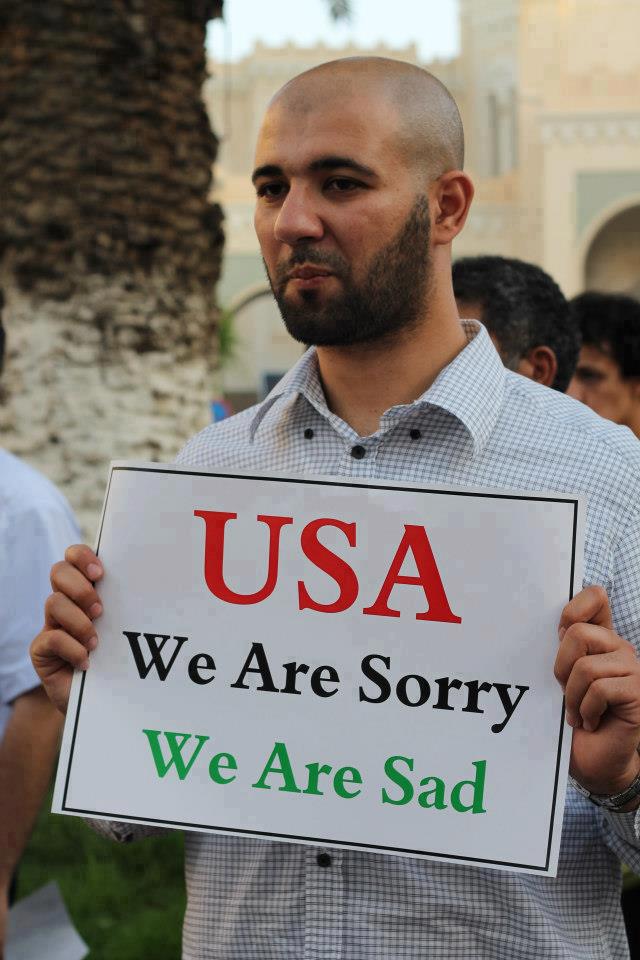
 tằng, một ông đại sứ bị bắn chết, hàng trăm người khác bị thương, hàng ngàn người bị dọa giết, và liên tu bất tận các cuộc biểu tình không ngưng nghỉ.Nếu ai đó rỗi hơi đến mức có thể vứt đi 14 phút quý báu của đời mình mà không hối tiếc, xin mời ngó thử cái đoạn quảng cáo của phim “Sự vô tội của người Hồi” (The innocence of the Muslim). Kết luận duy nhất chỉ có thể là Sam Bacile làm bộ phim này để kích động người Hồi dùng vũ lực, chính xác là kiểu vũ lực và giết chóc mà chúng ta đang được chứng kiến. Người Hồi mắc bẫy thảm thương. Các lãnh tụ Hồi giáo cực đoan thù ghét phương Tây nhân cơ hội đẩy mạnh thánh chiến. Phần còn lại của thế giới ngồi trước TV, bụm miệng kêu thầm: “Ối trời ơi! Hóa ra bọn đạo Hồi này đúng là ưa bạo lực” . Mục đích của Sam đã đạt được một cách vinh quang, chói lọi.Có 3 điểm cần nhấn mạnh ở đây. Thứ nhất, phương Tây tôn thờ tự do ngôn luận tuyệt đối. Điểm này mẫu thuẫn với văn hóa của rất nhiều đất nước cho rằng tự do ngôn luận không có nghĩa là tự do phỉ báng người khác.Thứ hai, việc những người biểu tình yêu cầu Mỹ và phương Tây phải có luật ngăn cấm các sản phẩm văn hóa xúc phạm tôn giáo là điều không thể. Bây giờ là mấy giờ rồi ạ? Năm 2012 nếu ai đó bị mắc chứng trí nhớ ngắn hạn. Một đứa trẻ con 5 tuổi có thể toáy ngoáy máy tính của bố mẹ và tung lên mạng tất tần tật những bí mật mà bố mẹ nó thà chết chứ không để lộ ra ngoài. Với công nghệ thông tin như hiện nay, cấm văn hóa mạng là một điều không tưởng.Cuối cùng, đó là việc dân biểu tình ngây thơ cho rằng Mỹ và phương Tây có thể hồn nhiên cấm cản điều này điều nọ. Luật pháp phương Tây được xây dựng trên một hệ thống chưa phải là toàn diện nhưng tương đối có tính dân chủ. Trớ trêu thay, đây chẳng phải là điều mà bao nhiêu người ở Trugn Đông đã hy sinh để đạt được trong Mùa Xuân Ả Rập đó sao?Xin gửi các bạn một hình ảnh từ Libya, nơi rất nhiều người Hồi hối hận, buồn bã về việc Đại Sứ Mỹ Steven bị giết.

Food Speaks in Many Tongues

Anna Mindess started it, Joe Lurie and I continued it, and now Anna comes back with more. What, you might ask? Food idioms!

By now you know that Anna, co-author of Cultural Detective Deaf Culture, writes a food blog called “Bay Area Bites.” Inspired by the aforementioned articles, her latest is called “Food Speaks in Many Tongues.” Specifically she shares with us a few French, English, German, Spanish, Danish, Turkish, Japanese, Russian, Cantonese, Farsi, Arabic, Hebrew, Yiddish, Italian, and American Sign Language food idioms.

Illustrations are by Anna’s daughter, Lila Volkas.

Latino Growth in USA Signals Need for Change

Andrés Tapia has written an article for Diversity Executive, in which he outlines the need to adapt US business practices in order to attract, retain and make the most of Latino talent. In the article, he references (and gives you a sneak peak of) our upcoming Cultural Detective Latino/Hispanic.

Un Gringo Chévere! A Cool Gringo!

(English follows the Spanish)

Con el permiso de nuestros lectores gringos, este espacio se lo quiero dedicar a uno en especial. Quiero hablar de un gringo chévere con el que he tenido oportunidad de trabajar para un proyecto de inversión en Colombia. Y quiero resaltar más lo chévere que lo gringo, que dicho sea de paso él no considera ofensivo desde ningún punto de vista.

En mi país un gringo es un forastero que habla enredado. No importa si habla sueco, alemán, italiano, inglés u holandés. Un rubio (o castaño claro) de tez más clara que nuestro promedio, es gringo. Y no lo hacemos por ofender, sino tal vez porque eso quedó en el imaginario colectivo como un sinónimo de “no es de aquí”.

Este gringo chévere vivió veintiún años fuera de su país entre Suráfrica, Bahreim, Francia, Reino Unido y China. Ha dado la vuelta al mundo más de seis veces y, aunque siempre vinculado al sector financiero, ha podido trabajar en diferentes industrias que le dan un vasto conocimiento en muchos temas. Departir con él es sumamente enriquecedor.

Trabajar con este gringo es desafiante. Le admiro sus habilidades y conocimientos en el área financiera, pero él sabe que lo que más admiro es su gran capacidad de entender a los otros, de buscar similitudes y no diferencias, de centrarse en el modo de integrar las partes que se involucran en una negociación y de ver con ojos interculturales su entorno. Es un gran conciliador y excelente negociador. Además posee una gran habilidad para poner en contexto cultural las partes involucradas, casi siempre logra identificar la manera como piensa el otro.

Yo siempre le he dicho, que de lejos me parece el más intercultural de los estadounidenses con los que he trabajado. Tiene una mente global y una carrera profesional que le ha permitido desde cargos directivos confirmar que herramientas gerenciales sin aprehensión cultural no permiten un liderazgo efectivo. La satisfacción de los clientes o la motivación de los empleados se ven impactados directamente por sus expectativas y necesidades, y todos no necesitamos lo mismo.  Cuando comparte muchas de sus experiencias puedo transportarme a muchos escenarios en diferentes latitudes, y logra describir personas y entornos tan diversos sin caer en estereotipos ni prejuicios. Por supuesto que hay situaciones que agradan más que otras, pero es parte de nuestra interacción con cada entorno. Algunos sencillamente nos son más favorables.

Se ganó el título de chévere porque siempre está dispuesto a aprender, no critica sino pregunta, analiza y compara. Este gringo le da la importancia debida al entendimiento de un lugar, una cultura, un pueblo.  Es el que una vez cerrando un negocio en Medio Oriente tuvo que comer ojos de camello y aquí prueba las obleas, las almojábanas y queda encantado con las pitahayas, tanto que llega a buscarlas en su ciudad de residencia, las encuentra en el mercado chino, descubre que su sabor es muy diferente al colombiano y decide ¡comerlas con sal! Jamás he comido pitahaya con sal, aquí son muy dulces…pero esa es la interculturalidad, este gringo es del sur y dice allí comen con sal la sandía y el melón.  Cómo se dan cuenta, es un poco de cada lugar, un poco de aquí y de allá.

A veces centramos nuestros entrenamientos interculturales en aprender teorías y conocer de autores que nos han clasificado de una manera u otra. A veces nos dejamos llevar por la ilusión de pretender cambiar los seres humanos con un discurso y dejamos de lado lo simple, lo básico, como lo es el hecho que ser interculturales comienza en esa disposición misma de aceptar y reconocer.

Aceptar que somos diferentes. Reconocer que pensamos y actuamos diferente a partir del entorno que nos rodea, y de lo que nos ha sido heredado — valores, creencias, etc. Al aceptar y reconocer, se nos hacen fácilmente evidentes también los dilemas a los que nos enfrentamos en medio de las diferencias y que ponen a prueba nuestras habilidades a nivel interpersonal, empresarial y social. Al poner nuestras habilidades a favor de nuestra interacción con nuestro entorno – corporativo, social – podremos construir enlaces y puentes de entendimiento que nos permitan entonces entendernos a nosotros mismos y de esta manera entender a los demás.

Gracias gringo chévere, por permitirme trabajar contigo y aprender tantas cosas a la vez. Gracias por compartir tus aventuras en cada rincón del planeta y tus experiencias laborales y de vida con gente tan diversa. Gracias por permitirme presentarte un poco de mi país, de lo que somos y lo que brindamos.

Gracias y ¡hasta pronto señor!

With the permission of our gringo readers, I’d like to dedicate this space to one in particular. I’d like to talk about a cool gringo I had the opportunity to work with on an investment project in Colombia. And I’d like to emphasize that this cool gringo does not consider the term offensive in any way.

In my country a gringo is an outsider who talks weird. It doesn’t matter if he’s Swedish, German, Italian, English or Dutch. Someone who is blonde or has a lighter complexion than our average is gringo. We don’t say it to offend, but rather because that term has entered our collective imagination as a synonym for “not from here.”

The cool gringo of whom I’m writing lived 21 years outside his country, in South Africa, Bahrain, France, the UK and China. He’s been around the world more than six times, and while he’s always worked in the financial sector, he has been able to work in different industries that have provided him a vast knowledge of diverse subjects. To spend time with him is extremely enriching. He possesses a great ability to put things in cultural context, and is almost always able to identify how the other person thinks.

I have always said that he is by far the most intercultural of the US Americans I’ve worked with. He has a global mind and a professional career that have permitted him to ascertain which management tools permit effective leadership only when used with cultural appropriateness. Customer satisfaction and employee motivation are directly impacted by their expectations and needs; we don’t all need the same thing. When he shares his experiences I’m transported to many scenes in different latitudes, and he is able to describe diverse people and environments without falling into stereotypes or prejudices. Some situations are of course more appealing than others, as it depends on our interaction in each environment. Some situations are simply more favorable.

To work with this gringo is challenging. I admire his abilities and his knowledge in the area of finance, but he knows that what I most admire is his great capacity to understand others, to look for similarities and not differences, to focus on how to integrate the parties involved in a negotiation and watch the context with intercultural eyes. He is a great mediator and excellent negotiator.

He achieved the “cool” title because he is always ready to learn, not to critique but to ask, analyze, and compare. This gringo gives due importance to the understanding of place, culture, and people. He’s the type that, closing a negotiation in the Middle East, had to eat camel’s eyes. Here in Colombia he tried obleas (wafers), almojábanas (crullers), and was delighted with pitahayas (dragon fruit), even going so far as to try to find some where he lives. He finally found them in a Chinese market, but found they tasted very different from the Colombian variety, so he decided to eat them with salt! I’ve never eaten dragon fruit with salt; here they are very sweet. But there’s something about interculturalism. This gringo is from the southern US, where he says they eat watermelon and cantaloupe with salt. As you’ve no doubt noticed, he is a bit of every place he has lived, a bit from here and a bit from there.

At times we focused our intercultural training on learning theory and getting to know authors who have classified us in one manner or another. Sometimes we got carried away with the illusion of trying to change human beings via our conversation, ignoring the basic, simple fact that intercultural beings begin with a predisposition to acceptance and acknowledgement.

To accept that we are different. To acknowledge that we think and act differently depending on the context and on what we’ve inherited — values, beliefs, etc. Accepting and acknowledging make readily apparent the dilemmas we face in the midst of our differences, those that challenge our skills on interpersonal, organizational and social levels. By behaving appropriately to the corporate or social situation we can build links and bridges of understanding that then permit us to understand ourselves and, in this way, to better understand others.

Thank you, cool gringo, for enabling me to work with you and to learn so many things at once. Thank you for sharing your adventures in each corner of our planet, your work and life experiences with such diverse people. Thank you for giving me the opportunity to explain a bit about my country, about who we are, about what we provide.

Thanks, and see you soon, sir!