[Day 1 of 5] SIETAR Europa Congress Tallinn: Daily Wrap Up

For those of you who are passionate about intercultural but, like me, were not able to get to Tallinn, Estonia for the SIETAR (Society for Intercultural Education, Training and Research) Europa Congress, here is Vanessa’s first day wrap up. Enjoy!


Vanessa's avatarthe book of ness

Wednesday was “Pre-Congress How-To Workshop Day”.  We are wrapping up, and what were the biggest take-aways?

Image

Sabrina and I were first to present this morning.

We framed Social Media Marketing through an intercultural lens.  Have you ever been a tourist?  Have you ever been a traveler?  What’s the difference?  Tourists might just casually visit a country, without a strong connection or engagement with the local community, perhaps get easily distracted to shiny objects and come home with a suitcase packed full of purchases they didn’t anticipate.

What about a traveler?  Perhaps they spend more time planning and preparing for the visit to the new land.  Relationship building, engaging with local community, and being a conscious participant is the approach of a traveler.  Apply this to Social Media and get your passport ready for your journey.

Image

We have more inspiring stories about building a social media campaign using competencies…

View original post 428 more words

Dr. Carlos Cortés on Multicultural Identity

ForkhashiMany of you have probably heard of Young SIETAR, one of the most vibrant groups in our professional association. If not, you should—they are a terrific organization of not necessarily young professional from a variety of disciplines who share an interest in intercultural relations, and use virtual communication to interact with members around the world.

Dr. Carlos CortésYoung SIETAR recently offered a webinar with Dr. Carlos Cortés, Professor Emeritus of History at the University of California, Riverside, who is globally esteemed for his work on multiculturalism. He’s the general editor of the newly released Multicultural America: A Multimedia Encyclopedia, and the author of many other excellent books. The webinar was moderated by the very capable and personable Melissa Hahn.

I really respect Carlos. He’s intelligent, he’s funny, and he speaks his truth regardless of context. We’ve shared several wonderful dinners in the home of a mutual friend, and I have enjoyed our collegial relationship as we have both been on the faculty of the Summer Institute for Intercultural Communication for the past two decades. I’ve treasured every moment and learned a great deal.

Carlos said a few things in the public webinar that I was delighted to hear from a man of his experience and expertise. They are key components of the Cultural Detective (CD) Method, yet sometimes I feel that we are a solitary voice on the subject. It felt good to have someone else beating the drum for a change!

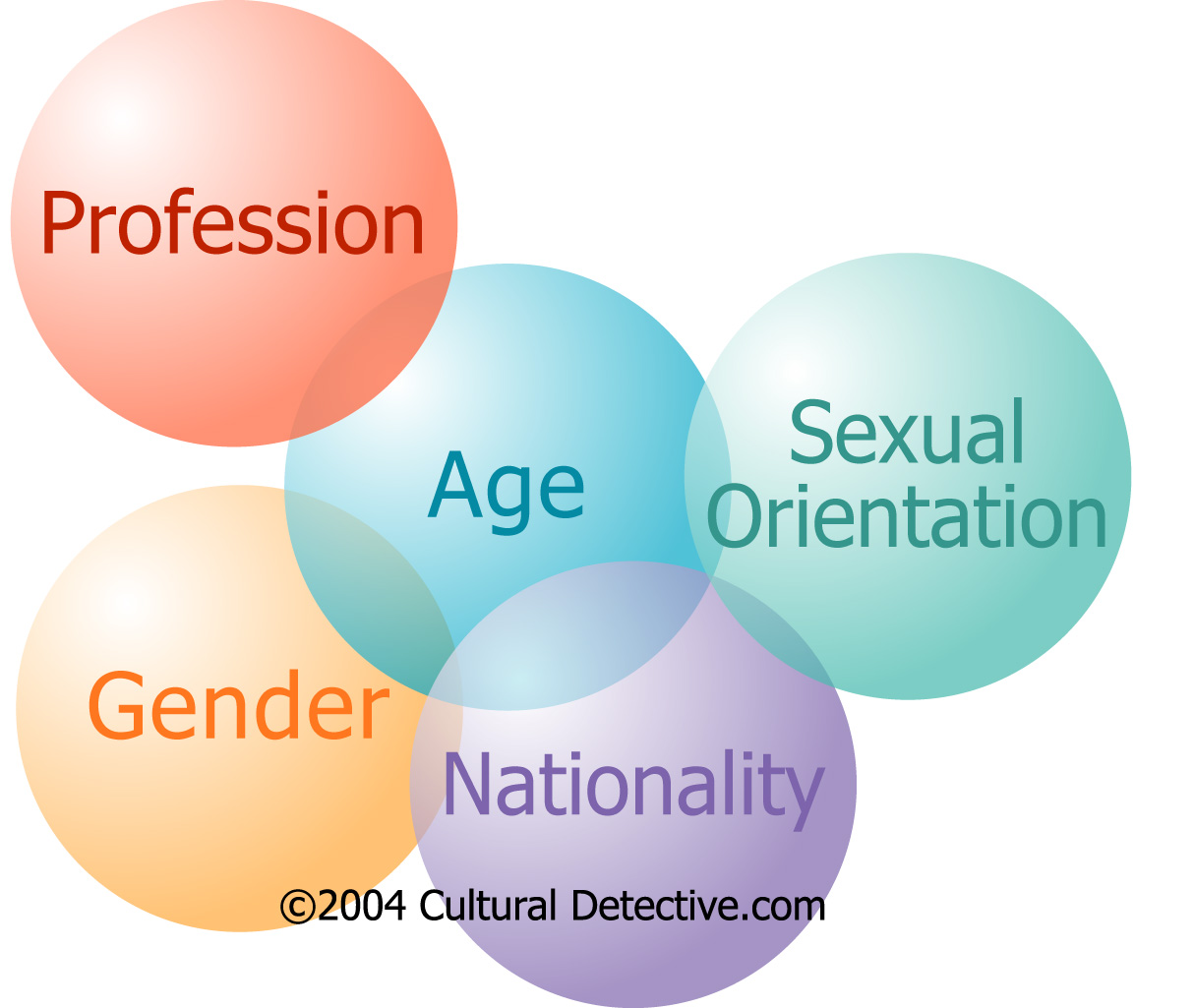
Carlos opened his presentation with a slide that Melissa had made, illustrating multicultural identity. A screen shot of that slide is below.

What is MC Identity?

©Melissa Hahn, used in the webinar by Dr. Carlos Cortés

Does the slide remind you of anything? If you are at all familiar with our Cultural Detective Method, I believe you’ll immediately think of two things. First, the image contained on the definitions page in every CD package:CultDiffsMap

This image that reminds us that none of us are one story. We have multiple layers of identity, we have been influenced by multiple cultural experiences, and we should never diminish ourselves or others by only acknowledging one layer.

Second, the slide may remind you of our graphic illustrating the layering of our Values Lenses, showing how complex we are as individuals. This is an approach we teach over and over again in our webinars and facilitator workshops using the following graphic:

LayeredLensesFinalCarlos explained that most intercultural instruments look primarily at nationality, and he supposes that this is because it’s the easiest: “low-hanging fruit.” He explained that while a multi-layered model is important, it’s also more difficult, and that is perhaps why no one has created one. I realized that we have one such model and process here, in our CD series, and I’ve failed to communicate that to Carlos!

The second point he made was in response to a question: “Is it easier if you have a clear identity for yourself before going overseas?” While most people I know would advocate such a linear development (self before other, or other before self), Carlos didn’t hesitate for a moment before stating, emphatically, “No!” He went on to explain that just understanding others is not enough, however, and that:

“We need a dialectic between understanding others and understanding self. I’m 79 and I’m still developing and understanding my identity.”

What an elegant, concise summary of the Cultural Detective Worksheet and the yin-yang nature of relationships! Many clients use our CD tools to understand others. Many use them to understand themselves. But every client ends up developing a better understanding of both self and others in an organic, dialectic process.

Carlos addressed a question about how can we help people develop their multicultural identities in positive ways. He returned to the topic of instruments, saying that he’s not against using them as long as they open us up to discussion and discovery, and help us to confront and expand our limitations, rather than boxing us in. That is exactly what CD is all about: dialogue, discovery, mutual learning and adaptation, then synergy and innovation.

Carlos talked about the need to discuss concrete things rather than generalities (a good example is the practical, real-life focus of Cultural Detective‘s critical incidents), and the need to hear from the voice of the people themselves (our Values Lenses use native language terms rather than global, externally imposed dimensions).

Some other highlights from Carlos’ talk include:
  1. The challenge of multicultural (or in CD parlance, Blended Culture) identity is that you don’t “slot into a silo”; you don’t seem to fit, and that causes fear in some people. You can start to feel that you give the “wrong” answer on every form, and that you an oddity in any system.
  2. Self-identity negotiation takes a long time. It may sound easy, to pick and choose the “best of” your multiple heritages, but even if you try to push “pieces” aside, they can creep back at the most inopportune times. Your multicultural identity is and will remain part of you. It’s not about reconciling identity; it’s about enjoying being multicultural.
  3. TCKs (third culture/blended culture kids) need two kinds of understanding about the journey they face. They need to feel comfortable with their multiple strands, and to understand that they don’t have to pick and choose among the various parts of their identity. Talking generalizations isn’t enough—specific examples help, e.g., how difficult it can be when you don’t fit a category on an application form.
  4. The only way to truly understand multicultural identity is to listen to people with that identity. They need to share their stories and we need to listen.
  5. There are three distinct yet intersecting concepts that many people confuse:
    • Heritage: Something we all have, the layout of our family tree.
    • Identity: This comes from within, though, of course, there are always others’ perceptions of our identity that help shape us.
    • Culture: You can self-identify with a culture, yet not participate in every aspect of the culture. For example, you can self-identify as Irish, but not speak Gaelic. Therefore, you are part of the culture, but not part of the Gaelic language portion of it.
  6. Carlos recounted his personal story. He was born of a mixed marriage (Catholic and Jew, Mexican and US America). The more his parents pushed him to learn their two differing cultures, to “choose sides,” so to speak, the more they actually pushed him to develop an integrated multicultural identity.
  7. Research on multicultural identity is nearly non-existent. It’s an open topic for young people. The information currently exists in separate disciplines: racial identity, disability, etc. We need people to write their stories, hundreds of them, and study them. Carlos has studied multiculturalism for 40 years, yet he learned more by writing his autobiography (Rose Hill: An Intermarriage Before Its Time, Berkeley, CA: Heyday, 2012).
  8. Every time we enter a new cultural milieu, it’s a growth opportunity in which we can deepen and expand our understanding of who we are in a new context.
  9. Regarding national identity and social fragmentation worldwide, Carlos said that the solution to fragmentation is that a common identity/culture is needed along with space for people to have alternative sub-groups/diversity.
  10. For those looking for good resources on this topic, he highly recommends Bill Cross’ Shades of Black and Stephen Murphy Shigamatsu’s work on Asian-American identity, When Half is Whole.

As you can tell by my enthusiastic review, the webinar was a delight. Young SIETAR has loaded the recording if you’d care to listen to the entire one hour discussion. Carlos tells me he’s also happy to have you write him directly.

What does multicultural identity mean to you? What are its challenges? And its benefits? What strategies have you used to help yourself or others develop constructive Blended Culture identities? Do Carlos’ ideas mesh with your experience?

Inteligencia Cultural para América Latina—Ciclo de webinars interculturales

BlogLa globalización y la tecnología han incrementado el comercio, los negocios internacionales y el número de empresas que se expanden alrededor del mundo, dinámica que ha provocado que sean cada vez más los profesionales y ejecutivos que interactúan con otros países y los equipos de trabajo que se forman con personas de diferentes culturas.

Este creciente contexto multicultural, relativamente nuevo para América Latina gracias al papel protagónico que ha venido jugando en los últimos años a nivel internacional, plantea grandes desafíos tanto para las empresas como para cada uno de los individuos que conforman su fuerza laboral. Cada vez son más las multinacionales y empresas latinoamericanas que deciden trasladar sus operaciones globales o regionales a distintos países latinoamericanos y que requieren que sus equipos colaboren y trabajen efectivamente a nivel global, y sobretodo que sean capaces de aprovechar las oportunidades que ofrece este contexto global y multicultural.

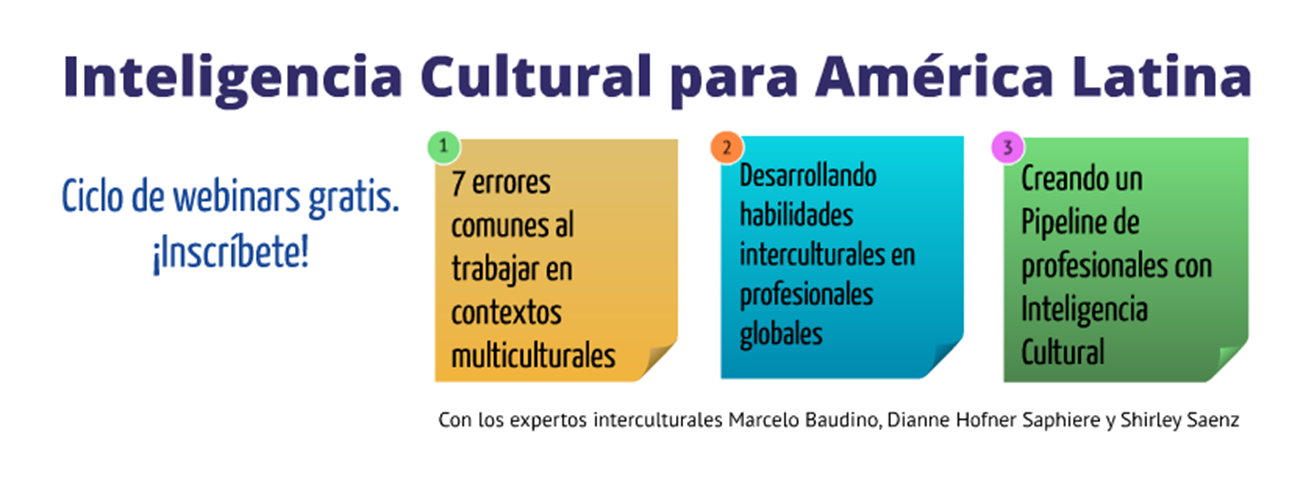
Con el objetivo de comenzar a desarrollar las competencias interculturales necesarias en los profesionales globales de América Latina, desde ICEBERG Inteligencia Cultural hemos creado un ciclo abierto y gratuito de webinars interculturales. Este ciclo ha sido diseñado para:
  1. Profesionales y ejecutivos trabajando con personas de otros países, ya sea de manera presencial o virtual
  2. Profesionales del área de RRHH, Capacitación y Desarrollo, Gestión del talento.
  3. Empresarios globales, expatriados e interesados en cuestiones interculturales

web1Webinar 1

La diversidad cultural no es un eslogan, sino un hecho empresarial y laboral diario. Tus colegas, clientes y proveedores probablemente son de culturas diferentes, por lo que necesitas comprender sus valores y comportamientos para gestionarlos y satisfacer sus necesidades. La habilidad para trabajar, comunicar y negociar interculturalmente, constituye una competencia fundamental. En este webinar exploraremos los 7 errores culturales más comunes que les impiden a los profesionales con algún grado de exposición internacional, ser efectivos a nivel intercultural. Mientras más consciente seas de ellos, más fácil te será evitarlos, y entonces, estarás dando el primer paso fundamental hacia el desarrollo de inteligencia cultural.

Fecha: Jueves 10 de octubre de 2013
Argentina: 12 pm • Colombia: 10 am • México: 10 am

Facilitador: Marcelo Baudino
Marcelo es el fundador y director de ICEBERG Inteligencia Cultural, la primera firma argentina especializada en el desarrollo de habilidades interculturales, un servicio de consultoría intercultural innovador para la región. Marcelo es un experto en el diseño y la facilitación de talleres y programas de entrenamiento intercultural para multinacionales y está especializado en América Latina, Estados Unidos y los países del BRICS. Ha impartido cursos para empresas como Deloitte, Cargill, ExxonMobil, Banco Itaú, SC Johnson, Chevron, Tarjeta Naranja, entre otras. Ver perfil de LinkedIn.

Regístrate aquí

web2Webinar 2

Este contexto global e interconectado en el que trabajamos actualmente, nos trae un sinnúmero de oportunidades que claramente queremos aprovechar:
  • La tecnología nos permite desarrollar proyectos y crear equipos con expertos de todo el mundo. Sin embargo, lo que lleva a un equipo multicultural y geográficamente disperso a ser efectivo, son las habilidades interculturales, algo nuevo para muchos de nosotros.
  • Clientes internacionales expresan su interés en nuestros productos y servicios. Sin embargo, ¿Cómo construir relaciones de confianza y entrar en nuevos mercados de manera rentable y sostenible?
  • Queremos ser lo más competitivos posible a nivel global, pero ¿qué significa esto?

Los participantes en este seminario adquirirán herramientas para mejorar sus habilidades a la hora de trabajar en equipos multiculturales, liderar proyectos regionales e internacionales y gestionar una fuerza laboral culturalmente diversa. También recibirán acceso a recursos interculturales y un plan para el desarrollo de competencias interculturales.

Fecha: Jueves 24 de octubre de 2013
Argentina: 2 pm • Colombia: 12 pm • México: 12 pm

Facilitador: Dianne Hofner Saphiere, M.S.

Bio: Dianne ha trabajado activamente en el ámbito de la formación y consultoría intercultural desde 1979, en colaboración con personas de más de 130 países y tres continentes. Su lista de clientes incluye ABB, Hyundai-Kia, Microsoft, Mitsui, Royal Dutch Shell, Schneider Electric, Telecom New Zealand, y Texas Instruments, organizaciones de intercambio internacional como AFS y CIEE, y universidades de todo el mundo. Dianne es la creadora del Cultural Detective®, un sistema dinámico de herramientas para alcanzar la efectividad intercultural y co-autora del libro Communication Highwire: Leveraging the Power of Diverse Communication Styles, publicado por Intercultural Press. Ver perfil de LinkedIn.

Regístrate aquí

web3Webinar 3

La creciente exposición a culturas de todas partes del mundo deja en evidencia la necesidad de prepararse no sólo como individuo, sino también como organización. Ya sea a través de una estructura de organización regional, de un programa de asignaciones internacionales, de un centro global de servicios compartidos o de un joint venture con una empresa extranjera, hoy en día las empresas necesitan desarrollar los procesos y estructuras internas que faciliten la incorporación y el desarrollo de profesionales con aptitud global. En este webinar los participantes conocerán herramientas y técnicas para fomentar el desarrollo de Inteligencia Cultural.  Examinaremos como a través de los procesos de reclutamiento, programas de formación, asignaciones internacionales y el diseño de valores organizacionales, se puede transformar la diversidad cultural de la compañía en una ventaja competitiva.

Fecha: Jueves 7 de noviembre de 2013
Argentina: 2 pm • Colombia: 12 pm • México: 12 pm

Facilitador: Shirley Saenz

Bio: Shirley Saenz es formadora y consultora intercultural en ICEBERG Inteligencia Cultural, firma líder de consultoría intercultural en América Latina y miembro de la junta directiva de SIETAR Argentina (Society for Intercultural Education, Training and Research). Ha investigado sobre las diferencias culturales entre los países de América Latina, la comunicación intercultural y la efectividad de equipos multiculturales. Durante los últimos años, Shirley ha estado viviendo y trabajando en países como Colombia, Francia, China, Brasil, Argentina y los Estados Unidos, lo cual le ha permitido adquirir un profundo conocimiento de estas culturas, y también fluidez en inglés, francés, portugués y español. Shirley se ha certificado en el Summer Institute of Intercultural Communication en Portland, Oregon, en “Métodos para la formación intercultural”, “Liderazgo personal: Trabajo en equipos interculturales efectivos” y “Cultura, comunicación y colaboración en equipos virtuales”. Ver perfil de LinkedIn.

Regístrate aquí

Names Across Cultures (First in a Series of Video Interviews with Authors!)

Name ChangesThere are many reasons people change their names: some people have a stage name, pen name, nickname, religious name, or an earned title or name. All too frequently, however, a name is involuntarily changed when someone immigrates, or when a teacher or teammates have trouble pronouncing the person’s birth name.

Many of us work with individuals who have been “renamed” by other colleagues, or who have changed their names to make them more palatable and pronounceable in a new location. Other times people adopt a different name due to a change in circumstance, profession, or age. For example, as a kid growing up in a small town, my father was called “Charlie:’ however, as a middle-aged adult living in a different town, he became known as “Chuck.”

Many people’s names have special meaning or significance. An interesting way to learn about a new acquaintance can be to ask the meaning and origin of the person’s name. And, if we wish to build trust with our friends and colleagues, in addition to understanding the meaning of their names, we can learn to pronounce their names correctly. You may recall that in January 2012 we shared a link for a handy-dandy little software that allows YOU to record the pronunciation of your name, and add it to your email signature, website, LinkedIn account, etc. What a great way for those unfamiliar with your name to hear it prior to meeting you!

Perhaps you, like me, are known by several different names bestowed on us by friends and colleagues. Dianne is the name given to me by my parents at birth, while my name in Japan is Dai-an (大安 or “great peace”, also a very auspicious day of the month). My Spanish-speaking friends and colleagues call me Diana María, and close friends and family call me Di. In my case, I’d rather be known as “Diana” or “Dai-an” than have my birth name “Dianne” mispronounced.

In many cultures, such as Mexico where I live, it is a sign of cariño or affection to bestow a nickname on others (click here for a list of some unusual terms of endearment in various languages). However, many people worldwide love their birth names, believe they are imbued with power, and would honestly prefer we not change their names for them.

Yet some people do want to change their name for various reasons, and have done so. Here’s a special little drag-and-drop game for you, to see if you can match some famous people’s birth names with the names they are more commonly known by now.

I recently spoke with Dr. Emmanuel Ngomsi, a diversity consultant originally from Cameroon, about the topic of naming. Emmanuel has a wealth of experience, is very passionate, and a consummate storyteller, as you’ll see in the interview below.

Do you have a story related to naming that you’d be kind enough to share with us? Have you changed your name, or has it been changed for you? How do you feel about that? Do you have any advice for others about names and naming?

See Part 2 of this interview.

Cultural Awareness Eases Expatriate Assignments

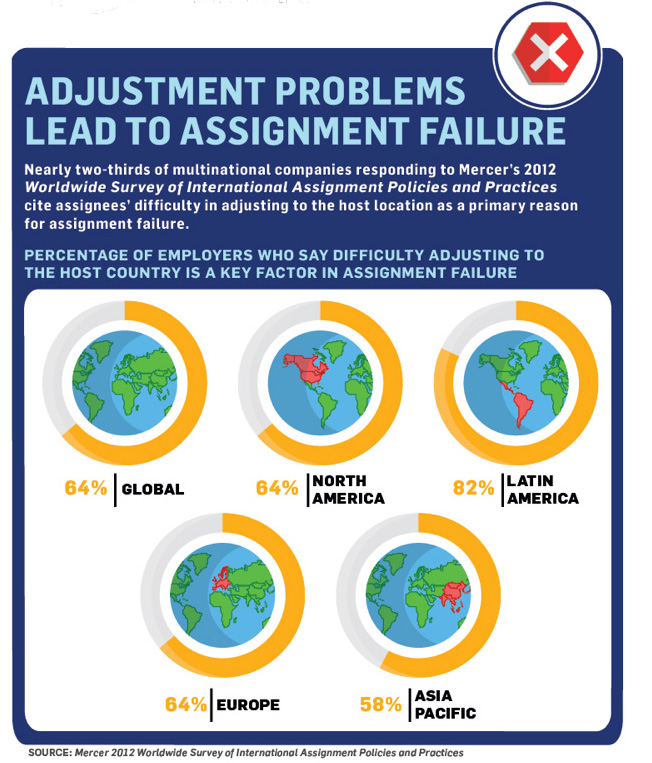
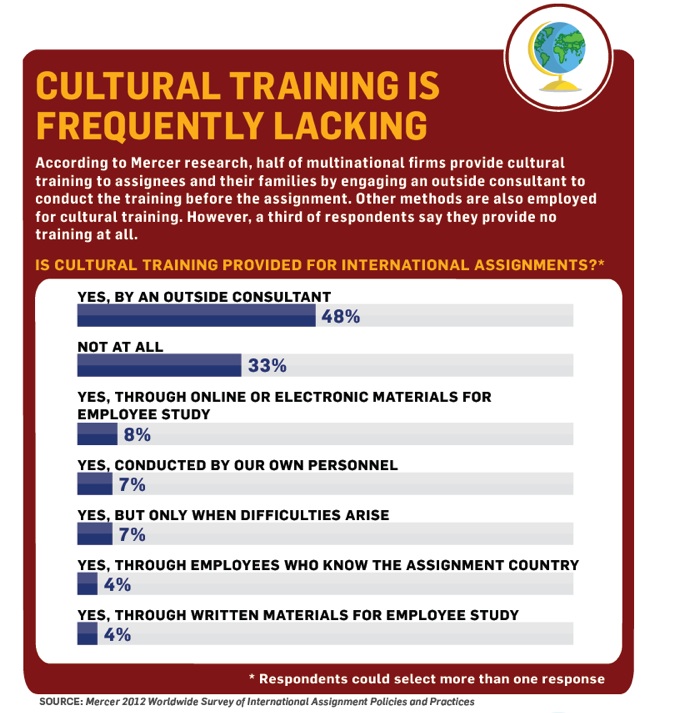
Mercer has released some useful new infographics, based on the findings in their 2012 Worldwide Survey of International Assignment Policies and Practices.

You all know that using Cultural Detective combined with reflexivity and good facilitation, you can do WAY better than “awareness”—developing the ability to collaborate across cultures.

©Mercer

©Mercer

@Mercer

@Mercer

Let’s save the lost money, the aggravation and stress on our people, and the potential loss of talent, by equipping expats and their families for their assignments! Also best to equip the receiving team, and to conduct team building, ongoing mentoring and coaching. Cultural Detective Online, along with good coaching or facilitation and organizational support systems and processes that reward intercultural competence, will make the difference.

Have You Taken Advantage of Our Free Webinars?

Night work

  • “Really? You are logging into this webinar, willingly and of your own accord, at midnight? No joke? And for you it’s 3 am?”
  • “Yes! I am so very excited to be here! Thank you for offering this learning opportunity!”

The response to the free “Cross-Cultural Effectiveness” webinars we have been conducting since February of this year has truly overwhelmed me. We’ve already welcomed hundreds of participants from six of the seven continents, including a broad diversity of professions and experiences—from hospitals to schools, disaster relief to hospitality. I’ve had the pleasure to meet incredible people who are building cross-cultural competence and using or hoping to use Cultural Detective in the most creative and needed ways! It has been such a joy and learning experience. Thank you all!

People don’t need to be inconvenienced by the time difference to participate in these webinars. We offer them twice a month, once at times convenient to the Americas, Europe, and Africa, and another more convenient to Asia and Oceania.

Would you like even better news? Those who participate receive a COMPLIMENTARY 3-day pass to Cultural Detective Online!

I’ve promised myself to use a different critical incident each and every webinar, and it’s amazed me the richness of the discussion this has generated, the powerful ways in which we can overcome stereotypes, the innovative ways the groups have generated to harness the power of diversity.

We also are committed to conducting special-interest webinars for you, to aid in ongoing cross-cultural competence development. Thus far we have held two, both in partnership with customers and colleagues: one on virtual teaming, and another on coaching across cultures. Stay tuned for future additions to the schedule!

If you would like to participate in a webinar, or get more of your colleagues and friends excited about intercultural competence, please register now. We have just updated the calendar through the end of December 2013.

If you use Cultural Detective in your work, and you would like to share what you do and how you do it in hopes of helping others succeed, please contact us. We may be able to partner on an upcoming webinar, or share your story in a future blog post! We also welcome your topic ideas. Keep ’em coming!

Estereotipos: entre el bien y el mal

(English follows Spanish)
La subjetividad es tan inherente al ser humano como lo son sus propias emociones. En el alma mezclamos de manera inseparable la voluntad, el intelecto y la emoción; y según cada una de estas “sea alimentada” podremos actuar de una manera u otra. De hecho es por esto tan famosa la llamada Inteligencia Emocional, que no es otra cosa que alimentar el intelecto y la voluntad para controlar las emociones (y que Daniel Goleman me perdone por hacerlo parecer tan simple).

Por nuestro lado, y digo nuestro porque aquí es lo que nos reune, la Inteligencia Cultural (CQ) busca entonces alimentar “el conocimiento” , la “aprehención mental de las diferencias” y modelar el “comportamiento” entre las culturas.  Obviamente el comportamiento se nutre de nuestras emociones y por ende de alguna manera querámoslo o no se relaciona con nuestra subjetividad.

Sin embargo, como si fuera parte de un círculo vicioso nuestra subjetividad cambia según alimentemos el conocimiento y nos dispongamos a aprender y aprehender. Sí hay que conocer y disponerse a conocer, además de buscar fuentes de información diversas… variadas y paradójicamente, objetivas.

Los estereotipos sin duda alguna son uno de los principales desafíos en nuestra interacción intercultural. Para algunos es el bien… la bendición y el llevar consigo ese pre-juicio (pre: adelantado…inferido…establecido… no cuestionado) que les abre puertas y que les da acceso a una serie de oportunidades negadas para otros.

Ejemplos de esto hay muchos. Podríamos comenzar por las diferencias de género y por ende los pre-juicios alrededor de hombres y mujeres para el desempeño de oficios y responsabilidades. Aún es una realidad latente que hombres y mujeres no recibimos la misma remuneración al realizar/ejecutar la misma tarea y ocupando la misma posición.

Nelson Mandela es tristemente célebre por luchar contra el Apartheid y entregar su vida por demostrar que el color de la piel no interfiere con lo que somos o podemos ofrecer. Los prejuicios sociales se dramatizan entre el amarillismo y el realismo trágico en miles de tragicomedias y novelas reflejando una sociedad estereotipada.  No hay que dar muchos detalles de lo que significa tener un nombre de ascendencia árabe y musulmán en los Estados Unidos luego del 9/11.

Y así hay otras tantas, como la que vivo cuando me discriminan por el lugar donde nací. Entonces los estereotipos se convierten en una especie de estigma, de etiqueta, de prejuicio sin sentido y sin razón. Aunque parezca irreal cuando vivía en Londres a una compañera del college le prohibieron hablar conmigo “peligro es colombiana” y en 1998 buscando un lugar para vivir, llegué a uno de los suburbios a una casa donde lo primero que me dijeron: es usted familiar de Pablo Escobar?

Al final no importa lo bueno que cualquiera nacido en este país pueda tener. Lo malo es la nube negra que nos acompaña, nos limita, nos cierra puertas y lo peor, muchas veces tristemente habla por nosotros y enmudece nuestra voz.

Hay problemas, tal vez más que en otras latitudes… tal vez menos y más publicitadas. Los estereotipos se vuelven peligrosamente en contra de todos, y nos llevan al facilismo de generalizar y el derecho sesgado del absolutismo puro. TODOS los nacidos son, o TODOS los hombres, TODOS los musulmanes, TODOS…. y no! No todos ni todas somos iguales, si bien es cierto tenemos rasgos y características compartidas, el absolutismo es negarnos la posibilidad de nuestro valor como individuos… lo que somos más allá de lo que otros dicen que somos o debemos ser.

(English translation by Dianne Hofner Saphiere)

Stereotypes: Between Good and Evil

Subjectivity is as inherent to humans as are our emotions. In our souls we inextricably mix intellect and emotion, and we behave in one way or another depending on which one we feed. That which is famously called “Emotional Intelligence” (EQ) is, in truth, nothing more than feeding the intellect and controlling emotions (forgive me, Daniel Goleman, for making it seem so simple).

In our field, and I say “our” because it is what brings us together, Cultural Intelligence (CQ) seeks to feed “knowledge,” “mental appreciation of differences,” and to model “behavior” across cultures. Obviously behavior is influenced by our emotions and therefore, like it or not, it relates to our subjectivity.

However, as if it were part of a vicious cycle, our subjectivity changes according to how we nourish knowledge, and we can become better able to learn and comprehend. Yes, it’s necessary to know and to be ready to learn, to search for diverse sources of information — varied and, paradoxically, objective.

Stereotypes without any doubt are one of the major challenges in intercultural interaction. For some it’s the good; the blessing to take with them prejudice (established assumptions and inferences that are not questioned) that opens doors and gives them access to a series of opportunities denied to others.

There are many examples of this. We could start with gender differences and the prejudices surrounding men and women’s abilities to perform jobs and responsibilities. We live with the reality that men and women still do not receive equal pay for equal work or when occupying the same position.

Nelson Mandela is sadly famous for fighting Apartheid and devoting his life to demonstrating that the color of one’s skin does not interfere with who we are or what we have to offer. Social prejudices are dramatized between sensationalism and tragic realism in thousands of tragi-comedies and novels representing a stereotyped society. There is little need to give details surrounding what it means to be a Muslim man of Arab descent in the USA after 9/11.

And there are many more, like those I live with when people discriminate against me due to where I was born. The stereotypes become a type of stigma, a label, of mindless and irrational prejudice. Although it seems surreal, when I lived in London a college friend was prohibited from talking with me because I was “the Colombian danger,” and in 1998 when I was looking for a place to live, I arrived at a suburban house where the first thing they asked me was, “Are you related to Pablo Escobar?”

In the end, it doesn’t matter how good anyone born in this country might be. The evil is the black cloud that accompanies us, limits us, closes doors for us, and worse, that many times sadly speaks for us and mutes our voice.

We in Colombia have problems, perhaps more than in other locations; perhaps fewer but more publicized. Stereotypes come dangerously back against all of us, and they easily take us to generalizations and pure, biased absolutism. ALL OF US are born, ALL OF US are human, ALL OF US are Muslim, ALL … and not!

Not all of us are equal, even though we may share certain traits and characteristics. Absolutism negates the possibility of our value as individuals — it negates who we are, beyond that which others say we are or should be.

The “Veil” in Tunisia

P1020927I am very happy to share this guest blog post, written by a new member of our Cultural Detective community, Dr. Larry Michalak. His story illustrates a topic we’ve posted about before: veiling and how easily people can jump to the (wrong) conclusions about a person’s appearance.

What I particularly appreciate about Larry’s piece is that his list at the end illustrates a vital cross-cultural skill: the ability to generate multiple possible motivations for behavior. This ability is crucially important if we are to get beyond our own biases and expand our worldview, really get to know others, and develop respect, empathy and the ability to collaborate. Here is Larry’s post:

Sit in a café on any street in Tunis (one of the pleasures of life!), and you will notice that the women who pass are covering up more than they used to in years past. There is a new kind of women’s clothing that didn’t exist when I was here in the 1960s—headscarves and smock-like dresses that cover the arms.

This “veiling” phenomenon has become a widespread topic of conversation, journalism, and social and even political analysis. Women began covering up more in the late 1970s, the headscarf was suppressed by the government in schools and public offices until the Tunisian revolution in January 2011, and now women are free to dress as they please.

Some scholars count the percentage of Tunisian women who are veiled, and cite these statistics in articles. This mode of dress (the argument goes) has religious and/or political meaning. It shows an increase in religious conservatism, and/or means that the wearer of the veil is showing sympathy with Islamic politics, opposition to the U.S., etc. When these observations come from secularists they are usually accompanied by expressions of disapproval of the veil.

But there are problems with this argument. One of them is the difficulty of defining what constitutes “veiling.” There is the hijab, which in Tunisia can mean a headscarf or else a headscarf accompanied by a smock-like dress that covers the arms and comes down to the ankles. Sometimes there is just a headscarf, and sometimes the headscarf is worn to cover the woman’s hair—sometimes completely and sometimes not. Full veiling, such as one finds in the Eastern part of the Middle East (e.g., the chador in Iran, the burka in Afghanistan, and the nikab in Saudi Arabia), is very rare in Tunisia. The term “veiling” is used indiscriminately to refer to all these different ways of covering.

Some years ago there was an excellent article in Jeune Afrique by a Tunisian woman journalist who thought that fashion was probably the most important reason for veiling. Some women wear the veil as they would a miniskirt—because it’s the fashion—and the cut and the color are more important than any religious content. Many of these women who veil have never read the Qur’an or performed the prayer. Some go veiled on weekdays and wear bikinis on the beach on the weekend. Some wear the veil to nightclubs with their whisky-drinking boyfriends. And on the boulevards of Tunis, one can see veiled women holding hands with their boyfriends.

My conclusion is: You can’t tell much about people by looking at how they dress. Just as you can’t judge a book by its cover, neither can you judge a woman by her clothing. This goes for men, too. I have known traditionally dressed men with very modern ideas, and men in Western suits who would feel right at home with the Taliban. I once heard a scholar give a paper at a conference, with statistics on what percentage of the women he observed in different places and at different hours were “veiled.” But he was calling lots of things “veils” and assuming that the “veil” reflects religious and/or political opinions.

To make my point, here is a list of ten reasons, other than religious or political, that a Tunisian woman might “veil.”

  1. “I do it to piss off my parents—especially my mother, who doesn’t veil.”
  2. “On TV I saw some women in Egypt who wear it and I think it looks great!”
  3. “I just got married and now I don’t have to advertise my looks.”
  4. “I just washed my hair, and I can’t do a thing with it.”
  5. “So that the guys will leave me alone on the bus.”
  6. “I want people to think that I’m a virgin so that I can find a husband more easily.”
  7. “I’m on my way to have sex with my boyfriend and I don’t want anyone to recognize me.”
  8. “I’m so beautiful that I have to cover up to keep the guys from going crazy.”
  9. “I’m not attractive and I’m self-conscious about it, so I leave my looks to people’s imagination.”
  10. And, finally: “It’s cold out today and I want to keep my head warm.”

In other words, sometimes a headscarf is just a headscarf!

Dr. Larry Michalak is a cultural anthropologist with degrees from Stanford, London and UC/Berkeley. He was Vice Chair of Berkeley’s Center for Middle Eastern Studies for 23 years. His specialty is the Arab World, especially Tunisia, where he was a Peace Corps Volunteer in the 1960s. He has now spent over ten years there. Larry is fluent in Arabic and French. In his retirement he has enjoyed traveling with his wife Karen as an enrichment lecturer for UC/Berkeley and the Smithsonian, and he has also taught on Semester at Sea.  His favorite topics are anthropology of food and anthropology of tourism.

Book Review: Global Dexterity

GlobalDexterity

Molinsky, Andy, Harvard Business Review Press. 2013.
ISBN10:1422187276, ISBN13:9781422187272

When it comes to cultural competence, there are some big gaps between knowing about, knowing how to, and actually developing and applying the skills to manage self in real situations. Andy Molinsky, in his new book, Global Dexterity: How to Adapt Your Behavior Across Cultures without Losing Yourself in the Process, has provided us with a methodology for bridging into the third and most critical of these steps. His choice of the word “dexterity” in the title of the book is well chosen to express the fact that we become effective when we have learned how to develop “muscle memory” to respond to real situations in intercultural management and in life, when on strange turf. It is about translating knowledge into behavior and acquiring the habits that make us good at it.

The insights Molinsky provides are not so much about how cultures differ, though the stories he tells make the reader fully aware of the dynamics of these differences. Certainly, one must know and recognize difference, but the book’s key insights are more about how we function wholistically in the circumstances in which we find ourselves. Global Dexterity is a workbook, and the work is up to the user.

Molinsky helps us identify our own “culture code” and that of others — differences in what he calls prototypical thinking and behavior, which may belong to people, to a place or a situation, or to all three at a given moment. In other words, the “detective” work of sniffing out the rules for what is seen as appropriate behavior in a specific cultural setting. The now online Cultural Detective, though not explicitly mentioned in Molinsky’s book, is a good tool for this work. Also, “culture code” as used here should not be limited to the Jungian approach for decoding cultural discourse developed by Clotaire Rapaille, for those familiar with it, though that is also a relevant form of investigation.

Since the variations in code can be almost infinite and therefore paralyzing when it comes to seeking out the right approach to a culture, Molinsky insists we not look for a single “right” behavior, but for a “zone of appropriateness,” a range within which to operate successfully in each culture. He then provides a practical navigational framework for looking into what is most likely to differ as we face situations in this zone. He asks us to pay attention to the relative measures of how direct, enthusiastic, assertive, self promoting and disclosing our behaviors are in comparison with those of the other party. These measures are, admittedly, not exhaustive, but are likely to give us the solid return on our investment of time used to understand and adapt our behavior.

Once aware of the culture code and the zones of appropriateness, the question is how can one stretch one’s comfort zone to overlap with the appropriateness zone of the other’s cultural code. Of course this can be a two way street, but in any case one must diagnose the situation, customize one’s behavior options to fit or bridge the gap, and, ultimately, integrate the customized behavior to the point that it feels right and can become the “new normal” for the situations it fits.

The author identifies three psychological challenges along the way, and he provides a process for dealing with them. First, he uses the word authenticity to speak of the challenge raised by conflict with values and beliefs. Secondly comes competence — does one have the know-how and skill to actually perform the new behavior? The final challenge is dealing with resentment — even if one can perform the behavior, will he or she feel embittered about having to do so?

The helpful metaphor in discussing these challenges is “acting.” An actor needs to learn a new role for a specific part of a drama. Here too, mastering the role needs to be seen as positive acquisition, the realization of potential, rather than as a loss or suppression of self. Today’s language teachers realize this when they no longer speak of “accent reduction” but rather of “accent acquisition.” The search for “authenticity” (the real me) unfortunately is wed to US pop psychology. Objecting, “It’s just not me,” is often an obstacle or an excuse for avoiding the discomfort involved in widening one’s repertoire. Thus, the theater metaphor is particularly useful here. In learning and practicing new skills, it is okay to say, “No, it’s not me…yet…”

So how does one make adopting new paradigm or behavior acceptable to the old self? Besides thinking of it as theater, one can enhance the recognition and acceptance of new behavior by calling on one’s own inner diversity to change one’s perceptions, viz., by aligning the new behavior with one’s goals, weaving it in with other personal or cultural values, or by working to understand and accept the other culture’s logic. If this automatically sounds like rationalistic deviation from what one holds as norms, it must be remembered that we regularly play one value against another in making changes and decisions, and that cultures themselves have both conflicting and complementary discourse to help us navigate life. The author again offers us process, “workbook” pages, for applying this alignment process.

None of this adaptation is likely to occur simply by knowing about differences, and it is here that Molinsky has most to offer to intercultural pedagogy and pedagogues. Few people can incoporate new and alien behaviors spontaneously. It takes practice, practice, paractice, and it is this feature that is most neglected in current intercultural praxis. Gone are the days when a trainer had four or five days to offer participants enough hands-on exercises to try out and then integrate new behaviors in a process of familiarization, rehearsal, and “dress rehearsal” or application to real situations. The reader will have to do this on his or her own, so the author provides pages, tools and questions to facilitate this. There is a potential here for online learning that should be pursued, and Molinsky’s approaches would combine extremely well with a subscription to the Cultural Detective Online tool to provide the ongoing, structured learning needed.

Inevitably, Molinsky points out, we are awash in trial and error, in the challenge of experiential learning. So, he offers further help. There are tips on how to increase one’s chances of being forgiven one’s mistakes, how to look for a cultural model to pattern oneself after, or even how to find a mentor who understands you and your culture well enough to provide feedback, information and support.

What happens, however, when absolutes collide, when ethical standards will be violated if one adapts behavior and accepts practices that are beyond the pale? Here is where the “without losing yourself in the process” line of the book’s title most comes into play. Our creativity for building options is challenged. Humor, gentle insistence, and, if the stakes are not too high, simply contradicting the local norm in your behavior, are given as examples.

Molinsky concludes the book and sums up its import with five key takeaways that compare conventional attitudes about cultural adaptation with the realities that become actionable using the insights, the paradigms and the processes he proposes.

The book is well written and an easy read. The challenge comes if one truly uses the tools it provides to put adaptation into practice. This is incumbant on intercultural professionals who need to model it for their clientele and students. We need to play with Global Dexterity’s excellent start and take it further, lest the old adage, “Those who can do, do; those who can not do, teach!” be applied to preachers of cultural competence who fail to develop and practice “dexterity.”

Using Army Recruitment Ads to Develop Cross-Cultural Skills

Terracotta ArmyLooking for exercises and activities for practicing cross-cultural skills? We at Cultural Detective emphasize that intercultural competence takes practice, is a practice, and cross-training with alternative approaches can help develop strong skills. Here is an approach that I personally never would have thought of, but it is really powerful!

Marion Burgheimer, a very active contributor to our Cultural Detective community, recently shared with us a selection of army recruitment ads from around the world. “Army recruitment ads?!” was my initial thought. I’ve used advertising clips, movie clips, but I for one never would have thought of this approach. Yet, Marion is based in Israel, and for me it makes perfect sense that this approach would be born from that experience. Take a look at the ads and you’ll see what I mean. The differences are astounding.

Marion tells us these ads are terrific tools for learning the skills for discerning what is important to the people with whom we live, work, and in other ways collaborate. The videos are embedded below.

Thank you for your generosity, Marion! Together we can enable equitable, sustainable cross-cultural collaboration!

Activity Instructions:

  1. Have students or participants view the films, then complete one side of a Cultural Detective Worksheet, in order to practice discerning the values at play in the ads, and link them with the messages and wording those values stimulate. Both are important skills that require practice.
  2. As a second step, encourage users to reference the corresponding CD Values Lenses, to see if they provide further clues about and depth of insight into the national values at play in the ads. You can find those Values Lenses in the Cultural Detective Online system.

Australia: (embedding is disabled for this one; just click through)

India

Japan

Lebanon

Russia

USA

Please share with us some of the values you see inherent in these various recruitment ads!