Interesting article in Diversity Executive magazine about product naming problems in the global market, some good examples, and a link to an article on the value of intercultural competence.
Kudos to all our interpretation and translation colleagues!
What are you favorite “Cultural DeFective” examples? And your strategies for preventing them?
Many of us have found ourselves in the difficult situation in which people ask us to equip others to be cross-culturally effective and globally competitive – and then give us just a few short hours to do so.
Such was my task recently in Bogotá. The Colombian government had just signed a Free Trade Agreement (FTA) with the USA, and I had been invited to work with a lawyer and a business consultant, so that the three of us could, in five hours (ok, we started a bit later than scheduled, so really 4-1/2 hours), better enable local businesses to make the most of this new opportunity. My colleagues were excellent, and thanks to terrific teamwork and generous sharing of expertise, we were able to take a very diverse group of enthusiastic participants a long way in a short time.
I thought some of you might find the design useful for adapting to your own needs.
Session Title: Global Competitiveness and Productivity
Advertised Session Objectives: Learn how to make the most of the new FTA, how to conduct business at international levels of quality and competitiveness, and how to negotiate effectively with US Americans.
Advertised Session Components: Legal context of the new FTA, negotiating with US Americans, and global business ethics.
OUR DESIGN
Legal Aspects of the FTA – one hour
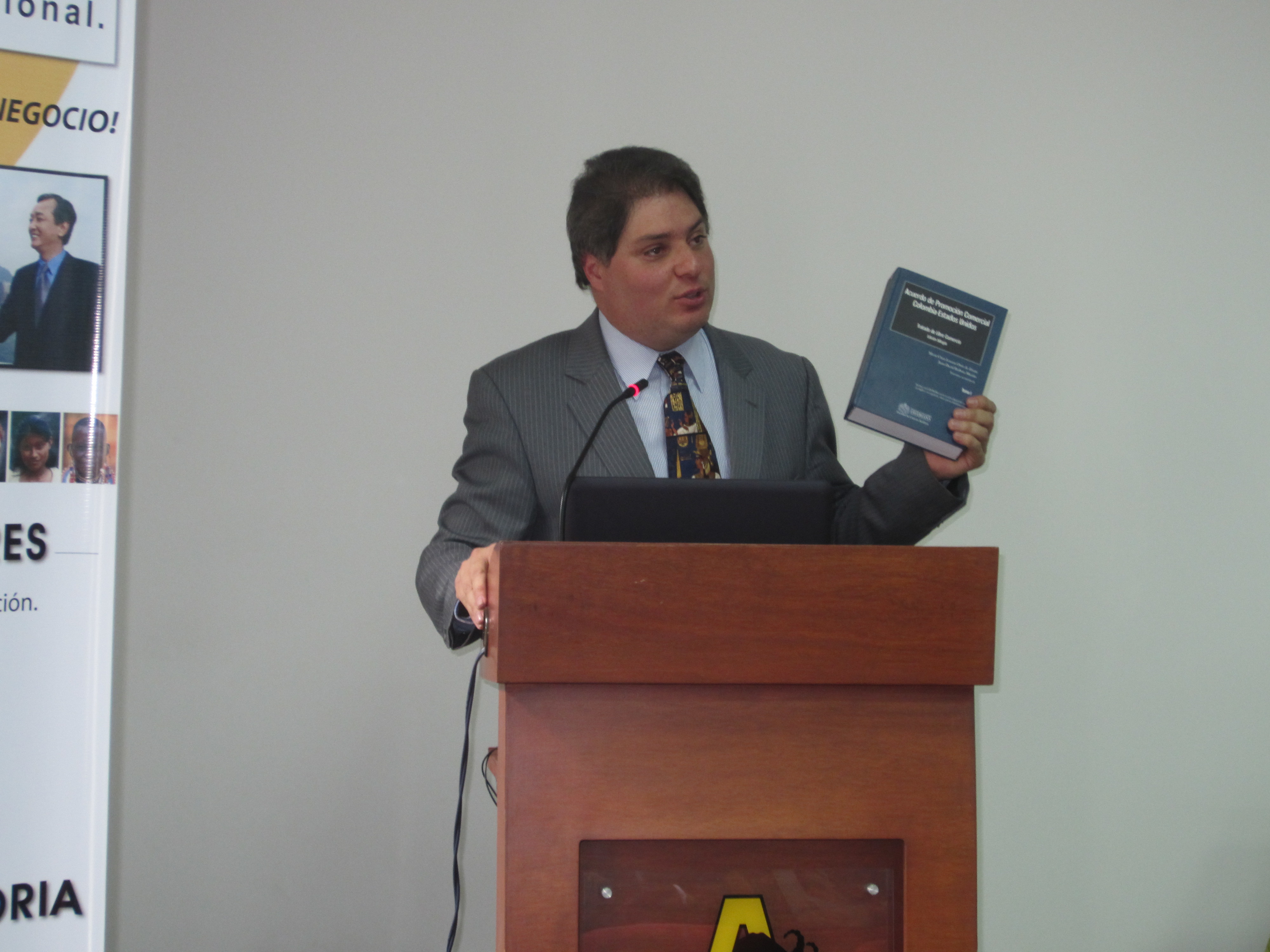
First, a very talented international lawyer, Andrés Forero, based in Bogotá, walked us through the various aspects of the new FTA, including a summary of the opportunities it presents for Colombian businesses. This was a most interesting session; Andrés knows the FTA inside and out, and he knows Colombian business. He took the complex and made it practical and understandable. He motivated those in attendance by explaining about the huge opportunities. And he also scared us a bit, telling tales of cross-cultural failures that he’d witnessed. Of added interest was the fact that he had been involved in translating the text of the FTA into English, and showed the full two volumes to the public for the first time ever.
Negotiating with US Americans – 2 hours
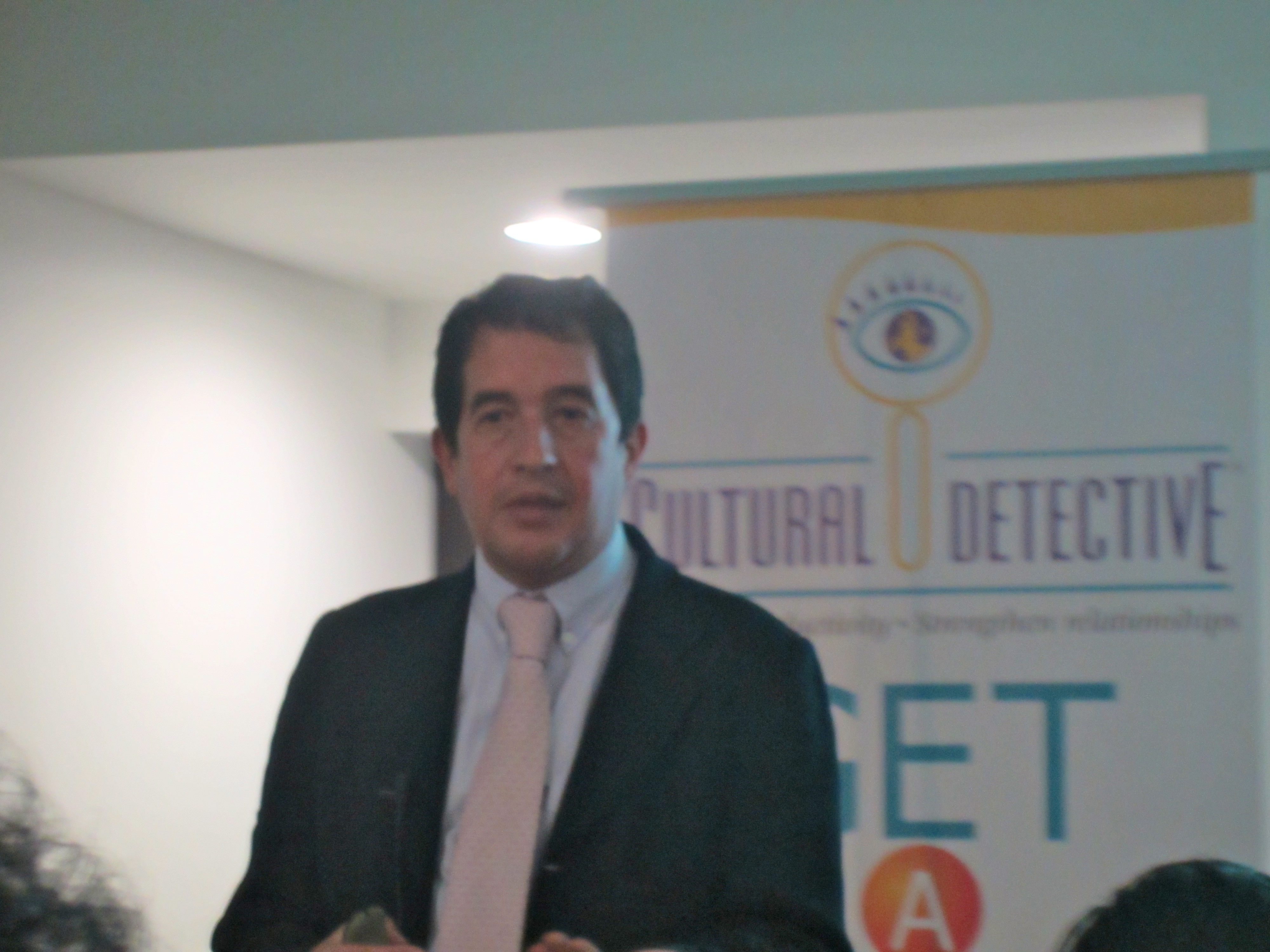
The extremely talented business consultant with whom I was working, Ing. Fernando Parrado, and I decided that we needed to just “jump in” with this group and immerse them in a case study of a typical Colombian-US negotiation. So we did. We told the story, and we debriefed it using the Cultural Detective (CD) Worksheet. This took about 45 minutes.
Once we had the Worksheet completed, we urged the participants to reflect on what they had done. They saw two different world views, two different approaches, both “correct” and both with value. They saw connections between actions and values, and that values and beliefs motivate behavior. And they saw that really effective strategies use the resources provided by all parties. This took another 10 minutes.
From there we introduced the three intercultural capacities on which Cultural Detective is premised (subjective culture, cultural literacy, cultural bridge), and then reviewed instructions for using the CD Worksheet/the CD Method properly. This took another 15 minutes or so.
Focusing on the US American values section of the now completed Worksheet, we began talking about what is important to US Americans. We defined the concept of culture, cultural diversity, and cultures such as regional, ethnic, socioeconomic, gender, and generational. We made sure participants understood that when we generalize we want to talk about central tendencies of a group of people. We don’t want to stereotype, to “box” an individual into the central tendency of the group.
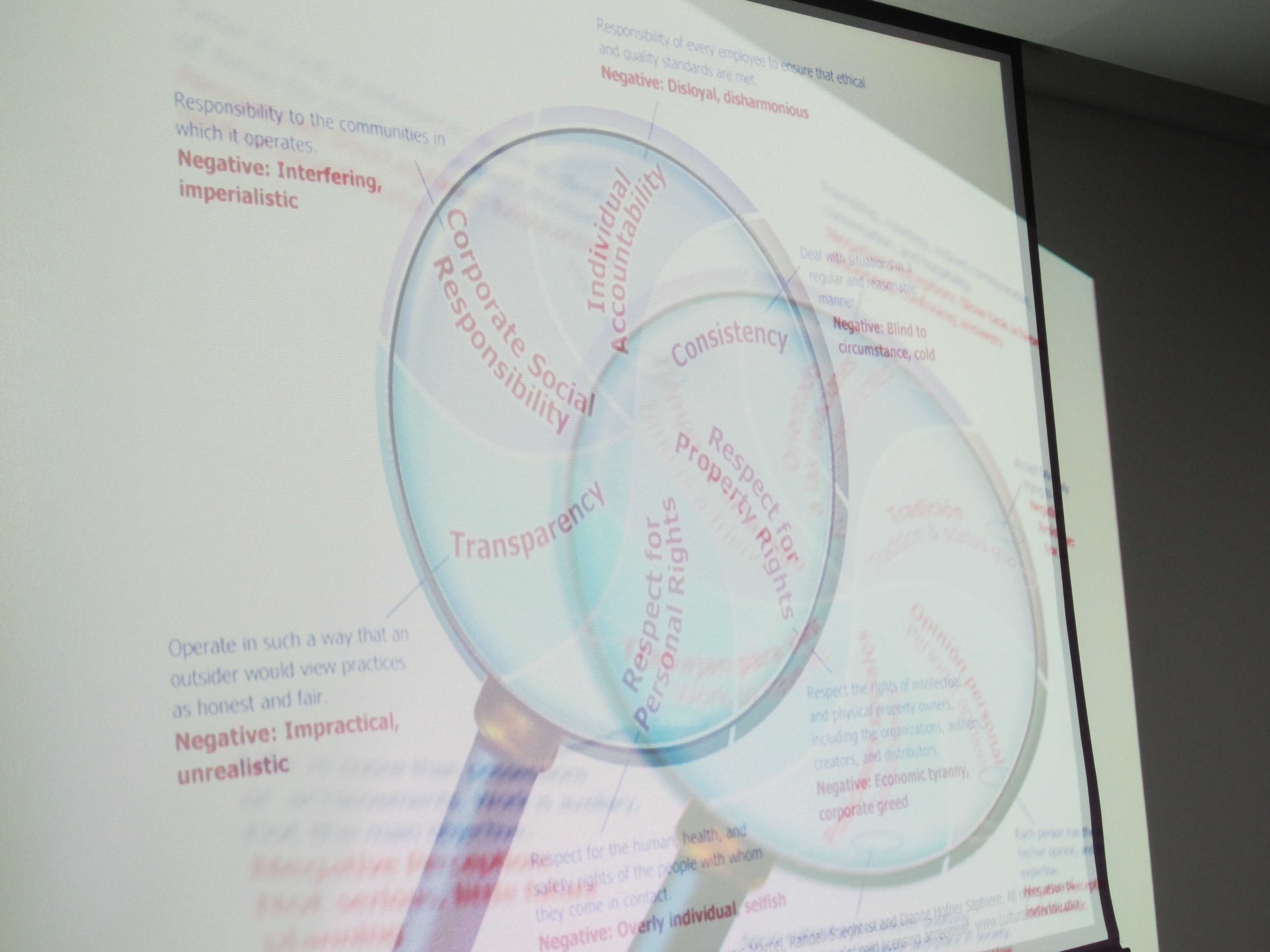
Then we introduced the concept of a Values Lens: that there are core values or central tendencies of a group of people. And that for each value there is a negative perception, that is, a way in which it can be viewed negatively by those who do not share the value or its expression. I told the participants, as I always do, about the danger of the Values Lenses. I cautioned them not to use them as yet another box into which to fit people, but rather as a tool for discovery, as clues for analysis. The values might apply to the situation, or they might not; they are a guide, a place to start.
These last two items took another ten minutes. It was quick. We covered a lot of territory in a short amount of time.
From here we introduced the US American Values Lens, sharing sample behaviors for each value, and sample negative perceptions. We asked participants if the Values Lens provided them any further clues to understanding the behavior of the US American in the case study, and indeed it did. Participants shared their stories of working with US Americans, and we were all able to learn from one another. This part took about 30 minutes.
Then we took a short break to eat some wonderful cheese-filled pastries and drink some of the famous Colombian coffee.
Understanding Colombians – 45 minutes
We came back from break ready to experience the debut of Cultural Detective Colombia. And what a debut it was! Fernando walked us around the Colombian Values Lens, sharing a story about each value, and explaining how to use it as a strength in working across cultures and making the most of the Free Trade Agreement. He also explained the Negative Perceptions for each value, again with illustrations, and positioning them as skills or competencies to develop when working internationally, at global standards.
Participants, who came in feeling that they had to “change” in order to be successful, now glowed with pride that they already held within them a heritage to be proud of, and onto which they could wisely add cross-cultural competence.
We again asked the participants if the Values Lens provided any further insight into the critical incident, and they found that it did. They enthusiastically declared the accuracy of the Colombian Values Lens. I felt very fortunate to be present for its debut.
This portion took about 45 minutes. While it was not requested by the client, it was an aspect we knew was very important if the participants were to achieve their objectives.
Global Business Ethics – 20 minutes
I am not an ethics professional, but the Cultural Detective Global Business Ethicsenabled me to be able to define the topic of ethics in an understandable way. More importantly, I was able to explain the difference between compliant and ethical behavior, and the grey areas created by cultural differences: an action might be “non-compliant” yet seen as the ethical or right thing to do, or an action might be “compliant” but seen as unethical or wrong from a cultural perspective.
With the help of Andrés, our lawyer, we introduced the CD Global Business Ethics Values and Negative Perceptions, using real-life examples. We then asked participants if the values from this ethics lens provided further insight into the Colombia-US negotiation case study. Indeed it did! We also asked them to overlay the Colombia Lens with the Global Business Ethics (GBE) Lens, and the USA Lens with the GBE Lens, and the huge contrasts were apparent. They saw the difference that culture makes on perceptions of right and wrong. Unfortunately we were only able to spend about 30 minutes on this portion.
Personal Values Lenses – 30 minutes
Why such a short time on Global Business Ethics? Because I knew that, if these people were to succeed in global business, they also really needed a grounded understanding of who they were as individuals. Thus, we gave participants about 15 minutes to fill in their own Personal Values Lenses, using an exercise and Lens from Cultural Detective Self Discovery. They could then easily compare their Personal Lens to the Colombian Lens and the USA Lens, as well as the GBE Lens.
In closing, we passed out laminated copies of the 75 or so Lenses in the Cultural Detective series, so participants could get a feel for how they might adapt their approach to a German or an Israeli or South Korean marketplace.
All in all, it was a very fast romp across a very broad territory. But, oh, the insights the participants gained! They left the room in the evening standing tall and looking enthused, which I tend to take as a very good sign.
—
Fernando and Andrés, thank you so much for this opportunity to work with you both in this way. It is not often I have the pleasure of working with people for the first time and we are able to find such synergy of talents; it was truly a privilege and a joy!
Everyone: what do you think of this design? What are your strategies for doing the impossible in a very short amount of time? I’m eager to hear!
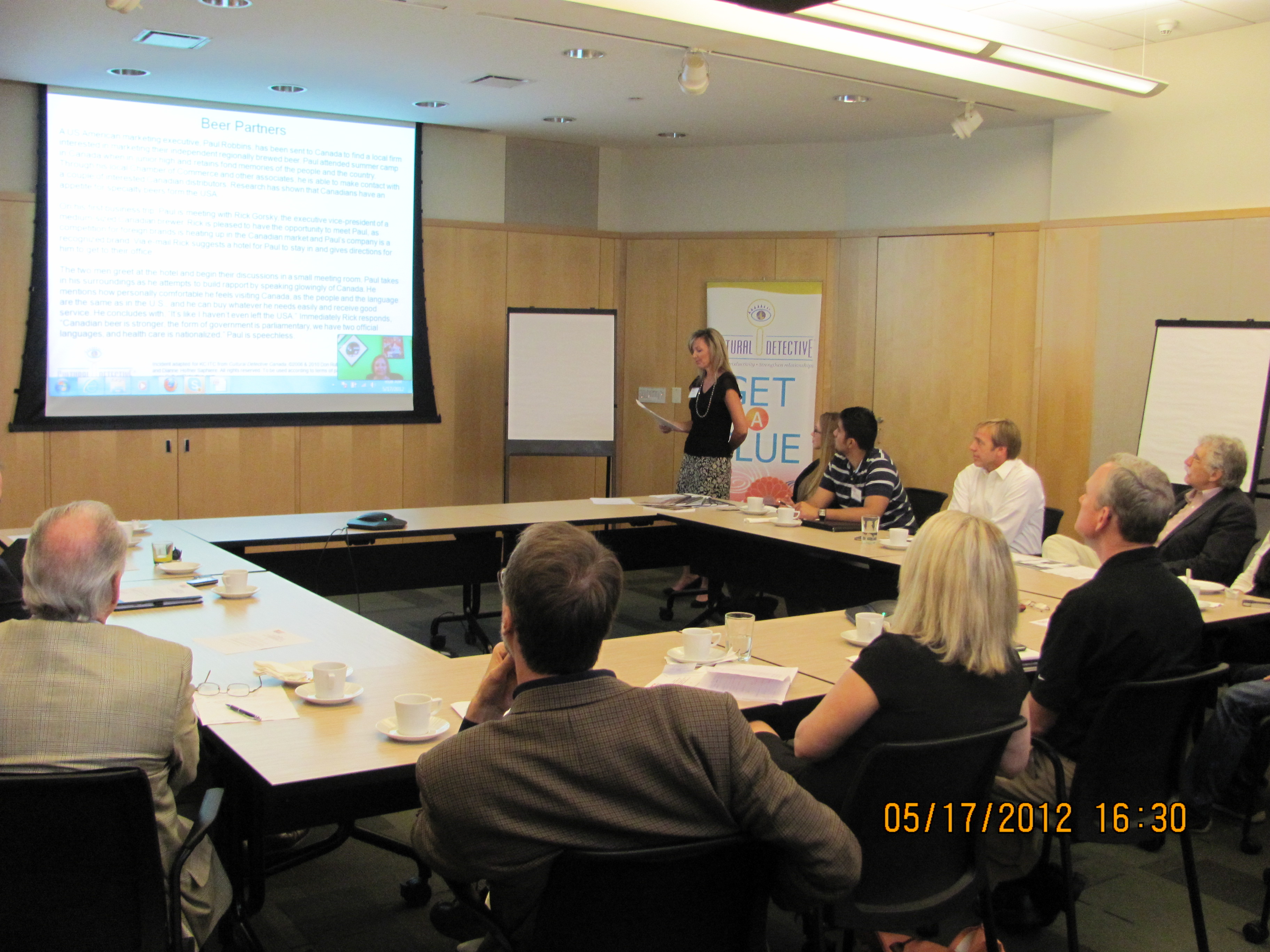
I recently had the opportunity to co-facilitate a Kansas City International Trade Council workshop focused on global expansion with Dianne Hofner Saphiere (via Skype from Mexico) and Janet Graham, who is currently a Baker University adjunct professor of International Business, Marketing, and Economics. We had a diverse group of business professionals, university professors, independent consultants and college students who actively participated in the workshop held at the beautiful Kauffman Foundation facilities.
Janet Graham brought a wealth of knowledge, discussing the various entry strategies when considering expanding globally. Some key decisions organizations must make in order to form a clear market entry strategy that she referenced include: which market to enter, when to enter the market and on what scale, and which entry mode to use? Great questions to which she provided some resources (such as globaltrade.net, globalEDGE, and WorldoMeters) to help direct the decision-making process. She quoted a local business leader from Hill’s Pet Foods who said the countries in which they have been most successful they’ve had a dedicated local distributor who markets and sells their products – and the relationship is key!
We then got to have fun bringing culture into the picture! Dianne pointed out that culture touches all parts of the strategy – communication, negotiation, competitiveness – and will ultimately affect how successful your business can be at expanding globally. I had the opportunity to showcase the Cultural Detective Method with the group by working through a global expansion incident involving a local specialty beer manufacturer exporting to Canada. We ended with an activity that tied the learning together by incorporating Values Lenses into developing strategies for expansion. The workshop was quick and to the point but brought together some true experts in the field and real world application of the Cultural Detective tools to meet local business needs.
The International Trade Council of Greater Kansas City was a gracious host and sponsor for the global expansion workshop – have you checked within your local community to partner with such organizations? It’s a great way to link the cross-cultural skill development to relevant community and business needs!
Tahrir Square (Cairo) at 3 am. Thousands of protesters still occupy the ground. They want a new revolution as dictator Mubarak may get away with his crimes in the Supreme Court and his ministers walk free from all charges.
I spent the whole night with the protesters, being introduced to everyone by none other than the leader of one of the most important revolutionary movements in Egypt: The Free Forum for Change.
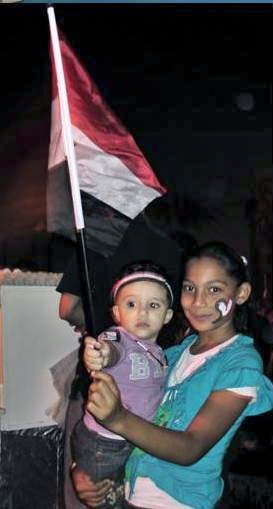
In this picture, you see Layla and her brother wide awake. At 3 am children their age are supposed to be dreaming about Disneyland. Tonight they are here learning to support a democratic land. Not sure if they understand it, but I am certain they are the youngest protesters on the ground.
During my recent and incredibly learning- and success-filled trip to Colombia, a client asked me to do a short presentation on the state of intercultural competence in Latin America. Such a small request, right (asked wryly and facetiously)? I live in México, but after four years I sure don’t count myself a culture-specific expert, and I am surely not qualified to speak for over half the hemisphere! So, what to do? Turn to an esteemed colleague’s expertise, of course. In this case, I turned to Adriana Medina (and her co-author, John Sinnigen).
The beauty of the source article I used, “Interculturality vs. Intercultural Competencies in Latin America,” is that the authors introduce facts and history we all know, but they put them into a context in such a way that makes total sense and creates new meaning. At least for me.
For example, one of their points is how Latin Americans have lived interculturality for hundreds of years if not longer: wars, imperialism and commerce between the many distinct indigenous cultures, then conquistadores, colonialism, slavery and intercontinental commerce. Intercultural competence on this stage is not some new import during the current age of global economic interdependence. Rather, Latin America’s gold, silver, emeralds and such were important to European economies beginning centuries ago. The authors’ point is, one of the valuable contributions that Latin American interculturalidad can add to the largely northern and western-originated notions of intercultural communication or intercultural competence is this: power, specifically power imbalances.
“Interculturality, the preferred term in Latin America, refers to a historic condition, a radical restructuring of the historically uneven relations of wealth and power that have existed between Europeans and their descendants and indigenous and other subordinated groups during the last half millennium. The aim is decolonization of institutions and the sociocultural fabric of the country.”
— A. Medina-López-Portillo and John H. Sinnigen, “Interculturality vs. Intercultural Competencies in Latin America,” chapter 13 in Deardorff 2009, Sage Handbook of Intercultural Competence
In their article the authors present six strengths that Latin American interculturalidad can contribute to the intercultural communication and competence field. And, speaking for myself, our field is in huge need of hearing and incorporating these perspectives into our theory and practice! Contributions of interculturalidad, according to Medina and Sinnigen, include that it:
Is counter-hegemonic; focuses on the balance of power
Starts with the needs of marginalized cultures (diverse indigenous movements from Mexico to Bolivia and Ecuador)
Advocates mutual respect and economic and political equality rather than the acculturation of the oppressed
Incorporates Andean/Amazonian concepts such as respect for Pachamama, good living, communitarian practices
Multilingual integration
Decades of dialogue leading to constitutional specificity
I want to thank this client for making this request of me, as it spurred me to learn more about a colleague’s work, and also to learn more about the work of Nestor García Canclini (more about his work in another blog post). I also want to thank Adri and John, whose work, I feel, is very important. I hope this might spur more of us to read, incorporate and build on their findings.
I have posted three PowerPoint slides summarizing this article, and you are welcome to download and use them if they might serve you. Please be sure to retain all source references, including the authors’ and Cultural Detective‘s. Together we can make a difference!
What do you think about the authors’ premises? How might we help the intercultural field to incorporate the Latin American perspective? How do you handle power differences in your work? I look forward to hearing from you!
—
Born and raised in Mexico City, Adriana Medina-López-Portillo is Assistant Professor of Intercultural Communication and Spanish in the Department of Modern Languages, Linguistics and Intercultural Communication at the University of Maryland, Baltimore County (UMBC). She is an accomplished intercultural trainer, having designed and led workshops for higher education, not-for-profit, governmental, and corporate clients in the United States and abroad. Among her favorite appointments are training for The Scholar Ship, a transnational academic program housed on a passenger ship, and offering pre-departure and on site orientations for the King Abdullah University of Science and Technology (KAUST) in Saudi Arabia. John Sinnigen is Prof. of Spanish and Intercultural Communication at UMBC. He is the co-editor of América para todos los americanos: prácticas interculturales (Mexico: UNAM, 2012).
As I had just finished facilitating the PTPI (People to People International) workshop and entering the elevator with some PTPI attendees, I was pleased to hear a funny comment by one participant: “I am so glad this was about developing cross-cultural skills as I was afraid we might be participating in some sort of scavenger hunt!”
Well, it was in fact a hunt in some ways – we searched for clues about what motivates our friends and colleagues to behave the way they do and what motivates us to act and react the way we do!
Key learnings from group wrap up were described as:
Seek to understand others values and what’s really motivating their behavior
Look for similar values and use those to collaborate
Appreciate differences
Incorporate the strengths of all team members – there is no “right way” to get things done
Show up with an open mind
The PTPI Cultural Detective session was designed to help the PTPI community members and their board of directors with strategies to improve their diverse recruiting – and it was received very positively with a quick post, “Incredible Presentation by Cultural Detective,” and the above photo from Liz Wegman, PTPI staff member. We had a group of about 35 PTPI leaders in attendance from all over the country and world who will return to their communities with fresh perspectives and strategies around building more diversity in their chapters.
Although diverse recruitment is not typically how I lead into discussions around working with the Cultural Detective tools, it certainly was an applicable organizational need which developing intercultural competence can help solve. Has PTPI’s unique application of the Cultural Detective approach spurred some ideas for you to assist your or your clients’ specific intercultural challenges?
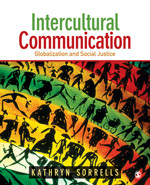
Intercultural Communication: Globalization and Social Justice provides fresh voice and much-needed current perspective on intercultural communication competence. Written as an undergraduate and graduate level text, as a 30+ year professional I also read it enthusiastically. From Sorrells’ debunking of racial color blindness (p. 62), to the commodification of culture (p. 190), to her closing call for global citizenship (p. 227), her keen intellect and passionate commitment to social justice is evident and unwavering throughout.
From the beginning the author makes clear the need to put intercultural communication in context and with a clear purpose:
“Regrettably, some of the most egregious injustices—exploitation of workers in homes, fields, and factories and violence perpetrated through racial profiling and ethnic cleansing—are performed within intercultural contexts and are enabled by intercultural communication.” (p. xiv)
…”the globalized context in which we live today makes ethnocentrism and ethnocentric approaches extremely problematic. The assumption that one’s own group is superior to others leads to negative evaluations of others and can result in dehumanization, legitimization of prejudices, discrimination, conflict and violence.” (p. 13)
“This text … provides a framework to create a more equitable and socially just world through communication.” (p. xiv)
By page 38, I knew I was in good hands, as Sorrells wove Amy Chua and her World on Fire into the intercultural mix, providing it as counterpoint to Francis Fukuyama’s The End of History and the Last Man.
The author appears to have challenged herself to address each topic, even the most familiar, through at least four lenses:
in what ways is the topic complex and contradictory,
how does the topic appear from micro, mess and macro views,
what are the local and global connections, and
how do the complexities and contradictions play out in our world today, particularly in terms of equity and justice?
Sorrells is an excellent teacher, providing rich yet succinct examples—unraveling the various interwoven threads of her stories to enable the reader to more clearly see each thread—while keeping the overall tapestry in mind. Her writing should energize and guide cadres of undergraduates, as well as professionals, to use intercultural communication theory and practice to bring more equity and justice to our world.
Sorrells covers the content you’d typically expect in a basic text on intercultural communication: nonverbal communication, context, dialogue, relationships, communication style, identity theory, use of space. What makes this book different is that she uses important current issues and topics to provide a fresh perspective and powerful, meaningful insight. She examines intercultural communication informed by topics such as power, hegemony, growing socio-economic inequities, the culture of capitalism, race, color-blindness, immigration, glocalization, hip-hop culture, appropriation, hybrid cultures, and online communication. She pulls from a variety of disciplines including feminist theory to address her topic. In the process, she introduced to this practitioner new ideas such as fragmegration (p. 131), culture jamming (p. 144) and polysemic space (p. 91).
The book begins by looking at why the intercultural field has not been able to settle on one definition of culture, tracing definitions of culture from anthropology, cultural studies, and globalization. The author next guides us through a much-needed review of the history of intercultural communication, doing so crisply and meaningfully. Revisiting the origins of the field may help us return to our collaborative purposes and away from the overly analytical comparative studies trends of today.
Each chapter concludes with discussion activities and questions, which for a trainer or coach will be invaluable. And they’ll make lesson planning for the classroom easy.
To enable students to navigate the complex intercultural spaces they inhabit, the author introduces a process of critical, reflective thinking and acting. She calls this “intercultural praxis.” Via six interrelated points of entry (inquiry, framing, positioning, dialogue, reflection, and action), “intercultural praxis uses our multifaceted identity positions and shifting access to privilege and power to develop our consciousness, imagine alternatives, and build alliances in our struggles for social responsibility and social justice.” (p. xvi)
Obviously the text is not intended for a basic-level reader of English! And, while this praxis model is definitely conceptually sound, it is far from easy to put into practice.
What were some of the points in this book that stood out for me? The concept of “positioning” is important:
… “how our geographic positioning is related to social and political positions. As you read these sentences, where are you positioned socioculturally? The globe we inhabit is stratified by socially constructed hierarchical categories based on culture, race, class, gender, nationality, religion, age, and physical abilities, among others. Like the lines of longitude and latitude that divide, map and position us geographically on the earth, these hierarchical categories position us socially, politically and materially in relation to each other and in relation to power.” (p. 18)
Sorrells explains that positioning “directs us to interrogate who can speak and who is silenced; whose language is spoken and whose language trivialized or denied; whose actions have the power to shape and impact others and whose actions are dismissed, unreported and marginalized.”
The author’s reference to modern-day anthropologists Jonathan Xavier Inda and Renato Rosaldo was also valuable. Their premise is that culture, in the context of globalization, has been “deterritorialized.” What this means is that “cultural subjects (people) and cultural objects (film, food, traditions, and ideas) are uprooted from their ‘situatedness’ in a particular physical, geographic location and reterritorialized, or relocated in new, multiple and varied geographic spaces,” (p. 43).
Hence, we find Hindi films and Amitabh Bachchan posters worldwide, with wildly different meanings attached. “Similarly, a person’s or group’s sense of identity, who migrates from Iran to Israel to the United States, for example, is reinscribed in new and different cultural contexts, altering, fusing, and sometimes transforming that identity.”
There were two very minor disappointments for me, amidst all the positives in this text. The first is that while this volume includes a great deal of content that other intercultural texts omit, Sorrells does not adequately address religion and its role in society today. The clash of religious and spiritual beliefs, the gaps between believers and non-believers, the judgments one to another, the fact that religion can provide access to power or motive for distrust, are important. Religion can divide or unite communities, nations, and continents. A chapter or at least a couple of pages devoted to the topic, as seen through Sorrells’ keen perspective, would be a valuable addition.
Second, while the book is overflowing with examples from all over the world, it is unnecessarily US-centered. Perhaps a US publisher wanted the book to sell to US universities, and thus preferred it be written that way. This could so easily have been a non-nation-centric book—with an even bigger market. It comes so very close that it seems a shame not to have gone the extra step.
Intercultural Communication: Globalization and Social Justice is a must-read for any intercultural professional or serious student of the field. And if you have the pleasure of teaching an intercultural communications class, this is a terrific new text.
International educators have historically assumed that K-12 international schools are, by default serving multinational and multicultural expatriate communities, providing students with experiences that result in intercultural competence. But are international schools truly teaching students to make meaning of their unique cultural experiences or, when it happens, is it more by good-fortune than by design?
I recently had the honor of being invited to present a series of half-, one-, and two-day programs, at the Student Services Summit sponsored by the Hong Kong International School (HKIS). HKIS is among the top tier of K-12 international schools worldwide, and enjoys a well-deserved reputation as a premium institution. Although it was my first time at HKIS, working with and at the School had a quality of home-coming for me: I grew up attending international schools in West Africa and South East Asia, and consulted extensively with international schools throughout Europe and South Asia in the 1990’s. Although each international school varies from the next, the culturally diverse environment they typically offer is very much home territory for me.
And so what a joy to be asked to facilitate a two-day program for international educators titled Deepening Intercultural Competence: Developing an Intercultural Practice. Participants were international educators from across Asia and beyond, mainly developmental guidance counselors (with a couple of administrators too), who share a common passion for preparing their students to participate successfully in a globalized world. They were very ready for a professional development program focused on strengthening their own abilities to role model moment-to-moment intercultural practice.
I centered our time together on The MashUp: A Professional Toolkit for Developing Intercultural Competence. The MashUp (MU) is a natural and powerful combination of two leading processes in the development of intercultural competence: Cultural Detective (CD) and Personal Leadership (PL). Where PL provides a process to disentangle from automatic judgments, emotions, and physical sensations, and to open to the unique possibilities of the present moment, CD provides a process for deconstructing the intercultural dynamics at play, considering the values, beliefs and personal cultural sense that may be motivating people’s words and actions, and developing cultural bridges to close the gap. As an integration of the two, the MashUp offers a proven and exceptionally effective way to successfully strengthen intercultural competence in individuals, in teams, and across organizations.
In Hong Kong, the MashUp was very well received by participants who immediately saw its relevance and practical service to the daily situations they encounter – as international educators and as expatriates themselves. As one person put it:
“How thrilled I am to have experienced these past 2 days – I feel excited and energized, ready to begin a new journey! This has been everything I had hoped it would be, and more. I am leaving today with great ideas to enrich my practice, and steps to move towards this goal. I also believe that I have a group of colleagues who have a similar mindset and interest in adding value to their practice.”
I too left the session inspired. These international educators are ready to intentionally provide their students (no longer simply to trust to good-fortune) with the role-modeling, orientations, and practices that develop intercultural competence. And if that’s true of the educators in my session, then we can know it’s true of many more!
You have two opportunities to learn more about this developmental MashUp of PL and CD.
The first opportunity will be live and in-person at the Summer Institute for Intercultural Communication, July 16-20. Developing Intercultural Competence: An Integrated Practice will be conducted by Dianne Hofner Saphiere and myself, Barbara F. Schaetti.
Communicating in the Language of Food, by Joe Lurie
Dear readers, I am very pleased to share with you another guest blog post by the talented Joe Lurie (though Joe, I’d prefer to “swim in the chocolate” rather than “bicycle in the yogurt”). You’ll remember that Joe previously shared with us the very popular article, “Language Under the Gun.”
—
Noting that French President Francois Hollande has been referred to by his political opponents as a fragile strawberry, a wobbly flan , a marshmallow, and “gauche caviar,” with the charisma of a smelly sausage, I was reminded of how a culture’s preoccupations shape the way language is used.
I was first introduced to the pleasures of French cuisine and its influence on the French language as a university student hitchhiking through Normandy, sampling butter, cream and apple brandy-suffused dishes.
Struggling to express myself in village bistros, I realized the truth behind Mark Twain’s observation that Intermediate French is not spoken in France. A friendly waiter, noting my frustration, reassured me saying, I know, it’s not pie, “Je sais, c’est pas de la tarte,” which means it’s difficult. He went on to add, butit’s not the end of the string beans, “maisc’est pas la fin des haricots” – a strikingly French way of saying, it’s not the end of the world.
A decade later, my French was much improved. While directing a US American study abroad program in Toulouse, my understanding of food’s influence on the language deepened. Before taking a French cooking class with my 20 students, we stopped at an open-air market. Because the line to buy cheese was not moving, our impatient guide complained: “on ne veut pas faire le poireau,” we don’t want to be like a leek. Later, we learned the translation: to wait like a motionless leek in the ground. Now late for cooking class, our guide urged the van driver to press on the mushroom! “appuyez sur le champignon!” – meaning step on the gas! Keeping a chef waiting simply would not do.
The students and I were struck by how carefully the chef conducted the lesson – artfully presenting and discussing the ingredients. The meal is serious business, not to be treated like a joke or, as the French say, like custard – c’était pas du flan ce cours de cuisine! As we prepared a fruit salad, the chef mumbled “oh purée!” mashed potatoes! – or damn it! and disdainfully discarded a blemished peach to preserve an aesthetically pleasing fruit plate.
During almost four years living in Strasbourg, Toulouse and the island of Corsica, I saw how the French passion for eating and discussing food flavored the language in tasty and unusual ways, though some expressions are unique to different regions or generations.
It began to make sense that endearing French metaphors are often rooted in the pleasures of taste. “What a nice person” is served up in French as “c’est une crème!” – what cream, while “lacrème de la crème,”the cream of creams is the best of all. And “you are so energetic” takes on a carb boost in French: you have the French fry (tu as la frite). To be in high spirits also can come from the fruit family, as in you have the peach (tu as la pêche), while having a banana (avoir la banane) is to have a big smile. And, of course, there’s the affectionate “mon petit chou,” my little cabbage.
Allusions to food also season the language of love. A broken-hearted UC Berkeley student of mine from Marseille described her flirtatious boyfriend as a Don Juan with the heart of an artichoke,“quelqu’un qui a un cœur d’artichaut,” offering each of his lovers a leaf from his heart. He was skilled at making romantic advances or as my student put it: serving up a dish, “faire du plat à quelqu’un,” a prelude to going off to the strawberries,“aller aux fraises,” to enjoy an erotic interlude.
Even insults and put-downs easily spring from the tongue as if from a farmers’ market. An idiot or jerk, for example, can be described in French as what a pickle! (quel cornichon!); an utter squash (une vraie courge); such a noodle! (quelle nouille!); or as having a green pea in the brain! (avoir un petit pois à la place du cerveau!). When struggling to drive in France, I’ve heard irate, gesturing French men speed past, yelling “espèce d’andouille!” – piece of sausage!– or, you imbecile!
I remember a heated debate in a Paris café about a Gerard Depardieu film. A friend dismissed it as a turnip, “un navet,”a startling vegetable metaphorfor atrashy film. When he called the actor a horrible drunk, an indignant Depardieu fan interrupted with: shut yoursmelly Camembert mouth! “ferme ta boîte à Camembert!”
Just as food evokes passion in France, its metaphorical expressions enliven debate. Butting in on a conversation is to bring your strawberry, ramener ta fraise.Being overly inquisitive about someone’s private life could provoke an acerbic “occupe-toi de tes oignons!” mind your own onions! the French version of mind your own business. But perhaps the classic French way of ending an argument is go cook yourself an egg, “va te faire cuire un œuf,” or go to hell.
Traveling through the Pyrénées with a French couple, my wife and I enjoyed great food and spirited conversations, especially about politics. When the husband praised Sarkozy, his wife sneered that the former President is overly dramatic – making a big cheese out of nothing, “il fait tout un fromage de rien du tout.” She added, you can’t tell if he’s talking about pork fat or pork meat, “on ne sait pas si c’est du lard ou du cochon,” you can’t tell if he’s lying or telling the truth. And she believed Sarkozy had casseroles hanging on his butt – “des casseroles au cul” – a scandalous past.
While serving as Dean of Students at an international college in Strasbourg, I was struck by how much my French colleagues valued using words precisely, reflected in the pervasive use of the verb “préciser.” I chuckled when I heard some professors describe student papers that lacked clarity. They complained that these students were lost, bicycling in the sauerkraut, pédalant dans la choucroute. In other regions, one might say bicycling in the yogurt or couscous. And then there’s swimming in chocolate, nageant dans le chocolat, or skating in the mayonnaise, patinant dans la mayonnaise – getting nowhere. Outside the college, I heard other vivid ways of describing confusion such as being in the soup, the pate or the cabbages (être dansle potage, le pâté or les choux).
Recently, I saw an exasperated French TV commentator despair over the French economy by throwing up his hands exclaiming what a salad! “quelle salade!” what a mess! And then he finished with the carrots are cooked! “les carottes sont cuites!” meaning it’s all over.
If one is unemployed and grouchy or as the French say, “pasdans son assiette,” not on your plate, landing a job would help to putbutter on the spinach “mettre du beurre dans les épinards,” to make things better. And then it’s time to put your hand in the dough, “mettre la main a la pate” – get down to business. After all, you’ve got to defend your steak, “défendre ton bifteck,” as in look out for your interests.
Speaking of steak, making a living is gagner son bifteck, to earn one’s steak; while making a profit is to prepare one’s butter, faire son beurre. And to have a pancakeavoir de la galette, is to be rich. Assuming pancakes are your goal, you’ll have to go all out, put on the sauce, mettre la sauce, and be prepared to make a strong sales pitch, vendre ta salade, by selling your salad.
A UC Berkeley graduate student in computer science from Tours told me he was building a start-up company – “une jeune pousse,” a young sprout and didn’t know what to expect or what sauce he would eat, “ne pas savoir à quelle sauce on va être mangé.” He knew he had bread on the board, avoir du pain sur la planche, a lot of work to do, but realized that while dealing with potential investors he had to avoid being rolled in the flour, être roulé dans la farine – duped. Otherwise, he risked eating the frog, manger la grenouille – going bankrupt. He didn’t want to end up without a radish, ne plus avoir un radis, or as we would say, without a cent. All his dreams for nothing – “pourdes prunes.” Still, if he becomes successful like a Bill Gates, he’s apt to be called a large vegetable, une grosse légume, and be among the grated cheese, le gratin – the elite.
The versatility of the cheese metaphor in a country with hundreds of cheeses is not surprising. “A dessert without a cheese is like a beautiful woman with only one eye,” observed Jean Brillat-Savarin in his Physiology of Taste. His famous 19th century book, exploring the nuances of cuisine – still is sold in France. And no wonder, with a line like: “He who invents a new dish will have rendered humanity a greater service than the scientist who discovers a planet.”
Today, as French supermarkets and fast food restaurants continue to proliferate, gourmands refuse to compromise or cut the pear in two, couper la poire en deux, in defending their culinary heritage. For more than twenty years, during “La semaine du goût,” Taste Week, thousands of chefs visit schools across the country. They teach children to appreciate fine food; make a baguette, a mousse au chocolat; appreciate a bouillabaisse; and learn the anatomy of the tongue. Restaurants with Michelin stars develop special meals for young children. And chefs are invited to daycare centers to prepare gourmet menus.
Will this unique early training insure the survival of the refined French palate and the nourishment of its language? A master chef is likely to respond, of course, “mais oui, c’est du tout cuit” – it’s completely cooked – it’s in the bag.
—
Joe Lurie is Executive Director Emeritus at University of California Berkeley’s International House, a cross-cultural communications trainer, consultant, university lecturer, and certified Cultural Detective facilitator. Another terrific article he wrote for Cultural Detective, also full of metaphor, was called “Language Under the Gun.”
You want to know about the real Arab Spring? Look at this picture. These young people, both Muslim and Christian, are those who started the revolution in Egypt in 2011, demanding dictator Mubarak to step down. However, this spontaneous, penniless, and immature movement has been hijacked by the more organized Muslim Brotherhood who stole the spot light and became the prominent candidates for the new regime.
Yesterday, just a few hours after the voting box closed down, I found myself in a secret apartment in the heart of Cairo, the headquarters of the youth revolution. A dozen young activists were working like bees in a beehive on their laptops, updating thousands of tweets and Facebook posts, sending the results of every single voting spot, reporting to the people of Egypt every potential problem of the election.
“Yes, our revolution has been kidnapped by the Islamists!” admitted Ahmed. “I slept in Tahir square, protesting for days, to see a new regime with a liberal and democratic mind set, not someone from the Muslim Brotherhood who wants the country to be back in the stone age. The only thing we can do right now is to be keen observers to make sure this is a fair election. If the Muslim Brotherhood wins, we will have a new revolution, a real Arab Spring.”

 Interesting article in Diversity Executive magazine about product naming problems in the global market, some good examples, and a link to an article on the value of intercultural competence.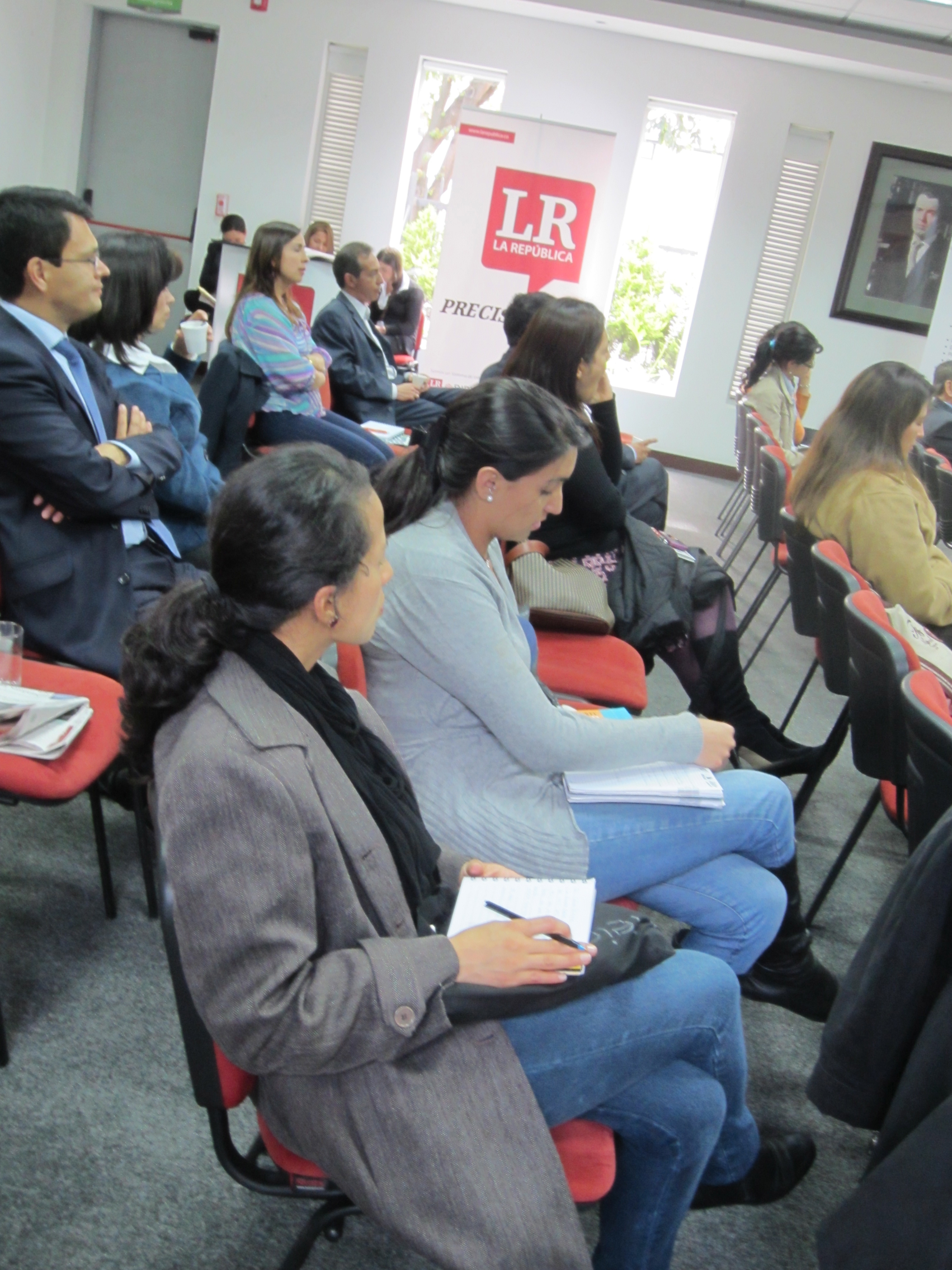




 present a series of half-, one-, and two-day programs, at the Student Services Summit sponsored by the
  A Professional Toolkit for Developing Intercultural Competence.
  educators are ready to intentionally provide their students (no longer simply to trust to good-fortune) with the role-modeling, orientations, and practices that develop intercultural competence. And if that’s true of the educators in my session, then we can know it’s true of many more!
 Communicating in the Language of Food, by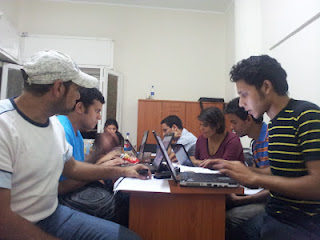
 Cultural Detective Blog