New Year’s Gift: Oldie but Goodie—The STADIApproach

Permission is granted to use this model freely and to circulate it, PROVIDED the © and url are maintained.

Permission is granted to use this model freely and to circulate it, PROVIDED the © and url are maintained.

It is said that experience is the best teacher. But learning does not lie in the experience itself; rather, it is our interpretation of the situation—the meaning we give to our experience—that provides our learning.

How might we better enable learners to constructively give meaning to their intercultural experiences? Are you looking for an easy and highly effective way to structure your next intercultural workshop or coaching session? Are you wondering how you might better enable study-abroad students to understand their experience in a way that builds cross-cultural competence? Do you have employees working internationally or multiculturally, and you’d like them to learn to truly harness the potential of diversity?

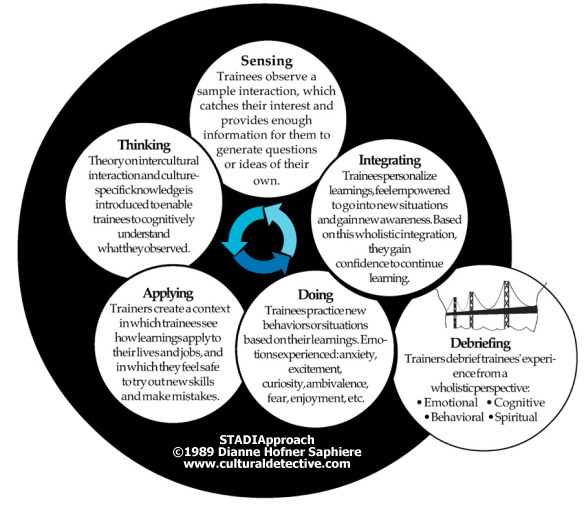
This “oldie but goodie,” the STADIApproach to Intercultural Learning, has been used in dozens of organizations worldwide with huge success. Click on the link to view a full article on the approach. I first published it for use with my proprietary clients in 1989; it is now even more useful as it can provide a design framework for blended learning approaches that leverage Cultural Detective Online. The CD Online system has STADI embedded into its core. In the hands of a skilled facilitator, teacher or coach, you can assist your learners to Sense, Think, Apply, Do and Integrate by analyzing the experience of others via the critical incidents in CD Online, as well as probing their own real life experiences.

We trust you’ll find the STADIApproach article helpful! Please accept it and use it as my new year’s gift to you, this January of 2014. It is my wish that the new year will enable all of you, dear readers, to better facilitate intercultural understanding, sustainability, respect and equity on this planet of ours.

Please share your experiences with us, and your designs that effectively leverage Cultural Detective Online to supplement your training, teaching or coaching endeavors.


Names Across Cultures (First in a Series of Video Interviews with Authors!)

Name ChangesThere are many reasons people change their names: some people have a stage name, pen name, nickname, religious name, or an earned title or name. All too frequently, however, a name is involuntarily changed when someone immigrates, or when a teacher or teammates have trouble pronouncing the person’s birth name.

Many of us work with individuals who have been “renamed” by other colleagues, or who have changed their names to make them more palatable and pronounceable in a new location. Other times people adopt a different name due to a change in circumstance, profession, or age. For example, as a kid growing up in a small town, my father was called “Charlie:’ however, as a middle-aged adult living in a different town, he became known as “Chuck.”

Many people’s names have special meaning or significance. An interesting way to learn about a new acquaintance can be to ask the meaning and origin of the person’s name. And, if we wish to build trust with our friends and colleagues, in addition to understanding the meaning of their names, we can learn to pronounce their names correctly. You may recall that in January 2012 we shared a link for a handy-dandy little software that allows YOU to record the pronunciation of your name, and add it to your email signature, website, LinkedIn account, etc. What a great way for those unfamiliar with your name to hear it prior to meeting you!

Perhaps you, like me, are known by several different names bestowed on us by friends and colleagues. Dianne is the name given to me by my parents at birth, while my name in Japan is Dai-an (大安 or “great peace”, also a very auspicious day of the month). My Spanish-speaking friends and colleagues call me Diana María, and close friends and family call me Di. In my case, I’d rather be known as “Diana” or “Dai-an” than have my birth name “Dianne” mispronounced.

In many cultures, such as Mexico where I live, it is a sign of cariño or affection to bestow a nickname on others (click here for a list of some unusual terms of endearment in various languages). However, many people worldwide love their birth names, believe they are imbued with power, and would honestly prefer we not change their names for them.

Yet some people do want to change their name for various reasons, and have done so. Here’s a special little drag-and-drop game for you, to see if you can match some famous people’s birth names with the names they are more commonly known by now.

I recently spoke with Dr. Emmanuel Ngomsi, a diversity consultant originally from Cameroon, about the topic of naming. Emmanuel has a wealth of experience, is very passionate, and a consummate storyteller, as you’ll see in the interview below.

Do you have a story related to naming that you’d be kind enough to share with us? Have you changed your name, or has it been changed for you? How do you feel about that? Do you have any advice for others about names and naming?

See Part 2 of this interview.

We Have to Teach in Context!

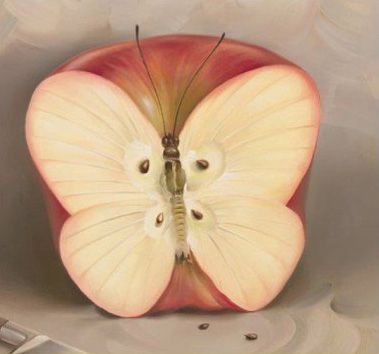
Apple-butterfly

What we learn has to “fit” with what we know.
It has to be appropriate for where we live and work.
Part of learning is to apply the new to the old, integrating the two.

A client called us, saying they had hired a young woman with an MS in Intercultural Communication to design courseware for them. The objective of the courseware is to improve participants’ job performance, in this case, to make them more effective and efficient at servicing international customers.

“We had a lot of hope for intercultural communication training. But we’ve been doing it for nearly two years now, and we are very disappointed with the results. We have seen no bottom-line impact on performance.”

In reviewing the courseware, I found that it in many ways it was very savvy, but appeared to have been taken nearly verbatim from the woman’s graduate studies. The exercises and activities were designed for master’s students in intercultural communication, and had not been adapted for customer service representatives!

We heard from another client recently that had invested three years developing a curriculum to improve the intercultural competence of their global staff. A diverse group of their international employees attended professional development classes in intercultural communication, and an elite group at head office developed a standardized curriculum to be used worldwide. One of the main objectives of this effort is to be able to better resolve conflicts and misunderstandings more effectively.

So what’s the problem? Everyone loves the new curriculum. However, they leave the program feeling no better equipped to resolve conflicts. They love the tools they’ve learned, they enjoy the trainers, but they don’t know how to use the new tools and skills in a real situation!

THE PROBLEM IN BOTH SCENARIOS
What do these two scenarios have in common? In both cases, the training designer was replicating a graduate-level education course—designed for professionals—and repurpose it, as-is, for skill building. And that just doesn’t work! I’ve seen it far too often in recent years, and it’s a distinction we really need to make. Doctors graduate to practice medicine and to help their patients learn healthy lifestyles; they do not generally teach patients how to be doctors.

Professionals need skills they can use on the job, and that includes cross-cultural skills. But those skills must be taught in context, via application and practice in simulated and, eventually, real situations.

SOLUTION ONE
In the first case, Cultural Detective was added into the client’s existing customer service training. Leveraging pre-existing company-specific case studies and audio-visual scenarios, we used the Cultural Detective Worksheet and Values Lenses to supplement the debriefing. In this way, the need for intercultural skills became more evident and was linked to job success for the customer support engineers. In addition, all practice of cross-cultural skills was integrated with the practice of vital job skills.

We retained many of the exercises and activities included in the original, separate cross-cultural curriculum. However, we wove them into the customer service training to supplement, amplify, and deepen learning using the Cultural Detective Method. Once cross-cultural skills were grounded in the business at hand—the purposes of the employees’ work (customer service)—they made all the difference in the world.

This client reported to us a 30% increase in customer satisfaction that they directly attribute to Cultural Detective.

SOLUTION TWO
The second case is still in process. I very much admire the quality of the curriculum and the incredible coordination it has taken to get so many trainers in such diverse locations “up to speed” with the material. Yet, they are starting to realize that although the training has been well-received, staff is not able to use what they have learned once they are back on the job. Yet with so much investment, they don’t want to completely redesign. And they don’t want to be dependent on outside material.

I advised them to weave into their curriculum a simulated conflict scenario, one that could be worked on and revisited throughout the training. In this way they do not need to completely redo their superb design, and the training they have already provided will still be useful. The difference? The revised curriculum is grounded in their reality and will allow staff to practice cross-cultural skills in simulated situations. That way, when they return to work, they will know when and how to apply the cross-cultural skills and tools they have learned.

SAMPLE DESIGN
Let’s look at a typical training curriculum, and then look at how easy it is to weave Cultural Detective into the existing design. Let’s say on Day One they teach what is culture (Iceberg, observable behavior linked to underlying values) and D.I.E. (learn to Describe before we Interpret and then only with culturally appropriate information, to Evaluate). On Day Two, they teach intention/perception and cross-cultural adjustment (culture shock).

Instead, they might start Day One by introducing a case study involving an everyday challenge. Having introduced the context, trainers facilitate learning as planned in the original curriculum (Iceberg and D.I.E.—Description, Interpretation, Evaluation). After doing so, however, they return to the case study, the professional context, and explore: how do values apply to this case study? What are the Evaluations that I am making, based on what Descriptions? From there, it’s a very easy introduction to the Cultural Detective Method, which this client has already licensed and, therefore, is welcome to use.

On Day Two, intention/perception can be taught as part of the debrief of the Cultural Detective Worksheet for the case study. And, the same case study can be used to ground teaching around culturally-appropriate service or cultural adaptation. From there, as they facilitate the remainder of the designed curriculum, they can provide staff the opportunity to speak with the individuals in the case study, in a simulated environment, and to use CD Values Lenses and the CD Worksheet to help them better understand their own values and worldviews. Finally, staff can use the CD Worksheet Method to facilitate a resolution to the case study—harnessing the advantages of diversity rather than navigating around or ignoring them.

If you’ve licensed the CD Method, you know how versatile it is. But what you may not realize is that Cultural Detective doesn’t need to replace other methods. Often, if you put Cultural Detective at the core of what you are already doing, you’ll find the rest supplements it quite naturally.

Always remember, adults tend to learn best in context; they want to know why something is important to know or do. If adults learn to use and apply intercultural tools in situations that replicate real life, they’ll be much more likely to employ them when the need arises.

Want to Get Rave Reviews AND Truly Make a Difference?

WowlargeHow would you like to revel in unsolicited, overwhelming praise and gratitude? And, on the job, no less?

We all make fun of “happy sheets,” those “feel good” evaluation forms participants are asked to fill out at the conclusion of a training session. But how sweet it is when a hardworking facilitator or coach receives unsolicited kudos! And Cultural Detective can enable you to do just that.

We help you look better and DO better! Cultural Detective provides a core process for developing intercultural competence, and you facilitators, coaches, team leads, study abroad counselors, professors—you add the bells and whistles, the supplementary activities and simulations, the design and personality that weave it all into a smashing success! You know you’re using a state-of-the-art Method, grounded in developmental and constructivist theories, adding both to your credibility and effectiveness.

Here’s an email one corporate trainer recently received after using Cultural Detective. Thank you for sharing it with us!

“Hi,

I trust you are back home, and preparing for your next Cultural Detective training session. I hope all is well.

I want to thank you for coming and bringing your fabulous Cultural Detective presentation and training. I swear to goodness I have used what I learned no less than five times, within our group, to resolve differences that could have been roadblocks otherwise. You squarely “nailed” the subject matter and how to use it. Your passion, your examples, your group exercises, how you drew people out to share their experiences and expectations and your patience (with at least one of us, who shall remain nameless) was inspiring. It was excellent, and the water-cooler talk I heard echoed the same thoughts as mine. I can truthfully say that I got more out of those short, few hours, than any other training I can think of. I am anxious to use the strategy in a discussion with parties of more diverse cultures than my five encounters so far. I’m confident we both will win.

I hope you can carry Cultural Detective all across the organization, because it applies to everyone; I even used it with my wife to determine where we were going to eat, just like the example you used! How about that for an example of classroom to practice! I don’t think it gets any better than that.

Well, thanks again. I just wanted you to know how much I though of your training and what it had done for me, in, what, a week? It was great. Thanks, and if ever I can be of service to you in someway, please don’t hesitate to ask.

Sincerely,

(signature removed for privacy), a practicing cultural detective

Burka-Clad Super Hero Fights for Girls’ Rights!


ba-cover
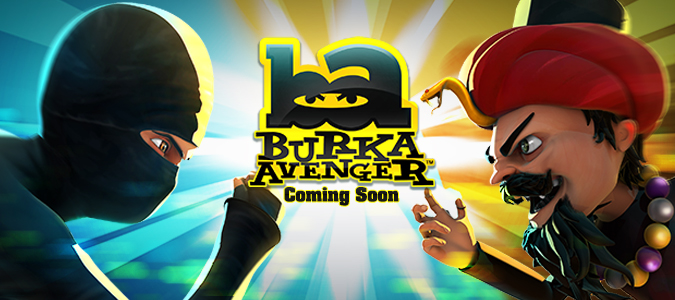
This week saw the television launch of an exciting new female superhero, direct from Islamabad, Pakistan: The Burka Avenger!

The star of the animated series of thirteen, 22-minute episodes is a teacher who uses books and pens to fight the evil people who shut down schools and prevent girls from getting an education. The humorous show also teaches kids to protect the environment, and, good news for the Cultural Detective community, to respect diversity and include others.

Each episode features an original song and guest appearances by some of the biggest musical acts in South Asia, including Ali Zafar, Haroon, Ali Azmat, Adil Omar, and Josh. Goals include entertainment and positive messages to youth. The series’ trailer (in English) is below.


The Burka Avenger is the brainchild of Aaron Haroon Rashid, a Pakistan pop star who wanted to create a positive role model to counter the Taliban’s ongoing opposition to girls’ education. In explaining the choice of the burka, which the teacher, Jiya, only wears in superhero mode, Rashid explained, “It’s not a sign of oppression. She is using the burka to hide her identity like other superheroes. Since she is a woman, we could have dressed her up like Catwoman or Wonder Woman, but that probably wouldn’t have worked in Pakistan.”

Of course this may well remind us of the indomitable Malala Yousafzai, whom the Taliban   famously attempted to assassinate last October. On her 16th birthday this past July 12, the amazingly poised and well-spoken Malala delivered the first-ever education policy recommendations written for youth, by youth, to the United Nations (video below). July 12th has now been named Malala Day in her honor.


It is not just Pakistan where girls’ rights to education are in danger. Fortunately, the people at Mighty Girl Books have assembled a terrific list of books for children and teens that explore the challenge of girls’ access to education, worldwide and throughout history.

You may also remember the comic book series “The 99,” in which superheroes inspired by Islam (they are named after the 99 attributes of Allah) fight crime, smash stereotypes and battle extremism. Series creator Naif Al-Mutawa gave a talk at TED Global 2010. A video of his talk is below, and a free online issue is also available.

10 Surefire Ways to Divide into Groups

saltyspicysweetsourAs educators and trainers, we often find ourselves needing to sort class members into small groups for an activity. Tried-and-true ways include having participants “number off” or color-coding their name tags. But even the ways in which we divide our students or trainees into small groups can contribute to learning and enjoyment: it can ground learners in the topic at hand, reinforce key points, provide insight into ourselves and others, and help develop teamwork.

In short, the way we divide into groups can become a subtle yet powerful element of spiral learning. For those of us who teach intercultural communication or diversity and inclusion, it can be helpful to divide into groups in ways that encourage learning about similarities and differences.

In that spirit, here are ten of my favorite “Quick Tips” for dividing a large group into small groups. Whether you want to explicitly debrief the learning or leave it as-is depends on your purposes. As with any activity, it needs to suit your style and that of your students, and be appropriate for the environment.

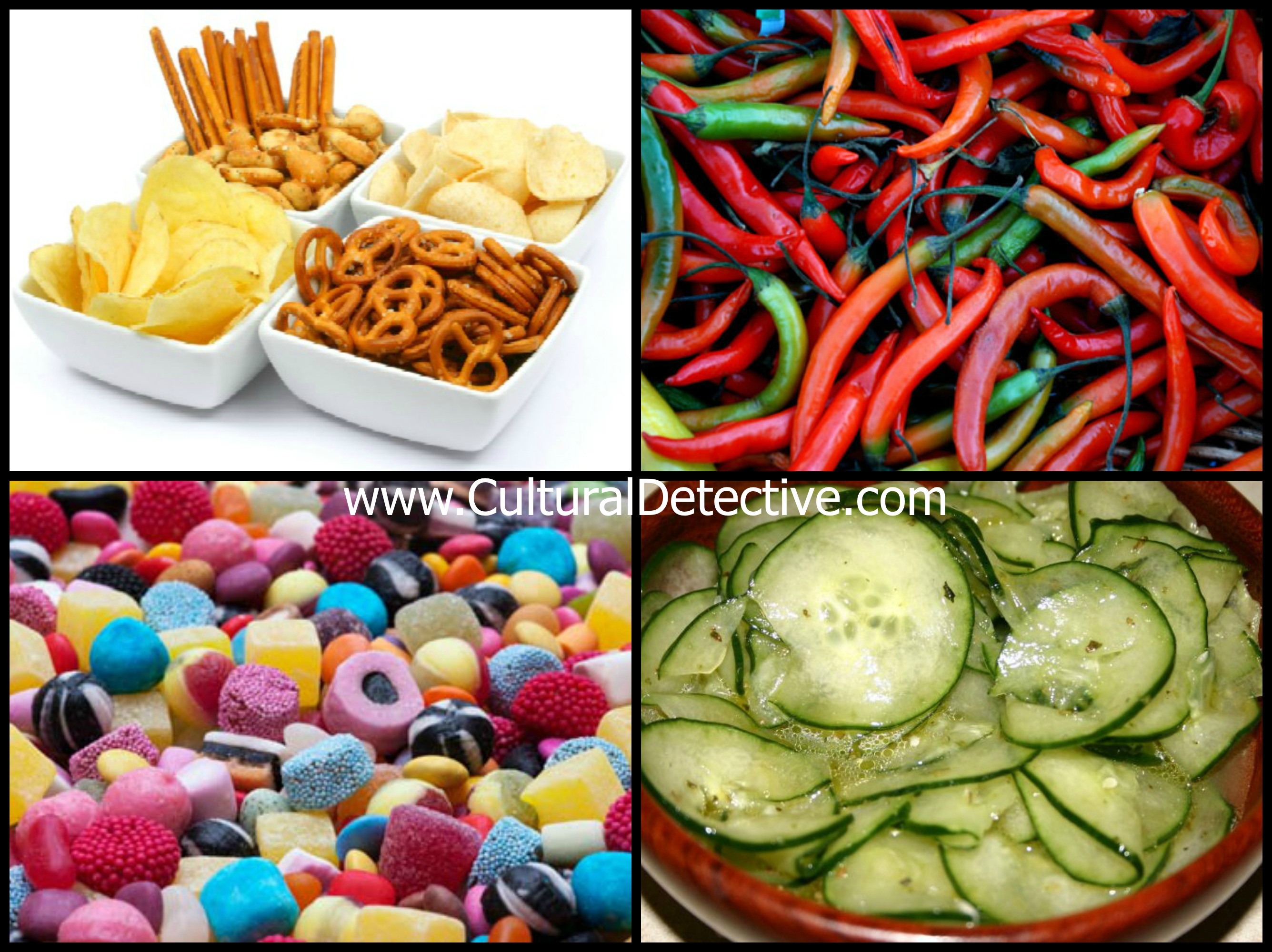
1. Salty/Spicy/Sweet/Sour
Using food is always fun and low stress for the participants. As individuals we like different tastes, and there are cultural tendencies as well. For me, the “sour” tastes of pickled food unite my German blood and my life experience in Japan, for example.
  • Instructions: Make a small sign with a flavor or taste, using as many flavors as you need groups. Then, ask class members to go to their favorite flavor.
  • Variations: Alternatively you could divide the group by having participants choose their favorite fruit or choose their favorite dish from among several common dishes. Or, try having a real snack at each location, and just see where people gravitate. Depending on the context, this could be a good time to use international and ethnic snack foods.
  • If you want to Debrief: Once you have the small groups, you can ask people to take a look around. Do they see themes in the groupings? Any cultural tendencies? Or, do they see reinforcement that we all have our individual taste preferences? Each time will be different. Ask people to reflect on why they like the taste they chose. What life experiences taught them to value that taste? Might this enhance their cultural self-awareness?
2. Goodies Sort
Again using food, this is one of my favorite methods, and one very popular with students or trainees! In the context of teaching or training, a treat is a good pick-me-up, and it’s easy to “internationalize” or add something new and different given the variety of food.
  • Instructions: Prepare “goodies” (chocolates, candies, pretzels, cheese sticks; I’ve even used dried squid and roasted grasshoppers) in as many varieties as you want groups. Put one item for each of your class members in a basket, and pass the basket. Then ask “pretzel people” to meet over here, “cheese people” over there, etc.
  • Variations: You can also use multicultural snacks! Another simple variation is to use the same kind of candy but in different colors: all the reds meet over here, the blues over there, etc. If you have a group that genuinely embraces informality, have them suck their candy, then stick out their tongues to find their fellow group members.
  • If you want to Debrief: Which snacks attracted you and why? Are your food preferences influenced by your ethnic and cultural heritage? Which rules your snack preference: personality or culture? Did any of the snacks look very unappetizing? If so, why? Perhaps make the point that just as our snack preferences vary according to whom we’re with and how we’re feeling (whether we’re tired, excited), our behavior in multicultural teams depends on the context, too.
3. Pertinent Quotes
Quotations have become quite popular on social media sites, and they are a powerful way to introduce a new topic or to summarize learning. Since this activity involves a bit of walking around, it gets people up and moving as well. It’s one of my favorite ways to get people into pairs.
  • Instructions: Assemble a set of quotations on the topic you are teaching. Choose half as many quotes as you have participants. Type up the quotes, dividing them in the middle: choose a fairly obvious place for breaking the quotation in half. Print them, cut them apart, fold them up, and have participants each choose one out of a basket. Then, ask them to find the person with the other half of their quote.
  • Variations: You can combine this method with the “Goodie Share” by taping the half-quote onto the bottom of a candy or snack, then asking participants to find their partners.
  • If you want to Debrief: To aid in this process, you could post a list of complete quotes on a flip chart. You can have some/each of the couples read their quotes aloud to the class. You might ask participants to speak to how “their” quotes relate to what they want to get out of your class today.
4. In • ter • cul • tur • al
This one’s a simple, quick, and easy way to divide participants into groups using a word that reinforces the theme, topic or key skill of the day’s learning session.
  • Instructions: Choose a word that represents an aspect of the theme you are teaching. That word should have the same number of syllables as the number of small groups you want. Instead of numbering off, have class members recite the word’s syllables. It’s a good way to reinforce key concepts.
  • Variations: You could say the word in another language, thus teaching a bit of a destination language, for example.
  • If you want to Debrief: Really not necessary, but… You could ask participants about different ways of hyphenating words, dividing syllables, in the languages they speak.
5. Playing Cards
This is another very quick way to divide participants into small groups: it can have a cultural component, yet it doesn’t necessarily need to be debriefed. With a unique deck of cards, it can be even more interesting.
  • Instructions: From a deck of playing cards, choose one card for each person in your class. Make sure you have “sets” of cards, one set for each group you want. Put all the cards from the abridged deck facedown on a table, and have participants each choose a card. Then group people as you’ve planned, by number (all 2s, 3s, etc.), or by suit, color, odds/evens, higher/lower than 8, etc.
  • Variations: Use Mexican Lotería cards, Japanese Hanafuda cards, mahjong playing cards, or another culturally appropriate (or new-to-your-participants) card deck to divide your class.
  • If you want to Debrief: Ask if everyone felt comfortable with your instructions. Were they familiar with the words you used (suit, Ace, etc.)? People who play cards have a culture unfamiliar to non-card players: shared “common sense,” vocabulary, customs. Some people associate card playing with gambling, and thus don’t like, or feel religiously forbidden from, playing. As with any educational activity, make sure this one will be comfortable for your learners.
6. What You’re Wearing 
I have learned so much from this simple activity over the years because participants always see something I hadn’t noticed. It can also serve as a wonderful impetus for reflecting on value differences.
  • Instructions: Have class members get into groups of 3 or 4, whatever you choose, based on similarities in what they are wearing. They decide what they have in common.
  • Variations: An alternative is to have learners group according to shoe type. This can be very fun, too, and it’s sometimes surprising the categories people come up with.
  • If you want to Debrief: If you choose to debrief this group-sorting activity, you may find a myriad of perceptions about clothing and shoe styles. Often people group into categories that they themselves might not have thought of on their own. Ask participants to discuss in their small groups how they decided to group themselves. Were they all focused on the same thing, or did they have different understandings of their clothing commonality? Groups can share with one another how they grouped, and compare similarities and differences. Did anyone share a perception of someone else’s clothing that surprised you? That echoed or differed from your own perception? What can this tell us about values and perceptions?
7. Number of Languages You Speak, Countries in Which You’ve Lived
This method also helps everyone learn a bit about each other quickly, that they might not have otherwise known.
  • Instructions: Have people line up according to the number of languages they speak, or the number of countries in which they’ve lived, and then divide them into groups.
  • Variations: Tell participants to assemble in groups of people who speak 1, 2, and someone who speaks 3 (or more) languages. This gives a bit more diversity in each small group. You can do the same thing with the number of countries in which participants have lived.
  • If you want to Debrief: Ask participants if they are surprised at who is in their group—have they learned something new about one or more of their colleagues? Does this change their perception of the other person? How and why? Does this change their perception of themselves? How and why?
8. Animal Sounds or Industry Vocabulary Across Languages
I have always been fascinated by the different sounds that animals make as represented in different languages. Really, in Japanese, mice say “chu”?! Use this interesting trivia to your advantage, and insert a bit of lightheartedness to your session.
  • Instructions: Print cards with an image of an animal and the sound that animal makes in a different language. Then ask people to make the sound on their card in order to find each other. You will need one card for each participant, and the number of animals you use should correspond to the number of groups you want to form.
  • If you want to Debrief: Explain that animal sounds are lighthearted, then shift to the inextricable connection between linguistic and cultural fluency. Ask participants to share with you differences they’ve noticed across languages, words that sound similar but mean different things in different places, or how much vocabulary, even in the same language, varies place-to-place. You could ask participants share other interesting sounds animals make in languages they speak.
  • Variations: You can use the same animal and have participants divide into groups according to the sound it makes in Spanish vs. German vs. Chinese, etc. You could use different animals and the sound they make in a destination language. Alternatively, you could use industry-specific vocabulary in different languages, or words having to do with the subject of your workshop in various languages.
9. Arm Cross/Hand Cross
This is a very easy way to divide the room into two groups, and to illustrate how something that looks similar can really be quite different once you analyze it a bit more.
  • Instructions: Ask your students to cross their arms over their chests. Those people with their left arms on top form one group, and those with their right arms on top form the other.
  • Variations: Asking participants to clasp their hands or cross their legs works just as well.
  • If you want to Debrief: We all have automatic habits that we don’t pay much attention to, things we do without making a conscious choice—like the way we cross our arms, or how we attempt to persuade someone, or apologize or disagree. Another  point you might debrief: ask whether, at first glance, with arms crossed, they all seemed to be doing the same thing? It wasn’t until you called attention to the subtle differences in how people were crossing their arms that they noticed. And so it can be with culture.
10. The Name Game
Many cultures around the world have a variety of traditions around naming their children: a girl may be called “daughter of __,” sons may be named according to birth order, a child may be named after an ancestor, or given a name that indicates a hope the parents have for the child (beauty, peace, etc.). Many people are very, very proud of their names, and others may have no idea how they were named or why. Some may have changed their name or had their names changed for them.
  • Instructions: Ask your students to think about their name, and a short (30 second) story about how they got the name, what their name means, how their name or nickname has varied over the years. Then tell students to walk around sharing their “name stories” with one another, until they find someone with a name story similar to theirs in some way. Participants can form pairs, groups of 3, 4, or 5—whatever is helpful.
  • Variations: An alternative of course is to find partners with very different name stories.
  • If you want to Debrief: This is a wonderful activity through which you can talk about value differences, or strategies for adapting to a new culture (do you change your name, adapt its pronunciation…).

Hey, all you trainers and teachers out there: What’s your favorite way to divide a large group into small groups for activities? Please share your creative approaches and recommendations!

Does Cultural Detective “Work” in a University Setting?

Simons-ESPEME

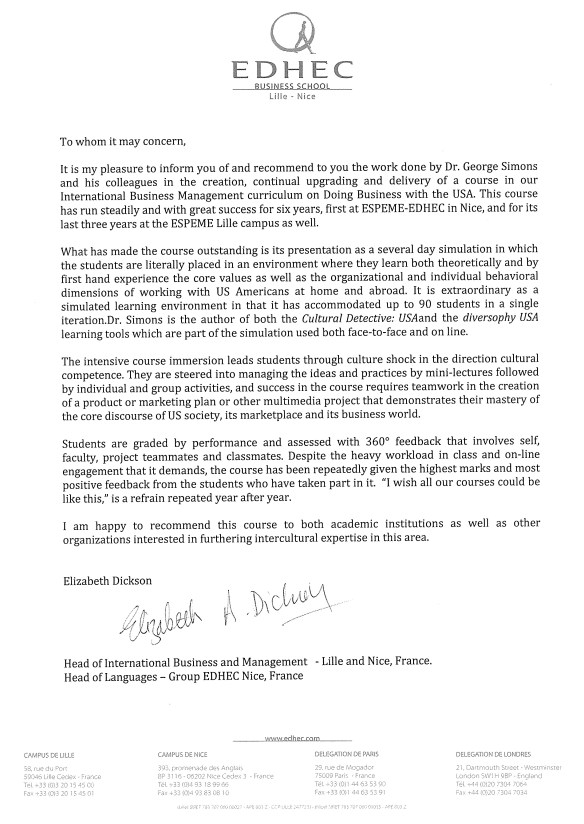
Click on the image to view a full-size version of this letter.

We are very proud to say that Cultural Detective has been an essential ingredient of the International Business Management Program in the ESPEME-EDHEC Business School in France over the past six-years. Dr. George Simons and colleagues have designed and delivered leading-edge courseware in fully simulated environments, spiraling around a Cultural Detective backbone. The results they have achieved have been remarkable. George has, over the years, most generously shared his experiences, his students’ projects (Blended Culture identity, comparative culture differences, movies, artwork, papers), and his designs with us.

I am thus quite eager to share with you this letter from Elizabeth Dickson, Head of the International Business Management Program at EDHEC Nice and Lille. I’m confident you’ll join me in congratulating George as well as his colleagues for the fine work they continue to do. I believe you will find it interesting to read Elizabeth’s letter, and to view what one head of a major educational institution feels have been the components of a successful international business course.

And, to answer the question in this post’s title, “Yes, by all means. There are quite a few universities on several continents using Cultural Detective to great effect.” It’s not just for business anymore.

There are quite a few other use cases that might prove interesting to you on our website.

Resumen de las principales diferencias culturales

CultDiffsMapSpanish

(English follows Spanish.)
En mayo de 2012 escribí un blog acerca de cuando trato con las dimensiones de cultura, frecuentemente las utilizo en forma de mapa, para ayudar a la gente a encontrar los factores que pueden estar en el camino de una mejor comunicación. He encontrado que esta es una excelente manera de trabajar las dimensiones.

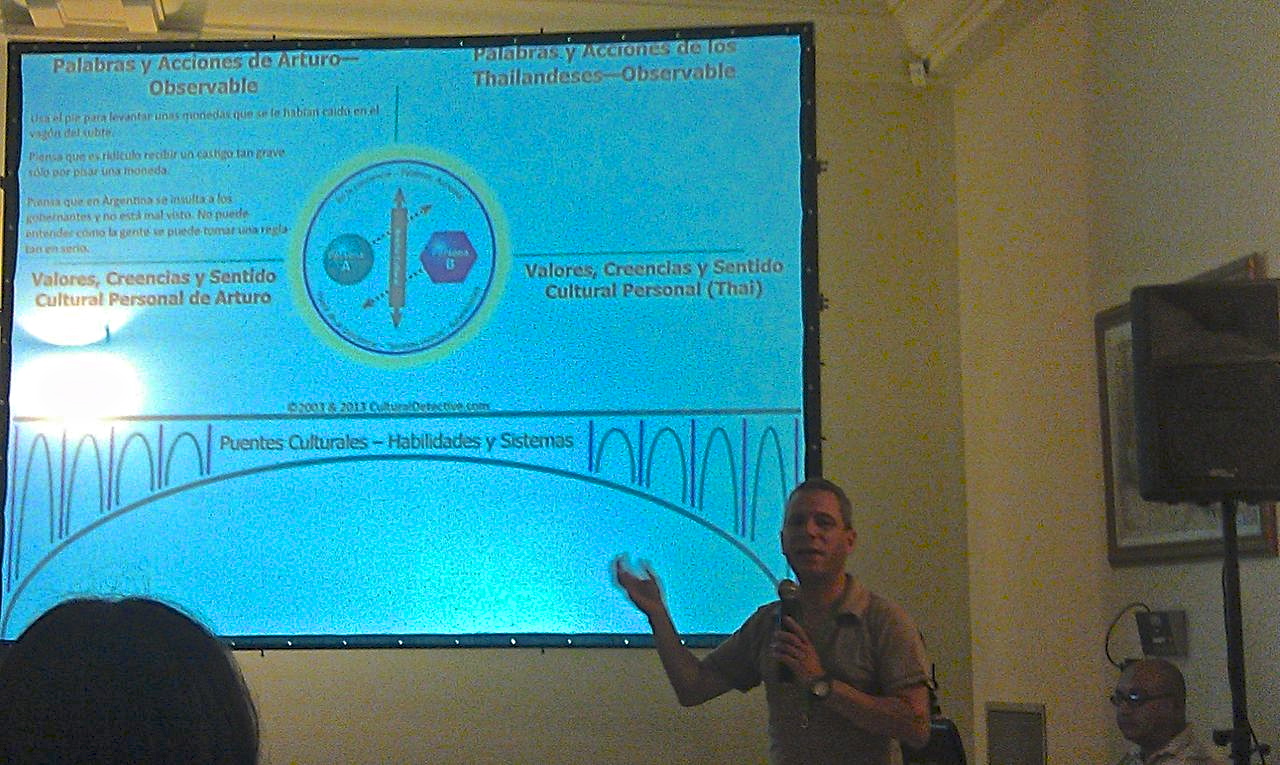
Fernando Castro debriefing a critical incident using the Cultural Detective Worksheet

Fernando Castro analizando una historia con la Hoja de Trabajo Cultural Detective.
Fernando Castro debriefing a critical incident using the Cultural Detective Worksheet

Este mes he tenido la alegría y el privilegio de trabajar con Fernando Castro de AFS Argentina y Uruguay. Él generosamente tomó este mapa de las diferencias y lo tradujo al español para nosotros.

Invito a todos a utilizar esta nueva versión en español bajo la licencia Creative Commons. Esto significa que usted puede utilizar el gráfico y la información en el artículo, siempre y cuando mantenga los derechos de autor y URL original.

¡Mil gracias, Fer!

In May of 2012 I wrote a blog post about how I frequently use the dimensions of culture in map form, to aid people to locate the factors that may be getting in the way of better communication. I have found that this is a terrific way to put the dimensions to use.

Fernando Castro debriefing a critical incident using the Cultural Detective Worksheet

Fernando Castro debriefing a critical incident using the Cultural Detective Worksheet

This month I had the joy and privilege of working with Fernando Castro of AFS Argentina and Uruguay. He most generously took this Map of Differences and translated it into Spanish for us.

You are all welcome to use this new Spanish language version under a Creative Commons license. This means that you may use the graphic and the information in the article so long as you retain the original copyrights and url.

¡Mil gracias, Fer!

Developing Intercultural Competence — Online?

“While other cultural databases do an effective job of providing country overviews, Cultural Detective Online offers unique and complementary capabilities.”
—Joseph K. Lunn, Project Portfolio Manager and Cross-Cultural Trainer, Zurich North America

What makes for a truly useful online learning tool? When I asked intercultural trainers this question they seemed to want to be able to emulate the face-to-face environment as much as possible. Keep the learners’ attention, make it experiential, real and applicable — and make them think! They don’t need “the answers,” they need to know how to come up with real solutions when they find themselves in the midst of cross-cultural conflict. Oh, and you know the old adage, keep it simple!

So, when developing the Cultural Detective Online tool, some key fundamental concepts were kept in mind:

  1. Personal/professional goal setting should be at the entrance to working with the tool — what are the learners’ objectives in using the tool? They should be able to adapt and change these but also keep them in mind in order to stay on track and achieve them.
  2. Culture-general and culture-specific content and process — this is fundamental to working with the Cultural Detective Method (read more by Janet Bennett on this topic if you are up on it), so no challenge here!
  3. Contextually based learning — also core to the Cultural Detective Methodology is working with real-world critical incidents and pushing the learner to develop an understanding of the underlying role and subtle nuances cultural values can play in everyone’s lives.
  4. Links between deep culture and surface culture, between values and behaviors — again innately a part of working with the Cultural Detective tools and richly impactful (where we get the big aha moments) once the learner discovers, develops and really hones this skill.
  5. Prompting for the learners to summarize and apply their learning to their real situations — this is where the work they’ve put in pays the learner back; in other words what’s the bottom line? How can I really use what I just learned to make a value added difference in my work, in my global team, with my international vendors/clients/offices, etc.?
So we’ve heard from some of our early adapters — Cultural Detective Online will take you further in your intercultural competence journey. Joseph Lunn of Zurich NA says,

“In addition to crisp, clear detailed summaries of each country’s cultural values, the nearly 400 cross-cultural incidents provided show users exactly what can go wrong when cultural understanding gaps exist. The tool follows-up by sharing the differences in cultural values that underlie each incident and offers concrete suggestions to build cultural bridges and avoid similar incidents. CD Online is a great hands-on teaching tool that adds value to:

    • Employees beginning overseas assignments
    • Global project team members
    • Mergers and acquisition partners
    • Outsourcing engagements

Thanks for making this tool available to those who need it at a reasonable cost!”

Developing intercultural competence online? Of course! Take a test drive and see for yourself: Cultural Detective Online!

Facilitated Online Learning Sessions for Cross-Cultural Skills


How can you quickly develop the skills necessary to lead your global team, manage your global project or prepare for expansion to emerging markets, without leaving your desk?

The Cultural Detective team presents a two-part series of Facilitated Online Learning Sessions that will provide you with the keys to a proven, industry-changing and industry-leading toolset for developing your individual and organizational global competence and to ultimately succeed where “culture conflicts” caused failed ventures.

  • Learn how to build trust in your global relationships.
  • Develop highly productive global teams.
  • Complete projects on time and under budget.
  • Determine how to best enter and succeed in your targeted international markets.
  • Know how to deliver superior client service, globally.
  • Get the most from your international assignees by equipping them with the skills necessary to excel in any culture.

Sessions will be held Wednesday and Friday, February 27 and March 1, 2013! Click here for more information or to reserve your spot. Seats are limited.